
Introduction
Vertical flight is one of the most important achievements in aviation engineering. Unlike fixed-wing aircraft that require forward movement to generate lift, rotorcraft can create lift through rotating blades, allowing them to take off and land vertically, hover in place, and operate in locations where traditional aircraft may not be practical.
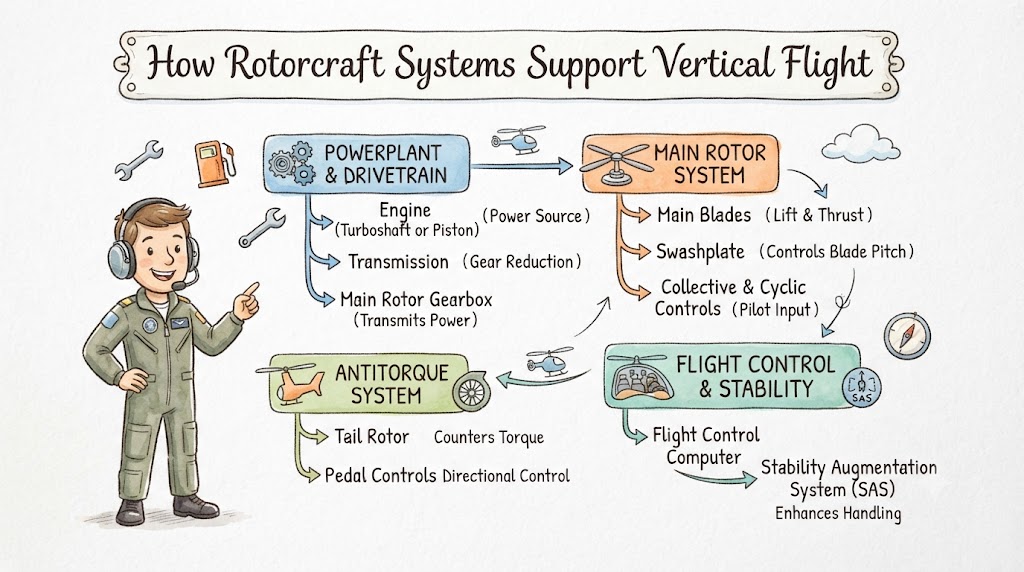
Helicopters and other rotorcraft achieve this capability through the combination of multiple interconnected systems. The rotor system generates lift, propulsion systems provide power, transmission systems transfer energy, and flight controls allow pilots to manage movement and stability.
The ability to perform vertical flight has transformed many industries, including emergency services, transportation, construction, military operations, and specialized aviation missions.
Understanding how rotorcraft systems work helps aviation students, engineers, and enthusiasts appreciate the complex technology behind helicopters and other vertical flight aircraft.
What Are Rotorcraft Systems?
Rotorcraft systems are the collection of mechanical, aerodynamic, and electronic systems that allow aircraft to fly using rotating blades.
Unlike airplanes that depend mainly on fixed wings, rotorcraft generate lift through rotor movement.
Common rotorcraft include:
- Helicopters
- Tiltrotor aircraft
- Autogyros
- Other rotor-based aircraft designs
The major systems that support rotorcraft operation include:
- Rotor systems
- Engines
- Transmission systems
- Flight controls
- Stability systems
- Structural components
Each system works together to provide controlled vertical flight.
Understanding Vertical Flight
Vertical flight means an aircraft can move upward and downward without requiring a traditional runway.
This capability depends on balancing several forces:
- Lift
- Weight
- Thrust
- Drag
Rotorcraft create vertical movement by using rotating blades that push air downward. The reaction force creates upward lift, allowing the aircraft to rise.
How Rotorcraft Generate Lift
Rotor Blade Movement
The main rotor consists of rotating blades designed with aerodynamic shapes similar to aircraft wings.
As the blades rotate:
- Air moves faster over the blade surfaces
- Pressure differences are created
- Lift is generated
The continuous rotation allows rotorcraft to maintain flight even without forward movement.
Lift and Weight Balance
For vertical flight to occur:
- Lift must overcome aircraft weight
- Engine power must support rotor movement
When lift equals weight, the aircraft can hover.
When lift increases, the aircraft climbs.
When lift decreases, the aircraft descends.
Hovering Capability
Hovering is one of the unique abilities of rotorcraft.
During hovering:
- The aircraft remains nearly stationary
- Rotor systems continuously generate lift
- Flight controls make constant adjustments
Hovering requires precise coordination between:
- Rotor speed
- Blade pitch
- Engine power
- Pilot inputs
Major Rotorcraft Systems That Enable Vertical Flight
1. Main Rotor System
The main rotor is the primary system responsible for generating lift.
It includes:
- Rotor blades
- Rotor hub
- Blade attachment systems
- Control mechanisms
The main rotor provides:
- Vertical lift
- Forward movement
- Directional control
How the Main Rotor Works
The pilot controls the main rotor using flight control systems.
By changing blade angles, the aircraft can:
- Increase lift
- Reduce lift
- Move forward
- Move backward
- Move sideways
This ability makes rotorcraft highly maneuverable.
2. Tail Rotor and Anti-Torque System
Helicopter engines create rotational force called torque.
Without compensation, the helicopter body would rotate in the opposite direction of the main rotor.
The tail rotor helps:
- Counteract torque
- Maintain directional stability
- Control yaw movement
Some modern helicopters use alternative systems instead of traditional tail rotors, depending on aircraft design.
3. Rotor Blade Design and Engineering
Rotor blades are carefully designed to provide efficient airflow management.
Important design factors include:
Blade Shape
The aerodynamic shape influences lift production.
Materials
Modern rotor blades may use advanced materials designed for:
- Strength
- Weight reduction
- Durability
Blade Pitch Control
Changing blade angle allows pilots to control lift and movement.
4. Propulsion Systems
The propulsion system provides the power needed to operate rotorcraft.
Common engine types include:
Turbine Engines
Many helicopters use turbine engines because they provide:
- High power output
- Reliable operation
- Suitable performance for demanding missions
Piston Engines
Some smaller rotorcraft use piston engines because of:
- Simpler operation
- Lower complexity
- Recreational suitability
5. Transmission System
The transmission transfers engine power to the rotor system.
It manages:
- Power distribution
- Rotor speed
- Mechanical energy transfer
A reliable transmission system is essential because rotorcraft depend heavily on continuous rotor operation.
6. Flight Control Systems
Rotorcraft require specialized controls to manage movement.
The three primary controls include:
Collective Control
The collective changes the pitch of all main rotor blades together.
It controls:
- Climb
- Descent
- Overall lift
Cyclic Control
The cyclic changes rotor blade pitch during rotation.
It controls:
- Forward movement
- Backward movement
- Side movement
Pedal Controls
Pedals control the tail rotor or anti-torque system.
They manage:
- Direction
- Yaw movement
7. Stability and Navigation Systems
Modern rotorcraft use advanced technology to improve flight control.
Systems may include:
- Sensors
- Flight computers
- Navigation equipment
- Stability augmentation systems
These systems help pilots manage aircraft behavior and improve operational awareness.
How Rotorcraft Achieve Different Flight Movements
Vertical Takeoff
During takeoff:
- Rotor blades increase lift
- Engine power increases
- Aircraft weight is overcome
The aircraft rises vertically without requiring a runway.
Hovering
Hovering requires maintaining balance between:
- Lift
- Weight
- Aircraft position
Small control adjustments are continuously made to keep the aircraft stable.
Forward Flight
During forward flight:
- Rotor systems continue producing lift
- Aircraft movement changes airflow patterns
- Controls adjust rotor behavior
This allows helicopters to travel efficiently after leaving hover.
Landing
During landing:
- Rotor lift is gradually reduced
- Descent rate is controlled
- Pilot manages aircraft position
A controlled landing requires accurate coordination between power and controls.
Rotorcraft vs Fixed-Wing Aircraft
| Feature | Rotorcraft | Fixed-Wing Aircraft |
|---|---|---|
| Lift Generation | Rotating blades | Fixed wings |
| Takeoff Requirement | Can take off vertically | Usually requires runway |
| Landing Requirement | Vertical landing capability | Runway landing required |
| Hover Capability | Yes | No |
| Maneuverability | High | Moderate |
| Low-Speed Control | Strong capability | Limited |
| Speed | Generally lower | Generally higher |
| Range | Mission dependent | Often longer |
| Flight Controls | Rotor-based controls | Wing and tail controls |
| Engineering Complexity | High mechanical complexity | Different structural complexity |
| Operating Locations | Flexible | Airport dependent |
| Maintenance Needs | Rotor-focused inspections | Wing and engine focused |
| Mission Flexibility | High for specialized tasks | Strong for transport |
| Pilot Skills | Specialized control techniques | Different skill requirements |
| Infrastructure Needs | Less runway dependence | Requires suitable runways |
Applications of Rotorcraft Technology
Emergency Services
Rotorcraft play an important role in:
- Medical evacuation
- Rescue missions
- Disaster response
Their ability to land in limited spaces makes them valuable during emergencies.
Military Operations
Military rotorcraft support:
- Transport missions
- Surveillance
- Specialized operations
Their maneuverability provides operational advantages.
Commercial Aviation
Rotorcraft are used for:
- Passenger transport
- Business travel
- Offshore operations
Construction and Utility Operations
Helicopters support:
- Heavy lifting
- Infrastructure work
- Remote location access
Personal and Recreational Aviation
Some individuals use rotorcraft for:
- Private transportation
- Aviation experiences
- Recreational flying
Engineering Challenges in Vertical Flight
Power Requirements
Vertical flight requires significant power because aircraft must continuously overcome gravity.
Rotor Efficiency
Engineers constantly work to improve:
- Blade designs
- Aerodynamic efficiency
- Performance
Weight Management
Reducing aircraft weight while maintaining strength is a major design challenge.
Noise Reduction
Rotor movement creates noise challenges, encouraging research into quieter designs.
Maintenance Complexity
Rotorcraft require careful inspection of:
- Rotors
- Transmission systems
- Engines
- Mechanical components
Rotorcraft Maintenance Considerations
Regular maintenance supports safe and reliable operations.
Important areas include:
Rotor Inspections
Checking blades and rotor components helps identify potential issues.
Engine Maintenance
Engine systems require regular monitoring and servicing.
Transmission Checks
Transmission reliability is critical for rotor operation.
Component Monitoring
Tracking component condition helps improve maintenance planning.
Future of Rotorcraft Systems
Rotorcraft technology continues evolving through:
- Advanced materials
- Improved flight control systems
- Electric vertical flight concepts
- Autonomous aircraft research
- More efficient propulsion technologies
Future developments aim to improve efficiency, reduce environmental impact, and expand vertical flight capabilities.
Common Misconceptions About Rotorcraft
“Helicopters Fly Only Because Rotors Spin”
Rotorcraft flight depends on complex aerodynamics, power management, and control systems.
“Rotorcraft Are Easier Than Airplanes”
Helicopters require specialized skills because pilots manage multiple control systems simultaneously.
“All Rotorcraft Use the Same Technology”
Different rotorcraft designs use different systems based on mission requirements.
“Vertical Flight Has No Limitations”
Rotorcraft face challenges related to power, efficiency, weather, and maintenance.
Frequently Asked Questions
1. How do rotorcraft systems enable vertical flight?
Rotorcraft systems enable vertical flight by using rotating blades to generate lift and specialized controls to manage movement.
2. What creates lift in a helicopter?
Lift is created when rotating rotor blades move through the air and generate aerodynamic force.
3. What is the role of the main rotor?
The main rotor provides most of the lift and helps control aircraft movement.
4. Why do helicopters need tail rotors?
Tail rotors counteract engine torque and help control directional movement.
5. How do helicopter controls work?
Helicopters use collective, cyclic, and pedal controls to manage lift, direction, and stability.
6. What engines power rotorcraft?
Rotorcraft may use turbine engines or piston engines depending on aircraft design and mission.
7. How can helicopters hover?
Helicopters hover by balancing rotor-generated lift with aircraft weight.
8. What makes rotorcraft different from airplanes?
Rotorcraft use rotating blades for lift, while airplanes use fixed wings and forward movement.
9. What are major helicopter components?
Major components include rotors, engines, transmissions, flight controls, and structural systems.
10. Why is rotorcraft engineering complex?
Rotorcraft combine advanced aerodynamics, mechanical systems, and control technology.
11. What industries use rotorcraft?
Rotorcraft are used in emergency services, military operations, transportation, construction, and recreation.
12. How are rotorcraft technologies improving?
New developments focus on efficiency, automation, materials, and advanced propulsion systems.
Conclusion
Rotorcraft systems make vertical flight possible by combining aerodynamic design, powerful propulsion, advanced controls, and precise engineering. From the main rotor that generates lift to the transmission and flight control systems that manage movement, every component plays an important role in helicopter and rotorcraft operation.
Vertical flight technology has transformed aviation by allowing aircraft to operate in environments where traditional airplanes cannot. As rotorcraft engineering continues to evolve, improvements in materials, propulsion, and automation are creating new possibilities for future aviation.

