
Introduction
Rotorcraft are among the most remarkable achievements in aerospace engineering. Unlike conventional fixed-wing aircraft that require forward motion to generate lift, rotorcraft can take off vertically, hover in place, move in multiple directions, and land in confined areas. These capabilities make rotorcraft indispensable in emergency medical services, search and rescue operations, military missions, offshore transportation, law enforcement, construction, and many other specialized applications.
Behind every successful helicopter or vertical flight aircraft is the discipline of rotorcraft engineering. This field combines aerodynamics, mechanical engineering, structural design, propulsion systems, flight controls, materials science, and safety engineering to create aircraft capable of operating safely in demanding environments. Designing a rotorcraft requires balancing complex aerodynamic forces, minimizing vibration, managing weight, and ensuring reliable performance under a wide range of operating conditions.
What Is Rotorcraft Engineering?
Rotorcraft engineering is the branch of aerospace engineering dedicated to the design, development, testing, operation, and maintenance of aircraft that generate lift using rotating rotor systems.
Unlike fixed-wing aircraft, rotorcraft create lift through powered or autorotating rotor blades. This allows vertical takeoff and landing, hovering, and highly maneuverable flight.
Rotorcraft engineering encompasses:
- Aerodynamics
- Structural engineering
- Mechanical systems
- Flight controls
- Propulsion systems
- Avionics
- Safety engineering
- Maintenance planning
- Materials engineering
Common rotorcraft categories include:
- Helicopters
- Autogyros
- Tiltrotor aircraft
- Advanced vertical takeoff and landing (VTOL) aircraft
Each type presents unique engineering challenges and design requirements.
Why Rotorcraft Engineering Is Important
Rotorcraft serve missions that conventional airplanes cannot perform efficiently.
Engineering innovations make it possible for rotorcraft to:
- Hover over a specific location
- Land in confined spaces
- Operate in mountainous terrain
- Support emergency response
- Transport personnel to offshore facilities
- Perform aerial inspections
- Conduct search and rescue missions
Achieving these capabilities requires careful engineering across every aircraft system.
Fundamentals of Rotorcraft Design
Rotorcraft design focuses on creating an aircraft that can generate lift, maintain stability, and operate safely in changing flight conditions.
Key design considerations include:
Vertical Takeoff and Landing
Rotor systems generate lift without requiring a runway, allowing operation from limited spaces.
Hover Capability
Maintaining a stable hover requires continuous adjustment of rotor blade pitch and power while balancing aerodynamic forces.
Weight Management
Reducing aircraft weight improves efficiency, payload capacity, and overall performance. Engineers carefully select materials and optimize structural designs to balance strength with weight.
Stability
Rotorcraft are inherently dynamic, so engineers incorporate mechanical and electronic systems to help pilots maintain stable flight.
Understanding Rotor Systems
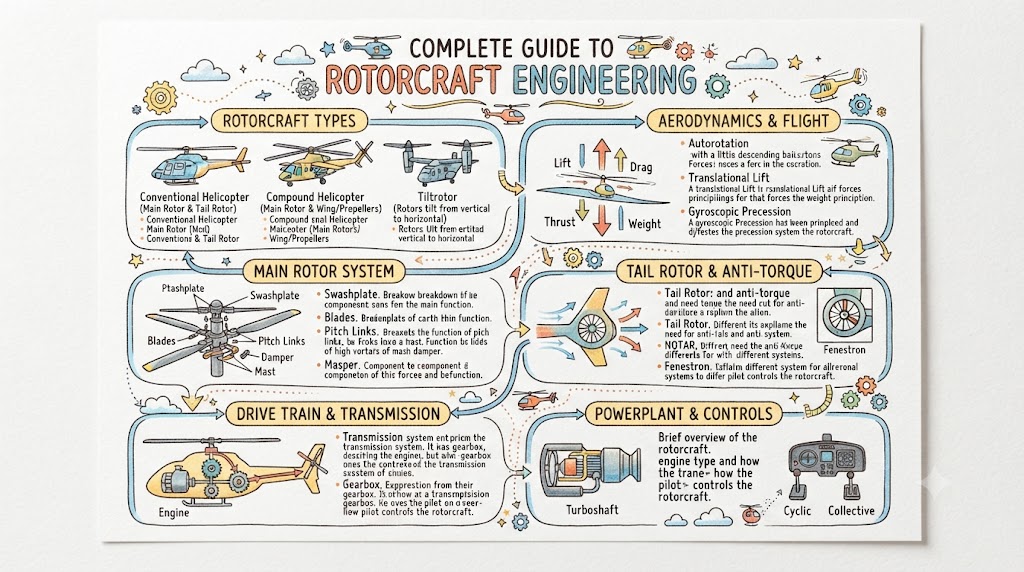
The rotor system is the defining feature of every rotorcraft.
Main Rotor System
The main rotor provides the lift required for flight and, in most helicopters, also generates the thrust needed for forward movement.
Primary components include:
- Rotor blades
- Rotor hub
- Blade grips
- Pitch links
- Swashplate mechanism
Engineers design these components to withstand significant aerodynamic and mechanical loads.
Tail Rotor System
In conventional helicopters, the tail rotor counteracts the torque produced by the main rotor and provides directional control.
Alternative anti-torque solutions include:
- Fenestron systems
- NOTAR (No Tail Rotor) systems
- Coaxial rotor configurations
Each design offers different advantages depending on the aircraft’s mission.
Rotor Blade Engineering
Rotor blades are among the most highly engineered components of a rotorcraft.
Engineers consider:
Aerodynamic Shape
Blade profiles are designed to produce efficient lift while minimizing drag.
Material Selection
Modern rotor blades commonly use advanced composite materials to reduce weight while improving strength and durability.
Structural Integrity
Rotor blades must withstand:
- High rotational speeds
- Aerodynamic loading
- Vibration
- Fatigue cycles
- Environmental exposure
Vibration Reduction
Engineers use sophisticated design techniques to minimize vibration and improve passenger comfort while reducing structural stress.
Helicopter Aerodynamics
Rotorcraft aerodynamics differ significantly from those of fixed-wing aircraft.
Lift Generation
As rotor blades rotate, airflow over each blade creates lift. By changing blade pitch, pilots control the amount of lift produced.
Hover Flight
Hovering requires the rotor system to generate enough lift to balance the aircraft’s weight while maintaining stability over a fixed point.
Forward Flight
During forward flight, the rotor system produces both lift and thrust, creating more complex aerodynamic conditions than those experienced during hovering.
Autorotation
Autorotation allows the rotor to continue turning using upward airflow if engine power is lost, enabling a controlled descent when executed under appropriate conditions.
Translational Lift
As the aircraft accelerates, the rotor system benefits from cleaner airflow, improving efficiency and reducing power requirements.
Rotorcraft Propulsion Systems
Rotorcraft propulsion systems provide the power needed to rotate the main rotor.
Common propulsion options include:
Turbine Engines
Widely used in larger helicopters due to their power output, reliability, and performance.
Piston Engines
Common in many smaller training and recreational helicopters because of their relative simplicity.
Supporting propulsion components include:
- Gearboxes
- Drive shafts
- Fuel systems
- Lubrication systems
- Cooling systems
These components work together to deliver reliable power throughout flight.
Rotorcraft Structural Engineering
Rotorcraft structures must withstand dynamic flight loads while remaining lightweight.
Key structural areas include:
- Airframe
- Landing gear
- Transmission mounts
- Rotor mast
- Tail boom
- Cabin structure
Engineers use lightweight metals and composite materials to achieve an appropriate balance between strength and efficiency.
Flight Control Systems
Rotorcraft flight controls differ significantly from those of fixed-wing aircraft.
Primary controls include:
Cyclic Control
Changes rotor disc orientation to control aircraft movement in different directions.
Collective Control
Changes blade pitch simultaneously to increase or decrease lift.
Anti-Torque Pedals
Control directional movement by adjusting the tail rotor or equivalent anti-torque system.
Modern rotorcraft may also incorporate digital flight control technologies that assist pilots during demanding operations.
Avionics and Navigation Systems
Modern rotorcraft rely on advanced avionics to improve operational awareness and safety.
Typical systems include:
- Flight displays
- Navigation equipment
- Communication systems
- Weather information systems
- Terrain awareness technologies
- Autopilot functions where applicable
These systems support pilots in a wide variety of operating environments.
Rotorcraft Safety Engineering
Safety engineering is integrated into every stage of rotorcraft development.
Engineers focus on:
- Structural integrity
- Redundant systems
- Failure analysis
- Emergency procedures
- Crashworthiness
- Human factors
- Reliability testing
Continuous evaluation and testing help improve rotorcraft safety over time.
Rotorcraft Maintenance Engineering
Proper maintenance ensures continued airworthiness and operational reliability.
Maintenance activities commonly include:
- Scheduled inspections
- Rotor blade examination
- Transmission inspection
- Engine maintenance
- Lubrication servicing
- Vibration monitoring
- Component replacement
- Maintenance documentation
Preventive maintenance often helps identify developing issues before they affect operations.
Common Engineering Challenges
Rotorcraft engineers continually work to improve several key areas.
Vibration
Managing vibration protects components, improves passenger comfort, and extends aircraft service life.
Noise
Reducing rotor noise remains an important engineering objective, especially for urban operations.
Weight
Every kilogram saved can improve payload, efficiency, and operational flexibility.
Fuel Efficiency
Engineers seek improved propulsion systems and aerodynamic designs to reduce fuel consumption.
Reliability
Rotorcraft operate in demanding environments, making reliability a major engineering priority.
Emerging Rotorcraft Technologies
Rotorcraft engineering continues to evolve through innovation.
Current areas of development include:
- Electric vertical takeoff and landing (eVTOL) aircraft
- Hybrid-electric propulsion
- Advanced composite materials
- Autonomous flight technologies
- Digital engineering tools
- Fly-by-wire control systems
- Predictive maintenance technologies
These developments aim to improve efficiency, sustainability, and operational capability.
Applications of Rotorcraft Engineering
Rotorcraft support numerous industries and missions.
Common applications include:
Emergency Medical Services
Rapid transport of patients and medical teams.
Search and Rescue
Operations in remote or difficult terrain.
Military Aviation
Transport, reconnaissance, logistics, and specialized missions.
Law Enforcement
Aerial observation, patrol, and emergency response.
Offshore Energy
Transportation of personnel to offshore facilities.
Construction
Heavy-lift operations and infrastructure projects.
Research
Scientific observation and environmental monitoring.
Rotorcraft Engineering vs Fixed-Wing Aircraft Engineering
| Feature | Rotorcraft Engineering | Fixed-Wing Aircraft Engineering |
|---|---|---|
| Lift Generation | Rotating rotor system | Fixed wings |
| Takeoff | Vertical | Usually runway-based |
| Hover Capability | Yes | No |
| Primary Flight Control | Rotor system | Control surfaces |
| Aerodynamic Complexity | Higher in hover and transition | Different flight characteristics |
| Structural Loads | Dynamic rotor loads | Wing and fuselage loads |
| Vibration Management | Major design focus | Less pronounced |
| Anti-Torque System | Required for many designs | Not applicable |
| Maintenance Complexity | Rotor systems require detailed inspection | Different maintenance priorities |
| Landing Flexibility | Confined areas possible | Typically runway dependent |
| Mission Flexibility | High | Different mission strengths |
| Noise Considerations | Rotor-generated noise | Engine and aerodynamic noise |
| Flight Envelope | VTOL capable | Conventional flight profile |
| Engineering Challenges | Rotor dynamics and stability | Wing performance and efficiency |
| Typical Applications | Rescue, transport, utility | Passenger, cargo, long-distance travel |
Skills Required for Rotorcraft Engineers
Successful rotorcraft engineers often develop expertise in:
- Aerodynamics
- Mechanical engineering
- Structural analysis
- Materials science
- Computer-aided design (CAD)
- Systems engineering
- Flight testing
- Problem-solving
- Safety engineering
- Technical communication
Career Opportunities
Rotorcraft engineering supports careers such as:
- Aerospace Engineer
- Rotorcraft Design Engineer
- Flight Test Engineer
- Systems Engineer
- Maintenance Engineer
- Manufacturing Engineer
- Research Engineer
- Structural Engineer
Career opportunities vary based on education, experience, and industry specialization.
Common Misconceptions
“Helicopters are simple aircraft.”
Rotorcraft are among the most mechanically and aerodynamically complex aircraft.
“Rotorcraft engineering is only mechanical.”
It also involves aerodynamics, electronics, software, structures, materials, and systems integration.
“Rotor systems are easy to design.”
Rotor blade design requires careful analysis of lift, vibration, fatigue, and structural loads.
“Rotorcraft maintenance is similar to airplane maintenance.”
Rotor systems introduce unique inspection, balancing, and maintenance requirements.
Rotorcraft Engineering Checklist
Before designing or evaluating a rotorcraft, engineers typically consider:
- Mission requirements
- Lift and performance goals
- Structural integrity
- Rotor system design
- Propulsion selection
- Flight controls
- Avionics integration
- Safety analysis
- Maintenance accessibility
- Regulatory compliance
Frequently Asked Questions
1. What is rotorcraft engineering?
Rotorcraft engineering is the branch of aerospace engineering focused on designing, developing, testing, and maintaining aircraft that generate lift using rotating rotor systems.
2. How is rotorcraft engineering different from fixed-wing engineering?
Rotorcraft engineering addresses unique challenges such as hovering, rotor dynamics, anti-torque systems, and vertical flight.
3. What aircraft are considered rotorcraft?
Rotorcraft include helicopters, autogyros, tiltrotors, and other aircraft that use rotor systems for lift.
4. Why are rotor systems so complex?
They must generate lift, provide control, withstand dynamic loads, and operate efficiently under changing aerodynamic conditions.
5. What materials are commonly used?
Modern rotorcraft often use lightweight metals and advanced composite materials to improve strength and reduce weight.
6. What are the biggest engineering challenges?
Vibration, noise, structural loads, weight management, fuel efficiency, and system reliability are among the most significant challenges.
7. What role does maintenance play?
Routine inspections, component monitoring, and preventive maintenance are essential for safe and reliable rotorcraft operation.
8. Are rotorcraft used outside military operations?
Yes. They are widely used in emergency medical services, offshore transport, law enforcement, construction, tourism, and search and rescue.
9. What skills are important for rotorcraft engineers?
Aerodynamics, structural analysis, systems engineering, problem-solving, CAD, and safety-focused design are all valuable skills.
10. Is rotorcraft engineering a growing field?
Continued advancements in vertical flight technologies, composites, digital systems, and eVTOL concepts continue to create opportunities for innovation and engineering development.
Conclusion
Rotorcraft engineering is one of the most challenging and rewarding disciplines within aerospace engineering. By combining aerodynamics, structural design, propulsion, flight controls, materials science, and safety engineering, it enables aircraft to perform missions that conventional fixed-wing airplanes cannot. From emergency response and military operations to offshore transportation and advanced urban air mobility concepts, rotorcraft continue to play an essential role in modern aviation.
As technology evolves, rotorcraft engineering will continue to benefit from innovations in composite materials, digital flight systems, hybrid propulsion, and advanced vertical flight concepts. Whether you are beginning your aerospace career or expanding your understanding of aviation technology, a solid foundation in rotorcraft engineering provides valuable insight into one of aviation’s most sophisticated fields.

