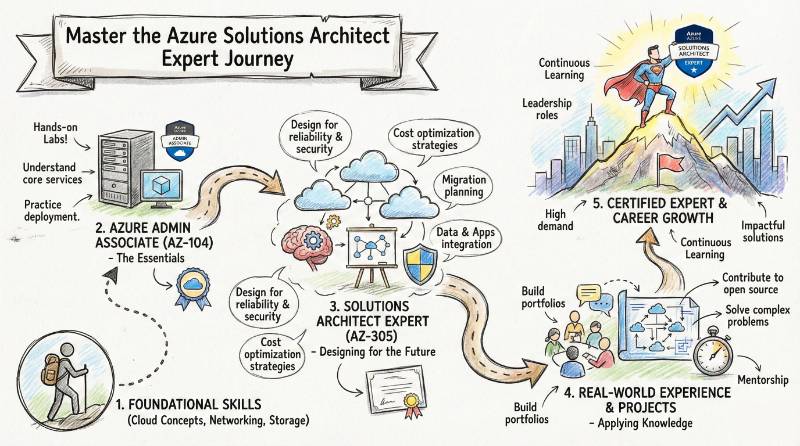
Moving from a senior engineer to a Solutions Architect isn’t just a title change; it’s a shift in how you see the world. After decades of building systems, I’ve learned that a true architect doesn’t just write code—they design the ecosystem where that code survives and thrives.
If you are looking to validate your skills or lead your organization’s cloud strategy, the Azure Solutions Architect Expert certification is the gold standard. It’s not just about knowing which button to click in the portal; it’s about understanding the “why” behind every design choice.
What is an Azure Solutions Architect Expert?
This is a high-level certification designed for those who have a deep understanding of Azure. It covers everything from infrastructure and security to business continuity and data platforms. It proves you can translate business requirements into secure, scalable, and reliable cloud solutions.
Who should take it?
- Senior Software Engineers looking to move into design roles.
- Cloud Architects who want to validate their expertise.
- DevOps Leads managing complex multi-service environments.
- IT Managers who need to oversee technical governance and strategy.
Skills you’ll gain
- Designing infrastructure for high availability and disaster recovery.
- Implementing complex security and identity management (Microsoft Entra ID).
- Budgeting and cost optimization for enterprise-scale deployments.
- Migrating legacy workloads to cloud-native architectures.
Real-world projects you should be able to do
- Enterprise Migration: Moving a large-scale on-premise data center to Azure without downtime.
- Global App Deployment: Designing a low-latency web application that serves users across five continents.
- Security Hardening: Building a zero-trust network environment for a financial services client.
Preparation Plans: How Long Does it Take?
Having mentored hundreds of engineers, I know everyone’s schedule is different. Here is how I suggest you approach your study:
7–14 Days (The Fast Track)
This is only for those who are already working in Azure daily. Spend 4 hours a day focusing strictly on Design Patterns and Governance. Use practice tests to find your weak spots immediately.
30 Days (The Standard Path)
Best for busy professionals. Spend 1 hour on weekdays and 4 hours on weekends. Focus on one pillar per week: Identity, Compute, Storage, and Networking.
60 Days (The Deep Dive)
If you are coming from another cloud provider (like AWS or GCP), take this time. Build one “Solution” every weekend—like a three-tier app or a hub-and-spoke network—to see how Azure pieces fit together.
Common Mistakes to Avoid
- Skipping the Admin stuff: You cannot architect what you cannot manage. Ensure you know AZ-104 concepts well.
- Ignoring Cost: In the exam and real life, the most expensive solution is usually the wrong answer.
- Focusing only on the Portal: Learn how CLI and Terraform/Bicep play into the architecture.
Choose Your Path: 6 Specialized Learning Tracks
Architects rarely work in a vacuum. Depending on your career goals, you should pair your Azure knowledge with one of these domains:
- DevOps:
Focus on CI/CD automation using Azure DevOps and GitHub Actions. - DevSecOps:
Integrate security scanning and “Policy as Code” into your design. - SRE (Site Reliability Engineering):
Focus on observability, Azure Monitor, and high-availability design. - AIOps/MLOps:
Designing infrastructure to support large-scale AI models and automated insights. - DataOps:
Building robust data pipelines using Azure Data Factory and Synapse. - FinOps:
Mastering cost management, tagging, and resource optimization to save your company money.
Role to Recommended Certifications Mapping
| Your Current Role | Recommended Certification Path |
| DevOps Engineer | Azure Administrator → Azure Solutions Architect → DevOps Engineer Expert |
| SRE | Azure Solutions Architect → Azure Monitor Specialist |
| Platform Engineer | Azure Solutions Architect → Azure Network Engineer |
| Cloud Engineer | Azure Fundamentals → Azure Administrator → Azure Solutions Architect |
| Security Engineer | Azure Security Engineer Associate → Azure Solutions Architect |
| Data Engineer | Azure Data Engineer Associate → Azure Solutions Architect |
| FinOps Practitioner | Azure Administrator → Azure Solutions Architect |
| Engineering Manager | Azure Fundamentals → Azure Solutions Architect |
Top Institutions for Azure Solutions Architect Expert Training
Choosing the right mentor is half the battle. These institutions offer specialized training and support for the Azure Expert track:
- DevOpsSchool:
A premier institution offering deep-dive technical labs and expert-led sessions specifically for Azure certifications. - Cotocus
Cotocus is known for their hands-on approach, helping engineers bridge the gap between theory and enterprise deployment. - Scmgalaxy:
A massive community-driven platform that provides extensive resources for configuration management and cloud architecture. - BestDevOps:
Focuses on the integration of DevOps practices within the Azure architectural framework. - devsecopsschool.com:
The go-to place for architects who want to specialize in securing cloud-native applications. - sreschool.com:
Offers training focused on reliability, performance, and monitoring in complex Azure environments. - aiopsschool.com:
Specialized in the future of operations, teaching how to use AI to manage Azure infrastructure. - dataopsschool.com:
Ideal for architects looking to master big data and analytics on the Azure platform. - finopsschool.com:
Teaches the vital skill of cloud financial management and architecture-driven cost savings.
Frequently Asked Questions
On Azure Solutions Architect Expert
1. Is the exam hard?
Yes. It is an expert-level exam. It tests your ability to make decisions, not just memorize facts.
2. How much time do I need?
Expect 80–120 hours of total study time if you have moderate experience.
3. What are the prerequisites?
While you can take the exam anytime, you must pass the AZ-104 (Administrator) to earn the Expert badge.
4. Is it worth the money?
Absolutely. It is one of the highest-paying certifications in the global market.
5. How long is the certificate valid?
It is valid for one year, but renewal is free and can be done online through Microsoft.
6. Can I skip the Associate level?
You can take the AZ-305 exam, but you won’t get the “Expert” title until you finish AZ-104.
7. Does this cover coding?
Not deeply, but you need to understand logic, JSON/Bicep templates, and script structures.
8. What is the career outcome?
Most move into Lead Architect, Principal Engineer, or CTO roles.
On General Career & Sequence
9. Should I learn AWS or Azure first?
If you work in an enterprise or Windows-heavy environment, start with Azure.
10. What is the best sequence for a beginner?
AZ-900 (Fundamentals) → AZ-104 (Admin) → AZ-305 (Architect).
11. Does the certification guarantee a job?
It gets you the interview. Your ability to explain architecture (which you learn while studying) gets you the job.
12. How does this help an Engineering Manager?
It allows you to vet your team’s designs and understand the cost/security implications of their requests.
13. Is hands-on experience required?
You can’t pass without it. You need to know how the Azure Portal and CLI behave in real scenarios.
14. What is the value in the Indian market?
Huge. With more global companies moving to Azure, there is a massive shortage of certified Architects in India.
15. Can I self-study?
Yes, but structured training from places like DevOpsSchool significantly reduces the “trial and error” time.
16. What is the most difficult topic?
Usually Networking (VNet peering, VPN Gateways, ExpressRoute) and Identity (B2B vs B2C).
17. How does this compare to a Degree?
A degree shows you can learn; this certification shows you can do the specific job of a Cloud Architect.
18. What if I fail?
Don’t worry. Analyze your score report, focus on the low-percentage areas, and retake it after 2 weeks of focused study.
19. Are there labs in the exam?
Sometimes. You should be prepared to perform tasks within a live Azure environment during the test.
20. Which path is better: DevOps or Architect?
They overlap. An architect designs the “house,” while DevOps builds the “assembly line.” Most senior pros do both.
Next Certifications to Take
Once you’ve conquered the Architect Expert level, don’t stop. Here are your three best options:
- Same Track (Deepening): Azure Security Engineer (AZ-500). An architect who knows security is twice as valuable.
- Cross-Track (Broadening): Certified Kubernetes Administrator (CKA). Azure runs on Kubernetes; mastering it is essential.
- Leadership (Growth): CISSP or PMP. If you want to move into C-suite or high-level management, these complement your technical expertise.
Conclusion
Becoming an Azure Solutions Architect Expert is a marathon, not a sprint. It’s about building a mental library of solutions that you can pull from when a business problem lands on your desk.
Whether you are leading a team in India or designing systems for a global startup, this certification provides the foundation you need.
Start with a solid training plan, get your hands dirty in the portal, and remember: a good architect never stops learning.
Leave a Reply