Introduction
Microsoft Azure is now a core platform for enterprises of every size, and security is one of the first concerns leadership raises when workloads move to the cloud. As a result, the Microsoft Azure Security Technologies (AZ-500) certification has become a key benchmark for engineers and managers who want to prove they can secure identities, networks, workloads, and data in Azure.
This guide walks you through what AZ-500 covers, who should pursue it, how to prepare, and how to use it as a foundation for long-term growth in DevOps, DevSecOps, SRE, AIOps/MLOps, DataOps, and FinOps.
What Is Microsoft Azure Security Technologies (AZ-500)?
Microsoft Azure Security Technologies (AZ-500) is a role-based certification focused on designing and implementing security controls, maintaining security posture, and protecting identities, data, applications, and networks in Azure. It validates that you can secure cloud resources in pure Azure, hybrid, and even multi-cloud environments as part of an end-to-end infrastructure.
What this certification covers
- Secure identity and access (Microsoft Entra ID, formerly Azure AD).
- Secure networking (network segmentation, firewalls, WAF, DDoS protection).
- Secure compute, storage, and databases (VMs, containers, AKS, SQL, storage).
- Secure Azure using Microsoft Defender for Cloud and Microsoft Sentinel (threat protection and SIEM/SOAR).
Who Should Take AZ-500?
AZ-500 is ideal for professionals who design, implement, and monitor security for Azure workloads. It suits:
- Security Engineers responsible for identity, network, and workload protection.
- Cloud or Platform Engineers working on secure Azure landing zones.
- DevOps, SRE, and Platform teams who must embed security into pipelines and infrastructure.
- Engineering Managers who need to understand Azure security capabilities to lead teams and review architectures.
You should be comfortable with core Azure services (compute, storage, networking, databases) and have hands-on exposure to Azure administration before attempting the exam.
Skills You Will Gain With AZ-500
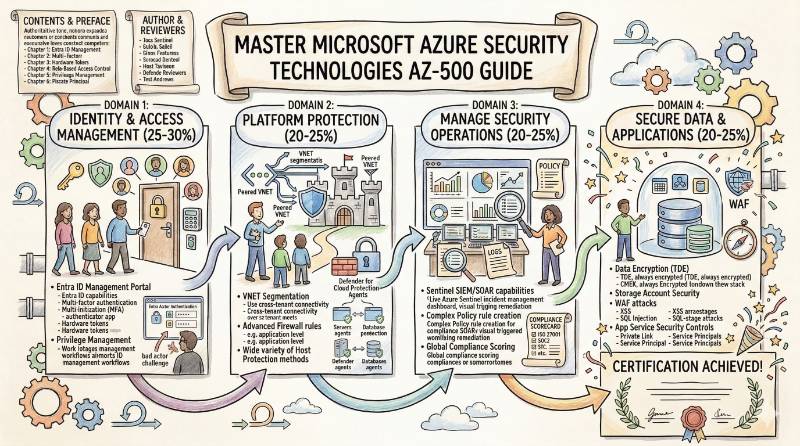
You can expect to build solid end-to-end Azure security capabilities across four big domains.
- Secure identity and access: Entra ID, Conditional Access, MFA, PIM, identity protection.
- Secure networking: NSGs, ASGs, Azure Firewall, Application Gateway, WAF, DDoS protection, Bastion.
- Secure compute and containers: VM hardening, patching, Defender for Cloud, AKS security, container registry security.
- Secure data and apps: storage encryption, SQL security, Key Vault, app secrets management, Defender for Cloud and Sentinel monitoring.
Real‑World Projects After AZ-500
After completing AZ-500, you should be able to handle practical security work in production environments.
- Design and implement a secure Azure landing zone with identity, network segmentation, and governance policies.
- Harden a multi-tier application with WAF, private endpoints, and Key Vault–based secret management.
- Implement Microsoft Defender for Cloud recommendations and Sentinel analytics rules to monitor and respond to threats.
- Secure containerized workloads on AKS, including network policies, identity, and secret handling.
- Set up end-to-end security baselines for virtual machines, storage accounts, and databases, including encryption and auditing.
AZ-500 in the Microsoft Certification Landscape
AZ-500 sits at the associate level and aligns directly with the Azure Security Engineer role. Many professionals use it alongside role-based certifications like Azure Administrator, Azure Solutions Architect, or DevOps Engineer to strengthen their profile.
Microsoft Azure Security Technologies (AZ-500)
What it is
AZ-500 is a role-based certification for professionals who secure Azure workloads, identities, and data across hybrid and cloud-native environments. It focuses on implementing security controls, maintaining security posture, and managing identity and access, network security, and threat protection in Azure.
Who should take it
- Security Engineers responsible for Azure and hybrid security.
- DevOps, SRE, and Platform Engineers who design and operate cloud infrastructure.
- Cloud Architects and Engineering Managers who review and approve secure designs.
Skills you’ll gain
- Design and implement identity and access controls with Entra ID, Conditional Access, and PIM.
- Secure Azure networks with NSGs, Azure Firewall, WAF, Bastion, and DDoS protection.
- Harden compute, storage, and databases with Defender for Cloud, encryption, and security baselines.
- Implement security monitoring, incident response, and automation with Microsoft Defender for Cloud and Sentinel.
Real-world projects after AZ-500
- Build a secure, policy-driven Azure subscription model for multiple teams, including RBAC, Blueprints/Policy, and PIM.
- Implement secure CI/CD deployment patterns using private endpoints, managed identities, and Key Vault.
- Design a security operations workflow that integrates Defender for Cloud alerts into Sentinel, with automated playbooks.
- Migrate an on-prem application to Azure with security built-in: identity, network, encryption, and threat protection.
Preparation plan
7–14 days (fast track, experienced Azure users)
- Focus on Microsoft’s official study guide domains and skim all objectives once.
- Do targeted labs for identity, Conditional Access, PIM, Azure Firewall, WAF, Defender for Cloud, and Sentinel.
- Take 2–3 full practice tests to identify gaps and revise only weak areas.
30 days (balanced working‑professional plan)
- Week 1: Identity and access (Entra ID, Conditional Access, PIM, identity protection).
- Week 2: Network security (NSGs, ASGs, Azure Firewall, WAF, Bastion, DDoS).
- Week 3: Compute, storage, and database security (VMs, AKS, ACR, storage, SQL, Key Vault).
- Week 4: Defender for Cloud, Sentinel, governance (Policy, Blueprints), and revision with practice tests.
60 days (deep-dive plan)
- Allocate 2–3 study sessions each week plus hands-on lab time.
- Repeat complex topics like Sentinel analytics rules, automation, AKS security, and hybrid security patterns.
- Build at least one end-to-end project integrating identity, network, workload, and monitoring security.
Common mistakes
- Underestimating identity and access; treating Conditional Access and PIM as minor topics.
- Ignoring Sentinel and automation scenarios, which appear in the exam and in real-world operations.
- Studying theory without hands-on labs in a real Azure subscription.
- Focusing only on VM security and skipping containers, AKS, and serverless security patterns.
Best next certification after AZ-500
- Same track: Azure Solutions Architect or advanced security-focused paths to deepen cloud architecture and security leadership.
- Cross-track: DevOps-focused or cloud developer certifications to strengthen collaboration with build and delivery teams.
- Leadership: Architecture or cloud strategy credentials that prove you can align security with business outcomes.
Choose Your Path: Six Learning Paths Around AZ-500
Once you have AZ-500 or are on the path to it, you can align it with different career directions.
DevOps path
Use AZ-500 to design secure CI/CD pipelines, infrastructure as code patterns, and environment strategies in Azure. Combine security knowledge with automation so that every deployment bakes in identity, network, and data protection from day one.
DevSecOps path
Here you embed security at every stage of the software delivery lifecycle. AZ-500 gives you deep Azure security knowledge, which you combine with secure coding, threat modeling, and security testing practices to build a modern DevSecOps culture.
SRE path
Site Reliability Engineers often own availability, performance, and incident response. AZ-500 helps you connect security signals from Defender for Cloud and Sentinel into your SRE tooling and runbooks, aligning reliability with security posture.
AIOps/MLOps path
Security for data pipelines and ML workloads in Azure is critical when teams deploy AI to production. AZ-500 gives you the foundation for securing data stores, APIs, and compute that power analytics and machine learning platforms.
DataOps path
DataOps teams handle data movement, transformation, and governance. With AZ-500, you are better equipped to secure data at rest and in transit, protect databases and storage, and implement access controls and auditing for data platforms.
FinOps path
FinOps practitioners optimise cost and value across cloud environments. Understanding Azure security controls helps you factor risk and compliance into cost decisions, and ensure that savings never come at the expense of security baseline.
Role → Recommended Certifications
Use AZ-500 as a key building block in a broader certification plan.
| Role | How AZ-500 helps | Recommended certifications path (including AZ-500) |
|---|---|---|
| DevOps Engineer | Designs secure pipelines and infrastructure. | Azure fundamentals → Dev/DevOps associate → AZ-500 for secure delivery practices. |
| SRE | Integrates security alerts into reliability work. | Azure fundamentals → Ops-focused cert → AZ-500 for security-aware SRE operations. |
| Platform Engineer | Owns landing zones and platform security. | Azure admin/architect → AZ-500 → advanced architecture-focused tracks. |
| Cloud Engineer | Builds and maintains secure cloud workloads. | Azure fundamentals → Admin/Developer → AZ-500 for security depth. |
| Security Engineer | Specialises in Azure security and operations. | Azure fundamentals → AZ-500 → further security or architecture-focused paths. |
| Data Engineer | Secures data platforms and pipelines. | Data platform certs → AZ-500 to secure storage, databases, and access. |
| FinOps Practitioner | Considers security posture in cost decisions. | Cloud fundamentals → FinOps-focused learning → AZ-500 to understand secure cost trade-offs. |
| Engineering Manager | Guides teams on secure architectures. | Broad cloud certs → AZ-500 → strategic or architecture-level tracks. |
Training Institutions for AZ-500
Several specialist institutions provide structured training and support for Microsoft Azure Security Technologies (AZ-500).
- DevOpsSchool:
Offers structured AZ-500 training with a strong focus on hands-on labs, real project scenarios, and integration with DevOps and cloud practices, helping engineers and managers connect exam topics to daily work. - Cotocus:
Provides role-based cloud and security programs that often bundle AZ-500 with related Azure and DevOps skills, making it easier for working professionals to build a complete cloud security profile. - Scmgalaxy:
Focuses on practical DevOps and cloud training, including Azure security, with attention to tools, automation, and best practices that matter for implementation teams. - BestDevOps:
Curates cloud and DevOps courses for professionals who want to strengthen their career in modern software delivery, including Azure security as an important capability. - devsecopsschool.com:
Targets security in the software delivery lifecycle, where AZ-500 forms part of a broader DevSecOps toolbox that blends Azure controls with secure coding and testing practices. - sreschool.com:
Tailors content for reliability and operations teams, showing how Azure security, observability, and automation intersect in SRE-style environments. - aiopsschool.com:
Focuses on automation and intelligence in operations, where understanding Azure security events and signals is critical for building effective AIOps pipelines. - dataopsschool.com:
Concentrates on secure and governed data pipelines, helping DataOps professionals apply AZ-500 principles to data platforms and analytics stacks. - finopsschool.com:
Combines cost management, governance, and risk, showing how Azure security features influence cloud financial decisions and policies.
FAQs on Microsoft Azure Security Technologies (AZ-500)
1. Is AZ-500 difficult for a working engineer?
AZ-500 is considered an intermediate-level exam: challenging but very manageable if you already work with Azure and invest time in hands-on labs. The difficulty usually comes from the breadth of services and scenarios rather than complex theory.
2. How long does it usually take to prepare?
Most working professionals take between three and six weeks of focused study, depending on their prior Azure and security experience. If you are new to Azure security, expect to be closer to the longer end so you can spend more time in the portal and with labs.
3. Do I need an Azure fundamentals certification first?
An entry-level Azure fundamentals certification is not mandatory, but it is strongly recommended. You should understand basic Azure compute, networking, storage, and identity concepts before you start deep security preparation.
4. Can I take AZ-500 without any security background?
You can, but you will likely need extra time because the exam assumes familiarity with security concepts such as identity, access control, network security, and incident response. Many engineers first gain some practical security exposure in their current role before sitting for AZ-500.
5. What is the main value of AZ-500 for my career?
AZ-500 proves that you can protect Azure environments in a structured, enterprise-ready way rather than relying on ad-hoc configurations. This is valuable for roles with responsibility for production systems, compliance, and risk.
6. Is AZ-500 more useful for security engineers or DevOps engineers?
It is highly relevant for both, but in slightly different ways. Security engineers see it as a core credential for their role, while DevOps engineers use it to design pipelines and platforms that are secure by design.
7. How does AZ-500 compare with other cloud security certifications?
AZ-500 is tightly focused on Microsoft Azure and its native tools, while other cloud security certifications may be vendor-neutral or focused on different platforms. If your organisation relies heavily on Azure, this laser focus is a big advantage.
8. Will AZ-500 help me work in multi-cloud or hybrid environments?
Yes, to an extent. The exam covers scenarios where Azure security must work alongside other environments, and many concepts such as identity, segmentation, and monitoring apply broadly.
9. What are common mistakes candidates make during preparation?
Many candidates rush through identity and access topics, or they ignore hands-on practice with Defender for Cloud and Sentinel. Others study only documentation and sample questions without building real labs.
10. How should I sequence AZ-500 with other certifications?
A practical sequence is fundamentals → role-based associate (admin, developer, or architect) → AZ-500 → more advanced or leadership-oriented certifications. This gives you a solid technical base before specialising in security.
11. Does AZ-500 increase salary potential?
Security skills in cloud environments are in high demand, and role-based Azure security credentials can support higher compensation and better role opportunities. The exact impact depends on your region, experience, and job market.
12. Is AZ-500 worth it for engineering managers?
Yes, particularly if you are responsible for cloud strategy, architecture review, or risk discussions with stakeholders. It gives you shared language and concrete knowledge to challenge designs and support your teams effectively.
General FAQs: Career, Value, and Strategy
Beyond the exam details, professionals always ask me about the bigger picture. Here are answers to the questions I hear most often in mentoring sessions.
- Is AZ-500 enough to get a job as a Cloud Security Engineer?
It is a powerful enabler, but not a guarantee. The certification validates your technical knowledge, which is the ticket to entry. To land the role, you must pair it with demonstrable hands-on experience (labs, GitHub projects) and the ability to articulate security concepts in interviews. It proves you have the foundation; your communication and problem-solving skills prove you’re ready for the job. - How does this certification affect my salary potential?
Significantly. Cloud security is a premium skill. Professionals with an AZ-500 typically command higher salaries than general Azure administrators because they are responsible for protecting critical assets. In most markets, holding this certification can place you in a higher salary bracket, often reflecting a 10-20% increase compared to non-certified peers in similar roles . - I have 20 years in on-premises security. Is this certification still relevant for me?
It is not just relevant; it is essential for your transition. While the core principles of security (least privilege, defense in depth) remain the same, the implementation in the cloud is radically different. This certification will help you translate your decades of experience into a modern context, showing employers that you can protect both their legacy data centers and their future in the cloud. - What is the renewal process like for AZ-500?
Microsoft makes renewal manageable. Your certification is valid for one year. When it’s time to renew, you can take a free, open-book online assessment on Microsoft Learn. It focuses on new features and updates released in the past year. This ensures your skills stay current without requiring you to re-take the full exam . - Can this certification help me move into a consulting role?
Absolutely. Consulting firms are constantly looking for billable experts. An AZ-500 certification assures them and their clients that you have a verified skillset in Azure security. It builds immediate trust and allows you to command higher consulting rates, as you are bringing a specialized, in-demand capability to the table. - Should I put my certification badge on LinkedIn?
Without a doubt. Claim your Microsoft Certification badge and add it to your LinkedIn profile. It makes your profile appear in more recruiter searches and visually confirms your expertise. It’s a small action that significantly boosts your professional brand and visibility in the job market. - How often does the AZ-500 exam change?
Microsoft updates its exams regularly to keep pace with the rapidly evolving Azure platform. Major changes, like adding new features or removing outdated ones, are announced on the official Microsoft Exam page. You should always check the “Skills Measured” document before you start your study plan to ensure you’re learning the most current version. - I failed my first attempt. What should I do?
First, don’t be discouraged—many excellent engineers don’t pass on the first try. You will receive a score report that breaks down your performance by domain (e.g., Identity, Networking). Use this as your roadmap. Double down on your weakest areas with hands-on labs and revisit the official Microsoft Learn modules. You now know exactly what to expect, which is a huge advantage for your next attempt.
Conclusion
Microsoft Azure Security Technologies (AZ-500) is more than just another cloud certification; it is a practical roadmap for securing real workloads in Azure across identity, network, data, and operations. For engineers and managers in India and around the world, it offers a structured way to upgrade skills, align with modern security expectations, and become a more trusted decision-maker in cloud projects.
When you combine AZ-500 with a clear learning path (DevOps, DevSecOps, SRE, AIOps/MLOps, DataOps, or FinOps) and role-aligned certifications, you build a profile that is both technically strong and strategically relevant for the next phase of your career.
Leave a Reply