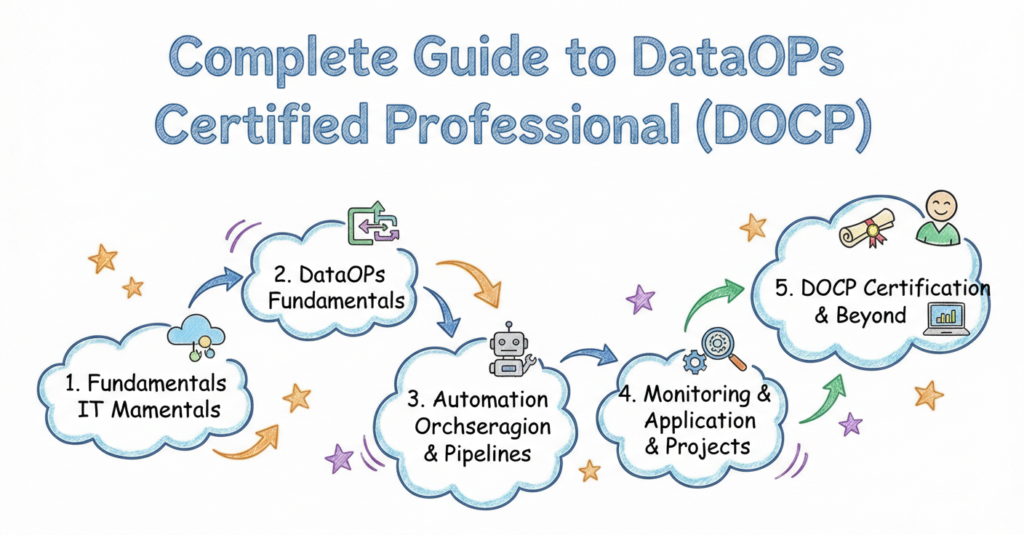
Data is used in every company now. Still, many teams face the same pain again and again: pipelines fail, reports show wrong numbers, and fixing issues takes too long. Most problems happen because data work is not treated like production software.
DataOps Certified Professional (DOCP) helps you learn a better way. It teaches you how to deliver data with clear process, automation, testing, monitoring, and governance. The goal is simple: ship trusted data faster, with fewer failures.
This guide explains what DOCP is, who should take it, what you will learn, how to prepare, and what to do next after you complete it.
About the provider: DevOpsSchool
DevOpsSchool is a training and certification provider that focuses on modern engineering skills like DevOps, SRE, DevSecOps, cloud, and related areas. Their programs are built for working professionals, so the style is practical and job-focused.
What you can expect from the provider
- Instructor-led learning: sessions are run live and are designed to be interactive.
- Hands-on practice: training is built around labs and real-world style exercises, not only theory.
- Multiple training modes: they offer online, classroom, and corporate training options.
- Support during learning: the provider highlights trainer support and guidance for learners during the program.
- Structured certification path: their certification pages are organized by track and program, so learners can choose a clear sequence.
What DOCP is
DOCP (DataOps Certified Professional) is a certification that teaches you how to deliver data like a real production system. It focuses on building pipelines that are repeatable, tested, monitored, and easy to fix when something breaks.
DataOps means using proven delivery habits from software engineering and DevOps in the data world, such as:
- Automation
- Testing
- Version control
- Monitoring
- Fast feedback
- Clear ownership
DOCP teaches you how to build and run data pipelines in a stable and repeatable way.
Who should take DOCP
DOCP is a good fit for:
- Software engineers who work on data pipelines, APIs, or analytics platforms
- Data engineers building ETL/ELT pipelines
- Analytics engineers maintaining models and transformations
- Platform engineers supporting orchestration, cloud, and data tooling
- SRE/operations teams who keep pipelines reliable
- Security engineers who manage access, audit, and compliance for data
- Engineering managers who need predictable data delivery and fewer incidents
If your job needs trusted data on time, DOCP is useful.
What you will learn in DOCP
You will learn how to build a full data delivery system that works like production software.
Key skills you’ll gain
- How to plan and run data delivery using DataOps thinking
- How to reduce pipeline failures with better design and checks
- How to set quality rules so bad data does not reach users
- How to track freshness, accuracy, and pipeline health with monitoring
- How to manage changes safely with version control and release steps
- How to build clear ownership, documentation, and runbooks
- How to add governance, access control, and audit readiness
DataOps Certified Professional (DOCP)
What it is
DOCP is a professional certification that teaches end-to-end DataOps practices. It covers how to deliver data pipelines with automation, quality checks, monitoring, and governance, so teams can trust data and move faster.
Who should take it
- Data Engineers and Analytics Engineers
- Cloud/Platform Engineers supporting data tools
- SRE/Operations teams supporting data reliability
- Managers leading data delivery teams
- Developers moving into data engineering roles
Skills you’ll gain
- Data pipeline lifecycle and best practices
- CI-style thinking for data (safe change, repeatable steps)
- Testing and validation for data quality
- Monitoring and alerting for pipeline health
- Governance basics: ownership, access, audit readiness
- Operational workflows: incidents, runbooks, postmortems
Real-world projects you should be able to do after it
- Build a production ETL/ELT pipeline with repeatable runs
- Create data quality checks for schema, nulls, duplicates, ranges, freshness
- Set up monitoring dashboard for latency, failures, and freshness
- Create runbooks for common pipeline failures
- Build a safe backfill process and re-run strategy
- Define dataset ownership and basic governance rules
Preparation plan (7–14 days / 30 days / 60 days)
This preparation plan is designed for working professionals, so you can choose a timeline based on your current experience and daily time available. The 7–14 days plan is best for quick revision if you already work on data pipelines, the 30 days plan gives a balanced pace with practice and clarity, and the 60 days plan is for deep learning with strong hands-on work and a portfolio-ready project.
7–14 days (fast revision)
Best if you already work in data pipelines.
- Learn DataOps basics and key terms
- Study common pipeline failures and fixes
- Create a simple “quality check list” for a dataset
- Learn monitoring basics: freshness, latency, failure rate
- Revise governance basics: access control, audit logs
- Do final revision with short notes and one mini case study
Goal: be able to explain a stable pipeline workflow end-to-end.
30 days (best for working professionals)
- Week 1: DataOps basics + pipeline lifecycle
- Week 2: Automation + safe change process
- Week 3: Data quality + contracts + checks
- Week 4: Monitoring + runbooks + incident handling
Goal: build a small portfolio pipeline with checks + alerts + documentation.
60 days (deep mastery)
- Weeks 1–2: Architecture and platform patterns
- Weeks 3–4: Testing depth + release workflow
- Weeks 5–6: Monitoring + reliability patterns + incident playbooks
- Weeks 7–8: Governance + ownership model + audit readiness
Goal: build a strong portfolio that shows reliability and governance, not just scripts.
Common mistakes and how to avoid them
- Treating DataOps as only tools: Start with workflow, ownership, and quality gates.
- No clear definition of “data is correct”: Write validation rules and contracts early.
- Monitoring only infrastructure: Track data freshness, volume, schema changes, and completeness.
- Manual fixes without learning: Use postmortems and add tests so issues don’t repeat.
- Over-building governance too early: Build minimum controls first, then expand.
- Ignoring access control until late: Design roles and auditing early to avoid rework.
Best next certification after this
Choose based on your career goal:
- Same track (DataOps depth): become a senior DataOps / Data Platform specialist
- Cross-track: add SRE or DevOps skills for reliability + automation
- Leadership: learn architecture + governance + delivery metrics to lead teams
Why DOCP matters in real jobs
DOCP matters in real jobs because companies don’t just want “pipelines that run” — they want data they can trust, delivered on time, every time. In most teams, the biggest problems are late data, wrong numbers in reports, broken dashboards, and repeated firefighting when pipelines fail.
Data teams are judged by outcomes:
- Is the data correct?
- Is it delivered on time?
- Can we trust the dashboard?
- Can we change the pipeline safely?
- Can we explain who owns the dataset?
DOCP helps you build systems that answer “yes” more often.
It also improves your career story. Instead of saying “I built pipelines,” you can say:
- “I reduced failures by adding quality checks and monitoring.”
- “I created a repeatable backfill and re-run method.”
- “I improved trust with ownership, documentation, and governance.”
Choose your path (6 learning paths)
DevOps path
Best if your goal is automation and delivery pipelines.
- Focus: CI/CD mindset, repeatable workflows, infrastructure automation
- Outcome: stronger platform delivery and safer changes
DevSecOps path
Best if your data systems need security and compliance.
- Focus: access control, audit, policy enforcement, secrets management
- Outcome: safer data delivery with fewer compliance risks
SRE path
Best if you want to own reliability and uptime for data platforms.
- Focus: SLOs, monitoring, incident response, postmortems
- Outcome: fewer pipeline incidents and faster recovery
AIOps/MLOps path
Best if you work with ML pipelines or data feeding models.
- Focus: reliable data inputs, monitoring, anomaly detection, automation
- Outcome: fewer model failures caused by bad or late data
DataOps path
Best if you want to be a full DataOps specialist.
- Focus: orchestration, testing, quality, governance, observability
- Outcome: strong end-to-end ownership of data delivery
FinOps path
Best if cost control and efficiency matter.
- Focus: cost visibility, usage controls, efficient design choices
- Outcome: reduce waste and keep data platform costs under control
Role → Recommended certifications mapping
This section helps you pick what to learn next based on your job role.
| Role | What to focus on first | Why it helps |
|---|---|---|
| DevOps Engineer | Delivery automation + DOCP | Extends DevOps discipline into data delivery |
| SRE | Reliability + monitoring + DOCP | Makes data pipelines stable and measurable |
| Platform Engineer | Platform basics + orchestration + DOCP | Data platforms need standard workflows and automation |
| Cloud Engineer | Cloud basics + security basics + DOCP | Data workloads are cloud-heavy; DOCP adds delivery discipline |
| Security Engineer | Security + governance + DOCP | Helps build access control and audit-ready workflows |
| Data Engineer | DOCP first | Direct match for pipeline delivery and quality work |
| FinOps Practitioner | Cost visibility + governance + FinOps practices | Data platforms cost money; governance + efficiency matters |
| Engineering Manager | Delivery metrics + governance + DOCP overview | Helps reduce incidents and improve predictable delivery |
Certification table
This table shows the track view. Only the allowed official links are used.
| Track | Level | Who it’s for | Prerequisites | Skills covered | Recommended order |
|---|---|---|---|---|---|
| DataOps | Professional | Data Engineers, Platform/SRE teams, Managers | SQL basics + pipeline exposure | DataOps workflow, quality, monitoring, governance | 1 |
| DevOps | Foundation → Professional | DevOps/Cloud engineers | Linux + Git basics | Automation, delivery workflow, infra practices | 1 → 2 → 3 |
| DevSecOps | Professional | Security + engineering roles | CI/CD understanding | Secure delivery, policy, compliance mindset | After DevOps basics |
| SRE | Professional | Reliability roles | Ops/monitoring basics | SLOs, incident response, observability | After DevOps basics |
| AIOps/MLOps | Professional | ML/ops and platform roles | Monitoring + pipelines basics | Automation, monitoring, operational ML thinking | After DevOps basics |
| FinOps | Practitioner → Professional | Cost + platform owners | Cloud basics | Cost control, governance, efficiency | After cloud basics |
Next certifications to take
1) Same track option (DataOps depth)
Choose this if you want to become a senior DataOps specialist:
- deeper quality engineering
- stronger governance
- advanced reliability patterns
2) Cross-track option (broader career)
Choose this if you want roles like Platform Engineer / Cloud Data Engineer:
- DevOps automation practices
- reliability skills
- cloud architecture skills
3) Leadership option (team lead / manager)
Choose this if you are leading teams:
- delivery metrics and planning
- governance programs
- standard playbooks and operating model
Training cum certification support institutions
DevOpsSchool
DevOpsSchool is known for structured programs that combine concepts with implementation steps. Learners typically benefit from hands-on practice, guided project framing, and interview-ready preparation. It can be helpful if you want a single place for training plus a certification path.
Cotocus
Cotocus supports practical learning that connects training with real delivery workflows. It can be useful if you want implementation thinking and guidance for real projects. It also suits teams that want to improve process, not just learn theory.
ScmGalaxy
ScmGalaxy is useful for structured learning with a focus on real-world scenarios. It often fits working professionals who want clear steps, examples, and interview readiness. It can help learners build confidence through guided practice.
BestDevOps
BestDevOps is helpful for learners who prefer simple explanations and practical examples. It suits people who want a step-by-step approach and easy learning flow. It can support building core delivery habits.
devsecopsschool.com
devsecopsschool.com is relevant if your DataOps work includes strong security and compliance needs. It can help you connect pipelines with access policies, audit readiness, and risk reduction. This is useful in regulated environments.
sreschool.com
sreschool.com is useful if you want to improve reliability and operational readiness for data platforms. It helps build thinking around monitoring, incident handling, and service-level goals. This supports stable production operations.
aiopsschool.com
aiopsschool.com is helpful when you manage large-scale monitoring and want smarter automation. It fits teams that want better detection, faster response, and operational improvements. This helps reduce repeated firefighting.
dataopsschool.com
dataopsschool.com is aligned closely with DataOps learning: quality checks, orchestration, governance, and observability. It can be a good fit if you want a DataOps-only learning focus. It supports building strong delivery habits.
finopsschool.com
finopsschool.com is relevant if cost control is a key priority for your data platform. It can help connect engineering choices with spend visibility and cost governance. This is useful when leadership asks for optimization.
FAQs on DOCP
1) Is DOCP difficult?
It is not “hard” if you already work with pipelines. It becomes difficult only when you have never handled production failures. The topics are practical and easy to understand with examples.
2) How much time do I need for DOCP?
If you already work in data systems, 7–14 days can be enough for revision. For most working professionals, 30 days is best. For deep confidence and portfolio building, choose 60 days.
3) What prerequisites do I need?
Basic SQL and basic pipeline understanding are enough. You should know what batch jobs, scheduling, and data movement mean. You do not need to be an expert in every tool.
4) Do I need programming skills?
Basic scripting and configuration skills help a lot. DOCP is focused on building stable workflows, so you need comfort with automation and simple coding patterns.
5) What type of jobs improve after DOCP?
Data Engineer, DataOps Engineer, Analytics Platform Engineer, Data Platform Engineer, and reliability-focused roles in data teams. It also helps managers improve delivery predictability.
6) What is the biggest benefit after DOCP?
You learn to reduce repeated failures. You also learn to add quality checks, monitoring, and runbooks so systems become more stable over time.
7) What should I build after DOCP to show skills?
Build one end-to-end pipeline with quality checks, monitoring alerts, and a small runbook. Even a small project looks strong if it shows production readiness.
8) Is DOCP useful if my company already uses modern tools?
Yes. Tools do not solve weak workflows. DOCP focuses on process, checks, monitoring, and ownership—this is what builds trust and stability.
General FAQs
1) Who should take DOCP?
Working engineers, data engineers, cloud/platform engineers, SRE teams, and managers who want reliable data delivery and fewer pipeline issues.
2) Is DOCP only for Data Engineers?
No. It is also useful for DevOps, SRE, Platform, Cloud, and Security roles because data platforms need automation, monitoring, and governance.
3) Do I need strong coding skills?
You need basic scripting and practical thinking. Most of the work is about building stable workflows, checks, and automation, not complex software coding.
4) What prerequisites are helpful before starting?
Basic SQL, understanding of pipelines (ETL/ELT), and basic knowledge of how production systems can fail and recover.
5) How much time is needed to prepare?
If you already work with data pipelines, 7–14 days can be enough for revision. For most working professionals, 30 days is best. For deep learning and portfolio building, 60 days is ideal.
6) What is the right learning order with other tracks?
If you are already in data work, start with DOCP. If you are new to delivery workflows, first learn basic DevOps concepts, then move to DOCP.
7) Is DOCP worth it if my company already uses modern tools?
Yes. Tools alone do not solve reliability problems. DOCP focuses on process, quality checks, monitoring, and ownership, which improves trust and stability.
8) What career outcomes can DOCP support?
It can help you move toward roles like DataOps Engineer, Senior Data Engineer (reliability-focused), Data Platform Engineer, Analytics Platform Engineer, and team lead roles.
9) What projects should I build after DOCP?
Build one end-to-end pipeline with quality checks, monitoring alerts, and a short runbook. This shows real production readiness.
10) How does DOCP help managers?
It helps managers reduce repeated incidents, create clear ownership, set delivery metrics, and improve predictability for reports and dashboards.
11) What is the biggest benefit in day-to-day work?
Fewer failures, faster recovery when issues happen, and more trust from business teams because data becomes consistent and dependable.
12) What should I focus on while preparing?
Focus on real workflow habits: testing, monitoring, safe changes, documentation, runbooks, and simple governance—these matter most in real jobs.
Conclusion
DOCP is a practical certification for people who want to deliver trusted data without constant firefighting. It helps you build strong habits like testing, monitoring, automation, clear ownership, and governance, so pipelines stay stable and reports stay accurate. If your work depends on data pipelines, dashboards, or data platforms, DOCP can improve your daily performance and also strengthen your career profile with real, job-ready skills.
Leave a Reply