Introduction
Software ships faster than ever, but security incidents and compliance pressure are also rising. Many teams have DevOps pipelines, yet security is still bolted on at the end instead of being part of the design.
The Certified DevSecOps Architect certification from DevSecOpsSchool is designed to close this gap. It proves that you can design and guide secure DevOps ecosystems across apps, pipelines, platforms, and cloud, where security is built‑in and automated.
This guide explains the Certified DevSecOps Architect program in simple language. You will see what it is, who should take it, skills you gain, real‑world projects, preparation plans, common mistakes, next certifications, learning paths, role‑based mapping, top training institutions, FAQs, and a clear conclusion.
What Is Certified DevSecOps Architect?
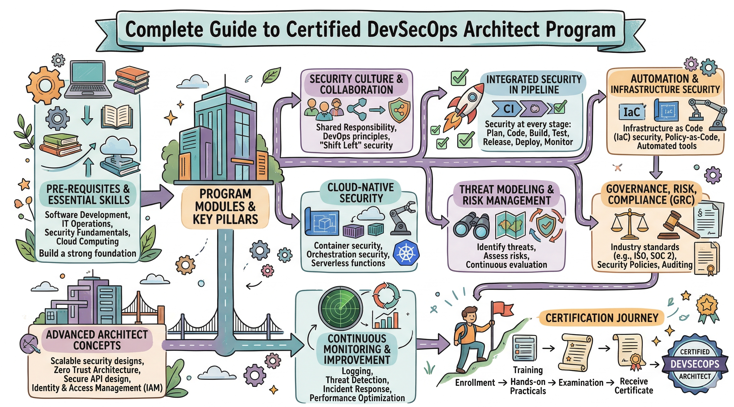
Certified DevSecOps Architect is an advanced certification that shows you can design secure DevOps and cloud architectures end‑to‑end. It focuses on secure CI/CD pipelines, security as code, cloud and Kubernetes security, compliance automation, and risk‑aware decision‑making at scale.
DevSecOpsSchool runs this program as part of its security‑driven DevOps training portfolio. The aim is not only to teach tools, but to help you think like an architect who balances speed, safety, and compliance for many teams and systems.
Who Should Take the Certified DevSecOps Architect Program?
This program is aimed at experienced professionals who already know DevOps and cloud basics and now want to lead security by design. It is ideal for:
- DevOps Engineers who want to own security for pipelines and platforms
- Security Engineers who want to integrate with DevOps instead of blocking it
- SREs and Platform Engineers who run shared Kubernetes and cloud platforms
- Cloud Engineers who design and implement multi‑account / multi‑cluster setups
- Architects and Tech Leads responsible for secure delivery patterns
- Engineering Managers who want a structured way to roll out DevSecOps
If you are expected to “make DevSecOps happen” across teams, this certification is directly aligned with that role.
Skills You’ll Gain as a DevSecOps Architect
Based on DevSecOpsSchool material and common DevSecOps architect responsibilities, these are the key skill areas.
- DevSecOps foundations
- Core DevSecOps principles, culture, and operating models.
- How to integrate security into every SDLC and CI/CD stage.
- Secure CI/CD and automation patterns
- Design of secure pipelines for build, test, and deploy across tools.
- Integration of SAST, DAST, SCA, container and IaC scanning.
- Policy‑as‑code and gates that block or flag risky changes.
- Cloud and Kubernetes security architecture
- Secure multi‑cloud patterns (identity, network, encryption).
- Kubernetes and container security (images, runtime, RBAC, network policies).
- Security as code and compliance as code
- Using IaC tools and policy frameworks to codify security controls.
- Mapping controls to standards (for example, ISO, SOC, PCI) and automating evidence.
- Threat modeling and risk management
- Practical threat modeling for pipelines, platforms, and critical changes.
- Making trade‑offs between speed, cost, and risk with clear severity rules.
- Vulnerability management and incident integration
- Designing vulnerability triage and fix workflows from repo to runtime.
- Integrating DevSecOps with SOC/SIEM, observability, and incident response.
- Leadership and governance
- Defining “paved road” patterns, standards, and guardrails across teams.
- Coaching teams, measuring adoption, and reporting risk and improvements.
Real‑World Projects You Should Handle After Certification
After completing Certified DevSecOps Architect training and real practice, you should be able to:
- Design and document a secure CI/CD reference architecture for multiple products.
- Implement “paved road” patterns: hardened base images, secure IaC modules, secret handling, identity baselines.
- Roll out pipeline‑integrated SAST, DAST, SCA, container and IaC scanning with clear pass/fail policies.
- Define threat models and compensating controls for high‑risk systems and changes.
- Integrate DevSecOps pipelines with observability and incident response workflows.
- Present security architecture and risk status to leadership in business‑friendly language.
Certified DevSecOps Architect
What It Is
Certified DevSecOps Architect is an advanced certification that proves you can design and guide secure DevOps ecosystems: from source code and pipelines to cloud platforms and operations. It blends technology, process, and culture so security becomes part of everyday delivery, not a final checkpoint.
Who Should Take It
- Senior DevOps, SRE, Platform, and Cloud Engineers
- Security Engineers, Architects, and AppSec leads
- Tech Leads and Engineering Managers responsible for delivery and risk
- Architects driving cloud‑native, microservices, and platform initiatives
You should already understand DevOps, cloud, and basic security, and now want a structured way to architect DevSecOps at scale.
Skills You’ll Gain
- Ability to design secure pipelines and platform guardrails.
- Understanding of how to integrate SAST, DAST, SCA, IaC, and container scanning without blocking teams.
- Confidence in threat modeling, risk scoring, and prioritization.
- Leadership skills to drive DevSecOps culture across multiple teams.
Real‑World Projects After It
- Build a DevSecOps reference architecture used by many teams.
- Implement a secure software supply chain for containers and IaC.
- Define an organization‑wide policy‑as‑code framework across cloud and CI/CD.
- Lead a DevSecOps rollout, including training, metrics, and governance.
Preparation Plan
7–14 Day Intensive Plan (If you already work in DevSecOps)
- Days 1–3
- Review DevSecOps fundamentals, SDLC stages, and your current pipelines.
- Map current tools and gaps to a reference DevSecOps architecture.
- Days 4–6
- Deep dive into secure CI/CD patterns, security as code, and policy as code.
- Design at least one end‑to‑end secure pipeline on paper and in a lab.
- Days 7–10
- Focus on cloud and Kubernetes security patterns relevant to your environment.
- Document standard patterns and “paved roads” you would recommend.
- Days 11–14
- Work through scenario‑based questions and case studies.
- Prepare a short “DevSecOps architecture proposal” as if for your company.
30 Day Balanced Plan (For busy working engineers)
- Week 1
- Refresh DevOps, cloud, and application security basics.
- Study DevSecOpsSchool’s Certified DevSecOps Architect domains and expectations.
- Week 2
- Secure CI/CD, tools integration, and security testing automation in depth.
- Hands‑on labs for SAST/DAST/SCA/container/IaC scanning in pipelines.
- Week 3
- Cloud and Kubernetes security architectures, identity, network, and policy patterns.
- Threat modeling and risk assessment exercises for real‑world systems.
- Week 4
- Governance, metrics, and culture: KPIs, dashboards, and rollout plans.
- Practice exam‑style scenarios and finalize your architectural “playbook”.
60 Day Deep Plan (If you are newer to security)
- Month 1
- Build solid ground in DevOps, cloud fundamentals, and basic AppSec (OWASP, common vulns).
- Study basic CI/CD pipelines and try adding at least one security tool.
- Month 2
- Follow a full DevSecOps Architect curriculum: secure pipelines, cloud/Kubernetes security, policy as code, threat modeling, governance.
- Complete multiple case studies and a small portfolio of “reference architectures.”
Common Mistakes in DevSecOps Architect Preparation
- Treating DevSecOps as just “adding more tools” instead of redesigning pipelines and responsibilities.
- Focusing only on one layer (for example, code scanning) and ignoring cloud, platform, or identity patterns.
- Creating overly strict policies that teams simply bypass, instead of risk‑based guardrails.
- Ignoring culture and communication, assuming diagrams alone will change behavior.
- Skipping scenario‑based practice and only reading tool documentation.
Best Next Certification After Certified DevSecOps Architect
Using common certification flows for software and security professionals:
- Same track (security / DevSecOps depth)
- Move into advanced security or DevSecOps professional programs to deepen your authority in secure pipelines and threat modeling.
- Cross‑track (cloud / SRE / observability)
- Add cloud architect, SRE, or observability‑master certifications to show you can design systems that are both secure and reliable in production.
- Leadership (architecture / management)
- Pursue architecture and engineering leadership certifications so you can drive org‑wide security strategy, budgets, and transformation programs.
Choose Your Path: Six Learning Paths Around DevSecOps Architecture
DevOps Path
Here, Certified DevSecOps Architect helps you evolve from DevOps engineer to someone who designs secure pipelines and platform guardrails. You define patterns so every team can ship fast and safely.
DevSecOps Path
This is the natural core path. You focus on embedding security into code, pipelines, and platforms, running DevSecOps as a continuous practice, not a one‑time project.
SRE Path
As an SRE, you combine reliability and security. Certified DevSecOps Architect helps you ensure that reliability patterns (SLOs, error budgets) sit on top of secure pipelines and hardened platforms.
AIOps/MLOps Path
In AIOps/MLOps, you secure data pipelines and ML workflows end‑to‑end. You design secure automation and monitoring so ML services and AIOps tools work in trusted environments.
DataOps Path
In the DataOps path, you apply DevSecOps thinking to data pipelines and platforms. You ensure data movement, processing jobs, and APIs follow secure coding and deployment patterns that are codified in pipelines.
FinOps Path
In the FinOps path, you use DevSecOps architectures that standardize infra, reduce misconfigurations, and prevent costly incidents. You help balance cost, speed, and risk using code‑driven controls and clear policies.
Role → Recommended Certifications Mapping
| Role | How Certified DevSecOps Architect helps | Recommended certifications after this |
|---|---|---|
| DevOps Engineer | Designs secure pipelines and automations instead of ad‑hoc fixes | Cloud DevOps/architect and Kubernetes or security‑focused certs |
| SRE | Connects reliability, incidents, and security guardrails | SRE master / observability / cloud architect programs |
| Platform Engineer | Builds secure, multi‑tenant platforms with strong guardrails | Cloud/platform architect and Kubernetes/cluster security certs |
| Cloud Engineer | Embeds security standards into cloud landing zones and infra | Cloud security and advanced architect certifications |
| Security Engineer | Integrates security into DevOps workflows, not just point scans | Advanced AppSec, cloud security, or DevSecOps professional certs |
| Data Engineer | Applies DevSecOps to data pipelines and platforms | Data engineering and cloud‑data + security certifications |
| FinOps Practitioner | Uses policy and automation to reduce risky, wasteful infra patterns | Architecture and FinOps‑oriented certifications |
| Engineering Manager | Guides secure delivery and platform strategy across teams | Architecture/leadership certifications for long‑term strategy |
Top Institutions for Certified DevSecOps Architect Training
DevOpsSchool
DevOpsSchool provides DevOps and cloud‑focused training that complements the DevSecOps Architect program. Their courses often include real pipelines, cloud deployments, and team‑oriented labs, which help you apply DevSecOps architectures in practical environments.
Cotocus
Cotocus delivers DevOps transformation and cloud adoption consulting. For DevSecOps Architect learners, they help connect certification concepts to real transformation projects, including governance, tooling selection, and org‑wide rollout.
Scmgalaxy
Scmgalaxy specializes in CI/CD and DevOps toolchains. This is valuable when you need to integrate security tools into existing pipelines and build reusable DevSecOps patterns across many repositories.
BestDevOps
BestDevOps curates DevOps and security content and communities. As a DevSecOps Architect candidate, you benefit from case studies, expert sessions, and community discussions that show how others solved similar problems.
devsecopsschool.com
devsecopsschool.com is the primary home for Certified DevSecOps Architect and related DevSecOps programs. It focuses on security‑driven DevOps training with strong emphasis on practical architectures, security as code, and real‑world patterns.
sreschool.com
sreschool.com teaches SRE concepts and reliability engineering. When combined with DevSecOps Architect knowledge, this helps you design platforms that are both secure and highly reliable.
aiopsschool.com
aiopsschool.com focuses on AIOps and automation. DevSecOps Architect skills let you design secure environments and pipelines that AIOps tools can safely automate and observe.
dataopsschool.com
dataopsschool.com is centered on DataOps and data engineering practices. When paired with DevSecOps Architect training, you can secure data platforms and pipelines with codified policies and pipeline checks.
finopsschool.com
finopsschool.com teaches FinOps and cloud cost governance. DevSecOps Architect skills help you design standardized, secure patterns that reduce misconfigurations and waste, improving both security and cost control.
FAQs on Certified DevSecOps Architect
1. Is the Certified DevSecOps Architect exam difficult?
Yes, it is advanced. It expects solid DevOps, cloud, and basic security experience plus the ability to think in architectures and trade‑offs, not just tools.
2. How long does it usually take to prepare?
Most working professionals need several weeks to a few months, depending on their starting DevSecOps experience and how deeply they practice scenario‑based design.
3. What are the prerequisites?
You should already be comfortable with DevOps basics, CI/CD, at least one major cloud provider, and have some hands‑on exposure to security tools or concepts.
4. What is the best study sequence?
A practical order is: DevOps and cloud refresh → DevSecOps fundamentals → secure CI/CD and security tools → cloud/Kubernetes security patterns → policy/compliance as code → threat modeling and governance → case studies and mock scenarios.
5. Is this certification more technical or managerial?
It is mainly technical‑architect level: deep enough to talk tools and patterns, but broad enough to cover strategy, governance, and culture across teams.
6. How does Certified DevSecOps Architect help my career?
It positions you as someone who can lead secure delivery and platform design, which is in strong demand for senior DevOps, security, cloud, and architecture roles.
7. Is hands‑on experience required, or can I just study theory?
Hands‑on experience is strongly recommended. You will need to understand how pipelines, tools, and cloud services behave in real environments to make practical architectural decisions.
8. Can I prepare while working full‑time?
Yes. Many candidates use a 30‑ or 60‑day plan, mixing reading with lab work and case‑study discussions during evenings and weekends.
9. Is the certification still relevant if my organization is early in DevOps?
Yes. Architect‑level DevSecOps skills help you set up good patterns from the start, instead of trying to add security later when pipelines and platforms are already messy.
10. Will this certification remain valuable in the future?
As more companies adopt DevOps, cloud, and microservices, the need for people who can integrate security by design will only increase, keeping this certification relevant.
11. How does it compare to a generic security certification?
Generic security certifications focus more on concepts and assessment. Certified DevSecOps Architect focuses on designing and running secure pipelines and platforms as part of day‑to‑day engineering.
12. Does this certification help if I want to move into leadership roles?
Yes. It gives you language, patterns, and frameworks to talk to both engineers and executives about risk, speed, and cost, which is essential for tech leads, architects, and managers.
General FAQs on Certified DevSecOps Architect
1. Is Certified DevSecOps Architect suitable for beginners in IT?
No. It is aimed at people who already know basic DevOps, cloud, and some security. Beginners should first learn CI/CD, a cloud platform, and basic AppSec concepts.
2. Do I need to know coding to become a DevSecOps Architect?
You don’t need to be a deep programmer, but you should be able to read and write basic scripts, YAML, pipeline definitions, and sometimes simple automation in languages like Python, Bash, or Groovy.
3. Which background is better for this certification: DevOps or Security?
Both work. DevOps people need to strengthen security skills, while security people need more CI/CD and cloud/platform experience. The certification is designed to bridge these two worlds.
4. Can this certification help me switch from pure Security to DevSecOps?
Yes. It gives you a structured way to understand pipelines, cloud, and platform patterns so you can move from standalone security work into integrated DevSecOps roles.
5. Is there a lot of theory, or is it mostly practical?
The focus is on practical architecture: patterns, reference designs, and how tools fit together. There is theory, but it is always tied to real pipelines, platforms, and use cases.
6. Do I have to specialize in one cloud (AWS, Azure, GCP) first?
You should be comfortable with at least one major cloud, but the concepts are cloud‑agnostic. Knowing one platform well makes it easier to understand the patterns and then apply them to others.
7. Can this certification help me negotiate a better salary or role?
It often does, because it shows you can handle both speed and security across teams, which is a rare combination. Employers value people who can own DevSecOps strategy, not only individual tools.
8. How can I practice if my company’s environment is very limited?
You can use personal cloud accounts, local clusters, and demo repositories to simulate pipelines and platforms. Build small “lab environments” where you design and test DevSecOps patterns on your own.
Conclusion
Certified DevSecOps Architect is a powerful certification for engineers, architects, and managers who want to lead secure DevOps and cloud transformations. It moves you beyond tool‑level knowledge to designing secure pipelines, platforms, and practices that many teams can rely on every day.
With a structured study plan, real hands‑on labs, and support from institutions like DevSecOpsSchool, DevOpsSchool, and the related ecosystem, this certification can become a key milestone in your journey toward senior DevOps, security, SRE, platform, and architecture leadership roles.

Leave a Reply
You must be logged in to post a comment.