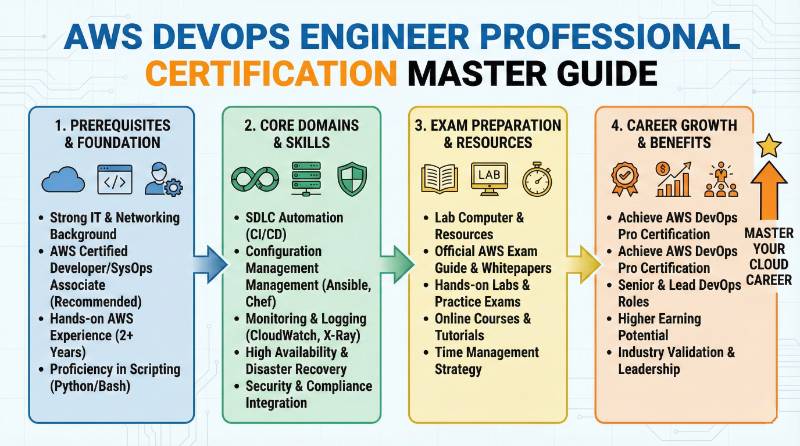
Introduction
Cloud-native engineering teams are under pressure to deliver features fast without breaking reliability, security, or costs. AWS DevOps Engineer – Professional sits exactly at this intersection of speed and stability.
This guide is written for working engineers, SREs, and managers who want to understand what this certification really covers, who should take it, how to prepare, and how it connects to long-term career paths like DevSecOps, SRE, AIOps, DataOps, and FinOps.
What is AWS DevOps Engineer – Professional?
AWS DevOps Engineer – Professional is an advanced-level AWS certification that validates your ability to build, operate, and automate production-grade systems on AWS.
It focuses on CI/CD, Infrastructure as Code, monitoring and logging, incident response, security, and compliance for distributed applications running at scale on AWS.
Why this certification matters for engineers and managers
- It proves that you can design and run automated delivery pipelines, not just write code.
- It shows you understand high availability, resilience, and cost-aware operations in real AWS environments.
- For managers, it is a strong signal that you can lead cloud transformation, standardize practices, and mentor teams across projects.
A strong DevOps certification like this also fits the wider “top certifications for software engineers” landscape where cloud, security, and data-focused credentials are highly valued.
AWS DevOps Engineer – Professional
What it is
AWS DevOps Engineer – Professional is an advanced AWS certification for engineers who design, automate, and operate production systems on AWS.
It proves that you can implement CI/CD, Infrastructure as Code, observability, incident response, and security controls across complex, distributed workloads.
Who should take it
- DevOps Engineers running CI/CD and environments on AWS
- SRE and Platform Engineers responsible for reliability and automation
- Senior Developers moving from pure coding into DevOps, SRE, or platform roles
- Cloud Engineers and Engineering Managers standardizing DevOps practices across teams
Skills you’ll gain
- Designing and implementing CI/CD pipelines on AWS (CodeCommit, CodeBuild, CodeDeploy, CodePipeline, and related tools)
- Infrastructure as Code using CloudFormation, CDK, and related services
- Observability: centralized logging, metrics, tracing, alerts, dashboards, and event-driven automation
- Building resilient and highly available architectures with automated failover and recovery
- Security and compliance automation, including policies, guardrails, and continuous validation
- Incident and event response playbooks, runbooks, and auto-remediation workflows
Real-world projects you should be able to do after it
- Build an end-to-end CI/CD pipeline with automated tests, blue/green or canary deployments, and rollback for microservices on AWS.
- Model complete environments (networking, compute, databases, observability) using Infrastructure as Code and deploy them repeatably across multiple accounts.
- Design centralized logging and metrics with automated alerts and Lambda-based self-healing actions for critical services.
- Implement security controls like IAM guardrails, encryption, and compliance checks integrated into pipelines and operations workflows.
Preparation plan (7–14 / 30 / 60 days)
If you already work daily on AWS (7–14 days intensive)
- Review the official exam guide and domain breakdown thoroughly.
- Map each domain to your current projects; write down real examples of CI/CD, IaC, monitoring, and incidents you handled.
- Do focused practice tests on weak domains (for example, SDLC automation or security/compliance) and revisit relevant AWS services.
If you have some AWS and DevOps experience (30 days)
- Week 1: Revise core AWS services (EC2, ECS/EKS, Lambda, RDS, VPC, IAM, S3, CloudWatch, CloudTrail) with a DevOps lens.
- Week 2: Build hands-on labs for CI/CD, Infrastructure as Code, and monitoring/logging.
- Week 3: Practice scenario-based questions, review whitepapers and sample architectures.
- Week 4: Full-length mock exams, error review, and light revision.
If you are still building DevOps depth (60 days)
- Month 1: Strengthen fundamentals in Linux, Git, scripting, containers, and basic AWS operations, plus Cloud Practitioner / Associate-level understanding.
- Month 2: Focus on advanced AWS DevOps topics: multi-account patterns, security automation, complex CI/CD, and large-scale monitoring.
- Final 2 weeks: Practice exams, revision, and consolidating runbook-style notes.
Common mistakes
- Treating it as a theory exam instead of a scenario-based, architecture-and-operations exam.
- Ignoring monitoring, incident response, and cost-conscious design while over-focusing only on pipelines.
- Weak understanding of IAM, security policies, and compliance automation.
- Not practicing multi-account, multi-region architectures and real failure scenarios.
- Relying only on practice questions without doing hands-on labs.
Best next certification after this
Using the “top certifications for software engineers” style thinking, you can branch into three directions:
- Same track / deepen DevOps
- Cross-track / widen scope
- Leadership / management
- Certified DevOps Manager or similar leadership-level certifications that focus on transformation, stakeholder management, and scaling DevOps across teams.
Certifications table
Below is a single consolidated table for this blog, centered on AWS DevOps Engineer – Professional and how it fits into a broader path. The external certification names and patterns are aligned with a “top certifications for software engineers” style roadmap.
| Certification / Track | Level | Who it’s for | Prerequisites (recommended) | Skills covered | Recommended order in career |
|---|---|---|---|---|---|
| AWS DevOps Engineer – Professional (AWS) | Professional | DevOps, SRE, Platform, Cloud Engineers, Senior Developers, Managers | Solid AWS experience, CI/CD basics, Linux, scripting, at least one associate-level AWS cert | CI/CD on AWS, IaC, monitoring and logging, incident response, security and compliance, resilient architectures | After 1–2 AWS associate-level or strong AWS project experience |
| Certified DevOps Professional (CDP) | Professional | Software engineers shifting to DevOps roles, automation-focused engineers | Linux, Git, CI/CD fundamentals | Core DevOps principles, pipelines, config management, containers, basic cloud operations | Often first serious DevOps certification |
| Certified DevOps Engineer (CDE) | Professional | Working DevOps engineers, SREs, platform engineers | CDP-level skills or equivalent | End-to-end CI/CD, environment automation, monitoring basics, collaboration with developers and ops | After CDP or equivalent experience |
| Certified DevOps Architect (CDA) | Advanced | Senior engineers, architects, and managers designing DevOps at scale | Strong DevOps background, experience with multiple tools and cloud | DevOps architecture, governance, toolchain selection, multi-team patterns, security and compliance integration | After DevOps Engineer / AWS DevOps Pro |
| DevSecOps Certified Professional (DSOCP) | Professional | DevOps engineers, security engineers, and SREs adding security depth | DevOps basics, application security awareness | Integrating security into pipelines, automated security testing, policy-as-code, secure architectures | Parallel or after DevOps Engineer level |
| Certified DevOps Manager (CDM) | Leadership | Engineering managers, senior leads, program owners for DevOps transformation | Solid DevOps background, team leadership experience | Scaling DevOps, org design, metrics and governance, stakeholder management, budgeting and roadmap | After architect/engineer-level certs |
Choose your path: 6 learning paths
You can position AWS DevOps Engineer – Professional as a central piece in different career paths.
1. DevOps path
- Start with fundamental DevOps certification (for example, Certified DevOps Professional).
- Move to role-focused certification (Certified DevOps Engineer, AWS DevOps Engineer – Professional).
- Grow into architecture and leadership (Certified DevOps Architect, Certified DevOps Manager).
2. DevSecOps path
- Build DevOps foundation (CDP / CDE + AWS DevOps Engineer – Professional).
- Add DevSecOps Certified Professional to bring security into pipelines and architecture.
- Later, combine with security or cloud security certifications aligned with industry demand for secure engineering.
3. SRE path
- Use AWS DevOps Engineer – Professional to gain strong automation, monitoring, and incident skills.
- Add SRE-focused certifications or training that cover error budgets, SLOs, and reliability engineering.
- Progress toward platform or reliability architect roles in large-scale systems.
4. AIOps / MLOps path
- First, gain DevOps automation, pipelines, and monitoring foundations through AWS DevOps Engineer – Professional.
- Then learn AIOps tools and MLOps workflows to automate incident detection and model deployment.
- Align yourself with institutes that specialize in AiOps and MLOps tracks.
5. DataOps path
- Use DevOps skills to automate data pipelines, testing, and deployments.
- Complement with DataOps-focused training that connects DevOps principles to data engineering workflows.
- This combination is powerful for roles where data quality, speed, and governance matter.
6. FinOps path
- Combine AWS DevOps Engineer – Professional with a strong understanding of cloud cost models and monitoring.
- Add FinOps-focused training to learn cost optimization strategies, budgeting, and chargeback models.
- This makes you valuable in organizations where cloud spend and business value alignment are critical.
Role → Recommended certifications
Use this mapping as a practical “what should I do next?” view, aligned with certification patterns highlighted for software engineers.
| Role | Core focus | Recommended certifications path (example) |
|---|---|---|
| DevOps Engineer | CI/CD, automation, environments, releases | CDP → CDE → AWS DevOps Engineer – Professional → CDA |
| SRE | Reliability, SLOs, incidents, observability | CDP → AWS DevOps Engineer – Professional → SRE-focused training / certs |
| Platform Engineer | Internal platforms, tooling, self-service, governance | CDP → CDE → AWS DevOps Engineer – Professional → CDA |
| Cloud Engineer | Cloud infrastructure, deployments, configurations | AWS associate-level certs → AWS DevOps Engineer – Professional → cloud architect-level certifications |
| Security Engineer | App and cloud security, secure pipelines | DevSecOps Certified Professional → AWS DevOps Engineer – Professional → security-focused certifications |
| Data Engineer | Data pipelines, ETL, orchestration | CDP → DataOps-focused training → AWS and data-engineering certifications |
| FinOps Practitioner | Cloud financial management, optimization, governance | CDP or cloud foundation → FinOps-focused programs → AWS DevOps Engineer – Professional for technical depth |
| Engineering Manager | Teams, delivery, reliability, transformation | CDP → AWS DevOps Engineer – Professional → CDA → Certified DevOps Manager |
Training cum certification institutions (3–4 lines each)
You can highlight these institutions as ecosystem partners for AWS DevOps Engineer – Professional and related DevOps certifications.
- DevOpsSchool:
DevOpsSchool offers structured, hands-on training programs for AWS DevOps Engineer – Professional and other DevOps certifications, with labs, projects, and interview preparation.
Their ecosystem covers DevOps, SRE, DevSecOps, AIOps, DataOps, and FinOps, making it suitable for engineers planning long-term multi-track growth. - Cotocus:
Cotocus focuses on corporate-grade training that aligns closely with real project environments and enterprise constraints.
Their programs help teams adopt DevOps, cloud, and related practices at scale, often combining AWS DevOps preparation with organization-specific scenarios. - Scmgalaxy:
Scmgalaxy is known as a community-driven platform with strong roots in source code management, CI/CD, and foundational DevOps skills.
It is a good option for engineers who want deep coverage of version control, build automation, and practical DevOps implementation patterns. - BestDevOps: BestDevOps acts as a hub that aggregates training opportunities, community content, and resources across DevOps and related domains.
Learners interested in AWS DevOps Engineer – Professional can use it as a discovery and comparison point for courses, tools, and practice material. - devsecopsschool.com: This platform specializes in DevSecOps, helping DevOps and security professionals integrate security into every stage of the pipeline.
Pairing AWS DevOps Engineer – Professional with DevSecOps programs from here creates a strong profile for secure cloud engineering roles. - aiopsschool.com: Aiopsschool focuses on AIOps, teaching how to use machine learning and automation to detect, predict, and remediate issues in complex systems.
DevOps and SRE professionals can use this training to extend their AWS DevOps skill set into intelligent operations. - dataopsschool.com: Dataopsschool teaches how to apply DevOps-style practices to data pipelines, analytics, and data platforms.
Combined with AWS DevOps Engineer – Professional, it prepares engineers for data-heavy, cloud-native environments where speed and quality both matter. - finopsschool.com: Finopsschool focuses on the financial side of cloud engineering, covering cost optimization, allocation, and governance.
Engineers and managers who have strong DevOps and AWS skills can use this to lead cost-aware, value-driven cloud initiatives.
Next certifications to take after AWS DevOps Engineer – Professional
Using the Gurukul Galaxy “top certifications for software engineers” style categories, you can position next steps as:
- Same track (double down on DevOps)
- Certified DevOps Architect (CDA) to design organization-wide DevOps architectures, toolchains, and governance.
- Cross-track (add a complementary specialty)
- Leadership (move into management and strategy)
- Certified DevOps Manager or similar leadership certifications that focus on scaling DevOps, managing roadmaps, and aligning with business outcomes.
Frequantly Asked Questions
1. Is AWS DevOps Engineer – Professional very difficult?
This exam is considered challenging because it tests real-world scenarios across CI/CD, Infrastructure as Code, monitoring, security, and incident response, not just definitions.
With focused study, hands-on labs, and good AWS experience, it becomes very achievable for working engineers.
2. How long does it take to prepare?
If you are already strong in AWS and DevOps, 2–4 weeks of focused preparation can be enough.
If you are still building depth, plan for 1–2 months to cover gaps, do labs, and complete several practice exams.
3. Do I need an AWS associate certification first?
It is not mandatory, but having at least one associate-level AWS certification or equivalent experience makes the professional-level exam significantly easier.
You should already be comfortable with core AWS services and basic automation before attempting this exam.
4. Is this certification worth it for software engineers?
Yes, it is valuable for software engineers who want to move into DevOps, SRE, or platform roles because it proves you can deliver and operate software, not just write it.
It also aligns well with broader market demand for cloud and DevOps skills highlighted in top certification lists.
5. What roles can I target after this certification?
Common roles include DevOps Engineer, SRE, Platform Engineer, Cloud Engineer, and, over time, DevOps Architect or Engineering Manager.
Your actual role will depend on your previous experience and how you apply the skills in real projects.
6. What are the key topics I must master?
You must be strong in CI/CD, Infrastructure as Code, monitoring and logging, incident and event response, security and compliance, and resilient architectures on AWS.
Understanding multi-account strategies, automation patterns, and cost-conscious operations is also important.
7. Can freshers attempt AWS DevOps Engineer – Professional?
Freshers can study for it, but the exam assumes significant hands-on experience with AWS and DevOps practices.
For most freshers, it is better to start with foundational DevOps and AWS associate-level certifications before attempting the professional-level exam.
8. How does this certification compare to generic DevOps certifications?
Generic DevOps certifications focus on principles and common tools, while AWS DevOps Engineer – Professional is deeply tied to AWS services and patterns.
If your projects are on AWS, this certification gives more directly applicable skills and credibility.
9. Is hands-on practice mandatory, or can I rely on theory?
Hands-on practice is almost mandatory; many exam questions describe realistic scenarios and architectures that you answer best when you have built similar systems.
Treat labs and mini-projects as preparation for both the exam and your day-to-day work.
10. How does this help with DevSecOps, SRE, or DataOps careers?
It builds strong automation, observability, and operations fundamentals that are common across DevSecOps, SRE, and DataOps roles.
You can then layer specialized certifications like DevSecOps Certified Professional, SRE, or DataOps-focused programs on top.
11. What kind of salary impact can I expect?
While exact numbers depend on location and company, cloud and DevOps certifications are consistently associated with higher salary ranges and more senior responsibilities.
The real impact comes when you combine the certification with visible project outcomes such as successful migrations, improved reliability, or optimized cloud spend.
12. How often does the exam content change?
AWS periodically updates exam versions and blueprints to reflect new services, patterns, and best practices.
Always rely on the latest official exam guide and current training material when planning your preparation.
Conclusion
AWS DevOps Engineer – Professional is a powerful milestone for engineers and managers who want to move from “just deploying on AWS” to designing and operating reliable, automated, and secure cloud platforms.
It fits naturally into broader DevOps, DevSecOps, SRE, AIOps, DataOps, and FinOps career paths, and pairs well with complementary certifications in architecture, security, and leadership to create long-term growth opportunities.
Leave a Reply