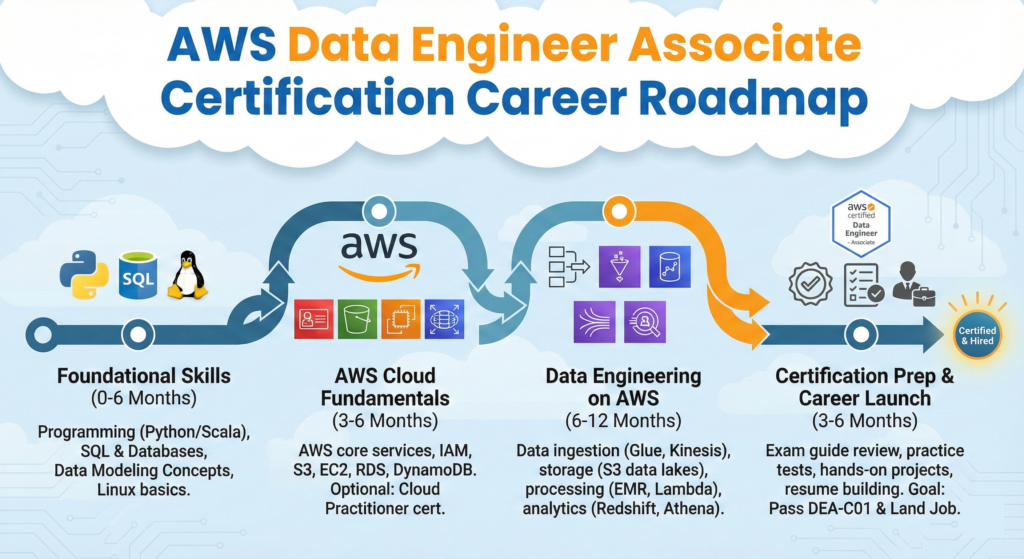
Introduction
The cloud has fundamentally changed how we treat data. It is no longer a static asset sitting in a silo; it is a high-velocity stream that drives business logic in real-time. Having spent the last twenty years watching the industry shift from physical racks to automated serverless pipelines, I can tell you that the AWS Certified Data Engineer – Associate is one of the most practical benchmarks released in recent years.
This guide is for the software engineers, SREs, and managers who need to move past the “basics” and start building production-ready data ecosystems.
Understanding the Certification: AWS Certified Data Engineer – Associate
What it is
This certification validates your ability to ingest, transform, and orchestrate data using AWS services. It focuses on building resilient pipelines and ensuring data quality while maintaining cost-efficiency and security.
Who should take it
Software engineers transitioning into data roles, current data engineers looking to validate their AWS expertise, and technical managers who need to oversee data-driven architectural decisions.
Skills you’ll gain
- Designing and implementing scalable ETL (Extract, Transform, Load) pipelines.
- Mastering data orchestration with AWS Step Functions and Amazon MWAA.
- Implementing fine-grained security and governance using AWS Lake Formation.
- Optimizing storage costs and query performance in Amazon S3 and Redshift.
Real-world projects you should be able to do after it
- Serverless Data Lake: Build a multi-tier data lake that automatically catalogs and partitions incoming data.
- Real-time IoT Streaming: Ingest millions of events per second via Amazon Kinesis for immediate analytics.
- Automated Compliance: Setup automated PII (Personally Identifiable Information) detection within your data pipelines.
Preparation Plan: Choose Your Speed
7–14 Days (The Expert Sprint)
If you already manage AWS Glue or Redshift daily, focus on “gap-filling.” Spend your time on the AWS Official Question Set and deep-dive into the security domains (IAM and KMS) which are often the trickiest for practitioners.
30 Days (The Professional Path)
Spend the first two weeks on hands-on labs for every major service. Devote the remaining two weeks to understanding the “trade-offs”—when to use Kinesis vs. MSK, or Glue vs. EMR.
60 Days (The Foundation Journey)
Ideal for software engineers new to the data stack. Spend month one building small, end-to-end pipelines. Spend month two on theoretical mastery, focusing on whitepapers and mock exams to sharpen your scenario-based thinking.
Common Mistakes to Avoid
- Over-Engineering: Choosing EMR for a task that a simple Glue job or even a Lambda function could handle more cheaply.
- Neglecting Security: Many fail because they focus only on the “flow” and forget how to secure the “storage” with encryption and Lake Formation.
- Ignoring Cost: The exam tests your ability to provide the most cost-effective solution, not just the one that works.
Best next certification after this: AWS Certified Data Analytics – Specialty (for deep-dive analytics) or AWS Certified Security – Specialty.
Comprehensive Certification Table
| Track | Level | Who it’s for | Prerequisites | Skills Covered | Recommended Order |
| Data Engineering | Associate | Engineers & Managers | Basic AWS Knowledge | Ingestion, ETL, Governance | After Solutions Architect |
| DevOps | Professional | SREs & DevOps | Associate Level Cert | CI/CD, Automation, SDLC | After Data Associate |
| Solutions Architect | Associate | All Engineers | None | Global Infrastructure, Security | Before Data Associate |
| Data Analytics | Specialty | Senior Data Leads | Associate Level Cert | Visualization, Modeling | After Data Associate |
Choose Your Path: 6 Learning Journeys
- DevOps Path:
Focus on Infrastructure as Code (IaC). Learn to deploy your data pipelines using Terraform and automate testing via Jenkins. - DevSecOps Path:
Prioritize security at every hop. Implement automated vulnerability scanning and data-at-rest encryption by default. - SRE Path:
Focus on reliability. Build self-healing pipelines that alert on latency spikes and automatically retry failed data jobs. - AIOps/MLOps Path:
Bridge the gap between data and AI. Use your pipelines to feed high-quality data into Amazon SageMaker training jobs. - DataOps Path:
Streamline the data lifecycle. Focus on versioning data and maintaining consistency across staging and production environments. - FinOps Path:
Master cloud economics. Use AWS Cost Explorer and tagging strategies to ensure your data storage doesn’t exceed the budget.
Role → Recommended Certifications Mapping
- DevOps Engineer: AWS Certified DevOps Engineer – Professional, CDE (Certified DevOps Engineer).
- SRE: SRECP (Site Reliability Engineering Certified Professional), AWS SysOps – Associate.
- Platform Engineer: Certified Kubernetes Administrator (CKA), AWS Solutions Architect – Associate.
- Cloud Engineer: AWS Solutions Architect – Associate, HashiCorp Certified: Terraform Associate.
- Security Engineer: DSOCP (DevSecOps Certified Professional), AWS Certified Security – Specialty.
- Data Engineer: AWS Certified Data Engineer – Associate, DOCP (DataOps Certified Professional).
- FinOps Practitioner: Certified FinOps Professional, AWS Cloud Practitioner.
- Engineering Manager: CDM (Certified DevOps Manager), AWS Solutions Architect – Professional.
Top Training Institutions for Mastery
To clear this exam, you need more than just videos; you need a lab-heavy environment. These institutions specialize in hands-on cloud and data training:
- DevOpsSchool:
Offers comprehensive, instructor-led bootcamps with a focus on real-world data scenarios and career-aligned projects. - Cotocus:
Provides deep technical training specifically for corporate teams and engineers looking to bridge the gap between theory and industry execution. - Scmgalaxy:
A resource-rich community platform offering tutorials and certification paths for every major DevOps and Cloud domain. - DevSecOps School (devsecopsschool.com):
This domain focuses on integrating security directly into the CI/CD pipeline rather than treating it as a final hurdle. It prioritizes automated security scanning, identity management, and “Security as Code” to ensure that every software release is inherently protected from vulnerabilities. - SRE School (sreschool.com):
Site Reliability Engineering applies software engineering mindsets to system operations to create ultra-scalable and highly reliable software systems. It is centered around Service Level Objectives (SLOs), managing error budgets, and automating “toil” to ensure that manual intervention is minimized during system failures. - AIOps School (aiopsschool.com):
Artificial Intelligence for IT Operations uses big data, analytics, and machine learning to enhance and automate IT operational tasks. By analyzing massive volumes of log and performance data in real-time, AIOps identifies patterns, predicts potential outages, and provides automated root-cause analysis to reduce mean time to repair (MTTR). - DataOps School (dataopsschool.com):
This discipline brings the agility of DevOps to data management and analytics pipelines. It focuses on the automated orchestration, testing, and continuous deployment of data to ensure that data consumers (like analysts and AI models) always have access to high-quality, high-velocity data. - FinOps School (finopsschool.com):
Also known as Cloud Financial Management, this is the practice of bringing financial accountability to the variable spend model of the cloud. It involves a cultural shift where engineering, finance, and business teams collaborate to optimize cloud costs and ensure every dollar spent on infrastructure drives maximum business value.
FAQs: AWS Certified Data Engineer – Associate
1. How difficult is this exam?
It is moderately difficult. It is more specialized than the Solutions Architect Associate, meaning you need to know services like Glue and Redshift in much greater detail.
2. Is 2026 a good time to get this?
The demand for cloud data professionals is at an all-time high. This certification is currently one of the most sought-after credentials for software engineers.
3. Do I need to be a Python expert?
No, but you should be comfortable reading and writing basic SQL and Python (specifically for AWS Lambda and Glue Spark jobs).
4. How long is the certification valid?
It is valid for 3 years. You can recertify by taking the latest version of the exam.
5. What is the biggest career benefit?
It moves you from being a “generalist” to a “specialist.” In today’s market, specialists in data architecture command significantly higher salaries.
6. Can a Manager benefit from this?
Yes. It provides the technical vocabulary needed to lead data teams and verify that the architectures proposed by your engineers are cost-effective and secure.
7. Are there any prerequisites?
There are no formal prerequisites, but having 1–2 years of AWS experience is highly recommended.
8. How many questions are on the exam?
There are 65 questions, and you have 130 minutes to complete them.
Frequently Asked Questions
Core Certification FAQs
- Is the AWS Certified Data Engineer – Associate difficult?
It is considered the most challenging of the Associate-level exams. While it doesn’t require the broad architectural knowledge of a “Professional” cert, it demands a deep, surgical understanding of specific data services like AWS Glue, Redshift, and Lake Formation. - How much time is realistically needed for preparation?
For an active engineer with AWS exposure, 30 to 45 days is standard. If you are a manager or a developer transitioning from another field, plan for a solid 60 to 90 days to ensure you have enough hands-on lab time. - Do I need to pass the Cloud Practitioner or Solutions Architect first?
There are no mandatory prerequisites. However, starting with the Solutions Architect – Associate is a veteran move; it builds the “cloud fluency” that makes the Data Engineer exam much easier to digest. - What is the “secret” to passing on the first try?
Scenario-based thinking. AWS rarely asks what a service is; they ask which service solves a specific business problem (e.g., “Which tool provides the lowest latency for streaming 1TB of logs while keeping costs under $50?”). - What is the real-world value of this certification?
In today’s market, it acts as a high-signal filter for recruiters. It proves you aren’t just a “user” of AWS, but an “engineer” who can build cost-effective, secure, and production-grade data pipelines.
Career & Growth FAQs
- Will this certification help me get a job in 2026?
Absolutely. The intersection of Cloud, Data, and AI is the strongest hiring sector right now. This cert places you exactly at that intersection, especially as companies rush to build clean data foundations for Generative AI. - What is the average salary impact?
While it varies by region, certified Data Engineers typically see a 15% to 25% increase in compensation compared to non-certified peers. In major tech hubs, this often translates to roles in the $115k–$165k range. - Can a Manager benefit from a technical Associate cert?
Yes. Managers who understand the technical constraints of Glue or Redshift make better estimates, hire better talent, and aren’t easily “fooled” by overly complex architectural proposals. - How does this compare to the old Data Analytics Specialty? The Associate cert is more about the “plumbing” (moving and securing data), whereas the Specialty was about the “science” (analyzing and visualizing). Most engineers find the Associate cert more immediately applicable to their daily tasks.
- What should I do if I fail?
Don’t sweat it—even veterans fail. AWS provides a detailed score report showing which domains (e.g., Data Security or Ingestion) you were weak in. Spend 14 days hitting those specific labs and then retake. - Does the certification expire?
Yes, it is valid for three years. Recertifying ensures you stay current with the high-speed evolution of AWS services. - Is there a discount for multiple exams?
Yes. Once you pass your first AWS exam, you typically receive a 50% discount voucher in your AWS Certification account to use on your next attempt.
Next Certifications to Take
Based on global industry standards, once you have mastered the Data Engineer Associate, you should look at these three paths:
- Same Track: AWS Certified Machine Learning – Associate or Specialty. This allows you to not just move the data, but build the intelligence that uses it.
- Cross-Track: AWS Certified Solutions Architect – Professional. This provides the “big picture” of how data systems interact with networking and compute at scale.
- Leadership: PMP (Project Management Professional). For those moving into high-level management, this bridges the gap between technical execution and business strategy.
Conclusion
The journey to becoming a certified data engineer is about more than just a badge; it is about adopting a “pipeline-first” mindset. In my two decades of experience, I’ve found that the engineers who succeed are those who understand the lifecycle of data—from the moment it’s generated to the moment it yields a business insight. This certification is your blueprint for that success.
Would you like me to draft a custom 30-day study schedule specifically for your current role?
Leave a Reply