
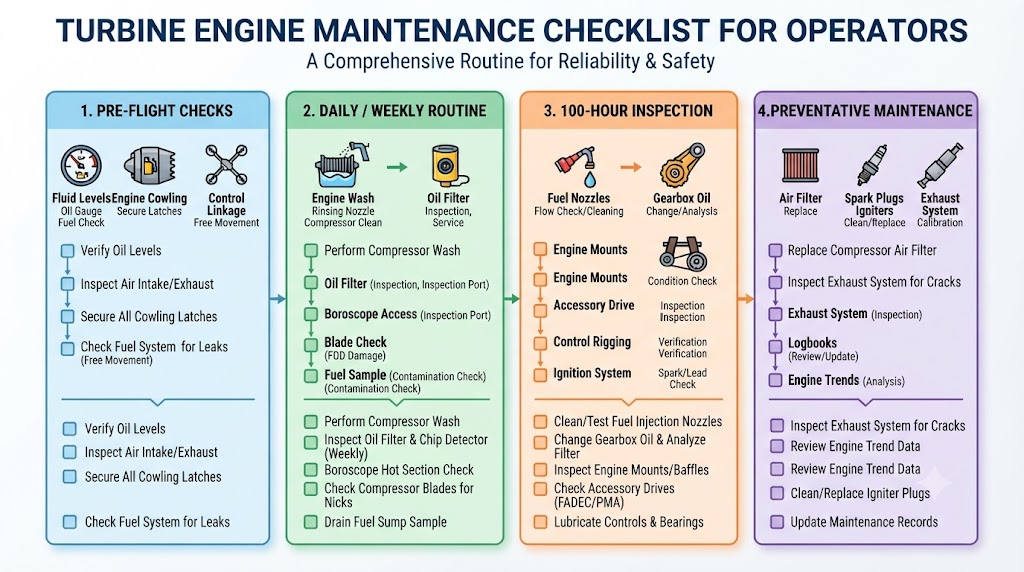
Turbine engines are designed for demanding aviation operations, but reliable performance depends on disciplined maintenance planning, accurate recordkeeping, and consistent monitoring. For aircraft operators, maintaining a structured turbine engine maintenance checklist can make it easier to track inspections, identify changing performance trends, organize maintenance records, and communicate effectively with qualified aviation maintenance professionals.
Turbine engines can differ substantially in design, components, operating characteristics, and maintenance requirements. Therefore, this checklist should be used as a planning and recordkeeping tool, not as a replacement for approved maintenance procedures or aircraft and engine manufacturer documentation.
Why Is Turbine Engine Maintenance Important?
A turbine engine contains numerous interconnected systems and components that operate under demanding conditions. Regular maintenance helps operators monitor the condition of these systems and ensure required maintenance is planned appropriately.
Effective maintenance management can help operators:
- Track scheduled maintenance
- Monitor engine performance
- Maintain accurate records
- Identify unusual trends
- Plan component replacements
- Coordinate maintenance efficiently
- Reduce avoidable scheduling problems
- Maintain better visibility into engine condition
The specific maintenance requirements always depend on the aircraft, engine model, operating environment, maintenance program, and applicable aviation requirements.
Understanding the Main Turbine Engine Sections
Before creating a maintenance checklist, operators should understand the basic areas of a turbine engine.
Depending on the engine design, major sections may include:
- Air inlet — Directs incoming air toward the compressor.
- Compressor — Increases the pressure of incoming air.
- Combustion section — Combines compressed air and fuel to produce hot gases.
- Turbine section — Extracts energy from the hot gases to drive the engine’s rotating components.
- Exhaust section — Directs gases away from the engine.
- Accessory systems — Support various engine functions.
- Engine control systems — Manage and regulate engine operation.
Not every turbine engine has the same configuration. Operators should become familiar with the specific engine installed on their aircraft.
1. Review the Applicable Maintenance Program
The first step in effective engine maintenance planning is understanding which requirements apply to the aircraft and engine.
Operators should organize information related to:
- Scheduled inspections
- Manufacturer maintenance instructions
- Applicable airworthiness requirements
- Component tracking
- Maintenance program requirements
- Engine records
- Inspection status
- Upcoming maintenance
Avoid relying on a generic maintenance schedule found online. The applicable aircraft and engine documentation should take priority.
2. Monitor Engine Operating Information
Regularly recorded engine information can help operators identify changes over time.
Depending on the aircraft and engine, relevant information may include:
- Engine temperature indications
- Pressure indications
- Engine speed
- Fuel consumption
- Oil consumption
- Vibration information
- Start characteristics
- Other manufacturer-specified parameters
The goal is to identify meaningful changes rather than focus on isolated numbers.
Operators should follow the engine manufacturer’s recommendations regarding which parameters should be monitored and how trends should be evaluated.
3. Turbine Engine Inspection Checklist
A high-level inspection checklist can help operators organize maintenance discussions.
General Engine Condition
- Review visible engine condition
- Check for obvious damage
- Look for signs of leakage
- Review external components
- Check for unusual conditions
- Review recent maintenance history
Inlet Area
- Review inlet condition
- Look for evidence of foreign-object damage
- Review applicable inspection status
- Record unusual observations
Exhaust Area
- Review visible exhaust condition
- Note unusual deposits or damage
- Review applicable inspection requirements
Accessories and Connections
- Review applicable accessory condition
- Review external lines and connections
- Check relevant maintenance records
These checks should not replace the detailed inspection procedures required by the aircraft and engine maintenance documentation.
4. Monitor the Engine Oil System
The lubrication system is an important part of turbine engine operation.
Operators should understand the applicable requirements concerning:
- Oil levels
- Oil consumption
- Oil condition
- Oil filters
- Chip detection systems where applicable
- Oil-system inspections
- Maintenance records
Changes in oil consumption or other unusual indications may warrant professional evaluation.
Operators should never assume that a particular oil specification or servicing procedure applies to every turbine engine.
5. Track Oil Consumption Trends
Rather than looking at individual observations in isolation, operators can maintain records that help identify trends.
A basic record can include:
| Information | Purpose |
|---|---|
| Operating hours | Establish usage |
| Oil consumption | Identify changes |
| Maintenance performed | Maintain history |
| Engine observations | Record abnormalities |
| Relevant inspection results | Support trend analysis |
If a trend changes noticeably, the operator should follow the applicable procedures and seek appropriate maintenance evaluation.
6. Monitor the Fuel System
Turbine engines depend on properly managed fuel systems.
Operators should maintain awareness of:
- Fuel-system maintenance
- Fuel quality
- Fuel contamination concerns
- Fuel filters
- Fuel-control components
- Applicable inspection requirements
- Related maintenance records
Fuel-system maintenance should always follow aircraft and engine-specific documentation.
Operators should not rely on generic fuel-system servicing information because configurations can differ significantly.
7. Monitor the Engine Inlet and Compressor Area
The inlet and compressor areas can be affected by environmental conditions and foreign-object exposure.
Operators should remain alert to:
- Visible damage
- Foreign-object damage
- Contamination
- Environmental exposure
- Unusual performance changes
- Applicable inspection requirements
The exact inspection process and acceptance criteria depend on the engine model.
Any suspected damage should be evaluated using appropriate maintenance procedures.
8. Pay Attention to the Turbine and Exhaust Areas
The turbine and exhaust sections operate in demanding conditions and are important areas of the overall engine maintenance program.
Operators may monitor for:
- Visible damage
- Unusual deposits
- Signs of deterioration
- Unusual exhaust appearance
- Changes in engine performance
- Applicable inspection status
Operators should not attempt to determine the serviceability of internal turbine components from visual observations alone.
Detailed evaluation should follow approved maintenance procedures.
9. Monitor Engine Performance
Performance monitoring is an important part of turbine engine maintenance planning.
Depending on the engine, operators may track:
- Engine speed
- Temperature indications
- Pressure indications
- Fuel consumption
- Oil consumption
- Vibration
- Start characteristics
Why Trend Monitoring Matters
A gradual change may provide useful maintenance information even when an engine continues to operate.
For example, operators can compare current information with established operating trends and report significant changes to maintenance personnel.
The applicable engine documentation should determine which parameters are relevant and how they should be interpreted.
10. Monitor Engine Vibration
Vibration can provide useful information about changes in engine condition.
Operators should:
- Know what normal operation looks like
- Monitor applicable vibration information
- Record unusual changes
- Report significant abnormalities
- Follow manufacturer guidance
Do not use generic vibration limits or internet-based diagnostic tables to determine whether an engine is safe to operate.
Aircraft and engine-specific information should be used instead.
11. Pay Attention to Engine Start Characteristics
Engine starts can provide useful operational information.
Operators may monitor for changes in:
- Start behavior
- Engine indications
- Temperature trends
- Starting time
- Unusual sounds
- Abnormal indications
A change in normal start behavior should be documented and addressed according to the applicable aircraft and engine procedures.
Operators should never substitute a generic starting procedure for the aircraft’s approved or applicable checklist.
12. Review Filters and Chip Detection Systems
Some turbine engines use systems designed to help identify contamination or wear.
These may include:
- Oil filters
- Fuel filters
- Screens
- Chip detectors
- Other monitoring systems
The maintenance team may use information from these components as part of an overall assessment of engine condition.
Operators should document applicable findings and ensure required follow-up is completed.
13. Monitor Engine Mounting and External Components
The engine installation includes components outside the engine itself that also deserve attention.
Depending on the aircraft, these may include:
- Engine mounts
- Mounting hardware
- External lines
- Hoses
- Wiring
- Connections
- Accessories
- Supporting components
Operators should be alert to visible damage, leakage, deterioration, or other unusual conditions.
Safety-critical components should be evaluated by appropriately qualified maintenance personnel.
14. Track Engine Components
Component tracking is an important part of maintenance planning.
Depending on the aircraft and engine, operators may need to track:
- Life-limited components
- Time-controlled components
- Inspection-controlled components
- Overhauled components
- Replacement components
- Engine accessories
A component-tracking system should identify relevant maintenance status and upcoming requirements.
Do not assume that one engine’s component limits apply to another engine.
15. Maintain Accurate Engine Records
Good records are essential for effective engine maintenance management.
Operators should retain applicable information about:
- Inspections
- Repairs
- Component replacements
- Engine changes
- Overhauls
- Maintenance actions
- Performance monitoring
- Applicable directives
- Manufacturer communications
- Parts documentation
Benefits of Good Records
Organized records can help operators:
- Plan upcoming maintenance
- Understand engine history
- Track components
- Communicate with maintenance providers
- Identify recurring issues
- Prepare for inspections
- Support future aircraft transactions
16. Create a Turbine Engine Maintenance Calendar
A maintenance calendar can help operators avoid missed requirements.
Include:
- Upcoming inspections
- Engine operating hours
- Component status
- Scheduled maintenance
- Performance reviews
- Documentation updates
- Planned engine work
- Maintenance appointments
Digital systems can be particularly useful for operators managing multiple aircraft or engines.
17. Turbine Engine Maintenance Checklist
Routine Monitoring
- Review applicable engine indications
- Monitor for unusual conditions
- Review visible external condition
- Monitor relevant oil information
- Track unusual vibration
- Record abnormal observations
Scheduled Maintenance
- Review upcoming inspection requirements
- Track applicable engine usage
- Review component status
- Confirm maintenance scheduling
- Coordinate with qualified maintenance personnel
Performance Monitoring
- Record applicable engine parameters
- Monitor performance trends
- Review fuel-consumption trends where applicable
- Review oil-consumption trends
- Monitor vibration trends where applicable
- Record unusual start characteristics
Documentation
- Update maintenance records
- Record component replacements
- Track applicable requirements
- Retain supporting documentation
- Review upcoming maintenance
- Maintain engine history
18. Common Turbine Engine Maintenance Mistakes
Ignoring Gradual Performance Changes
Operators may pay attention to obvious problems while overlooking gradual changes.
Better approach: Maintain appropriate records and review trends over time.
Missing Scheduled Maintenance
An overlooked maintenance requirement can create unnecessary operational and scheduling problems.
Better approach: Use a maintenance calendar and component-tracking system.
Poor Recordkeeping
Incomplete records make it more difficult to understand engine history.
Better approach: Update records consistently after applicable maintenance.
Treating Every Turbine Engine the Same
Different engine models can have significantly different maintenance requirements.
Better approach: Use model-specific documentation.
Ignoring Abnormal Indications
An unusual indication should not simply be dismissed because the aircraft continues to operate.
Better approach: Document the observation and follow the appropriate maintenance procedures.
Buying Unverified Components
An apparently suitable component may not be appropriate for a particular engine.
Better approach: Verify part identification, documentation, compatibility, and applicable requirements.
Relying on Memory
Operators manage numerous dates, components, and maintenance requirements.
Better approach: Use organized records and reminders.
19. How Operators Can Improve Maintenance Planning
Effective maintenance management does not have to be complicated.
Use Organized Records
Keep engine records in an easily accessible system.
Track Usage
Maintain appropriate records of engine operating time and other applicable usage measures.
Monitor Trends
Review relevant engine information instead of focusing only on individual observations.
Schedule Maintenance Early
Coordinate maintenance before requirements become urgent whenever practical.
Communicate With Maintenance Providers
Share relevant operational observations and records with qualified maintenance personnel.
Review Documentation
Keep applicable aircraft and engine documentation readily available and current.
Questions Operators Should Ask Their Maintenance Provider
Before or during maintenance planning, operators can ask:
- Which engine maintenance requirements are coming due?
- Are any tracked components approaching their applicable limits?
- Are there any significant performance trends we should monitor?
- What records should the operator maintain?
- Are there manufacturer communications relevant to this engine?
- Are there upcoming inspections that require advance scheduling?
- Are any replacement components likely to require advance planning?
- How should unusual engine indications be documented?
- What information should be provided after maintenance?
- Are there any recurring observations that deserve additional attention?
These questions can help operators maintain better communication with their maintenance teams.
Turbine Engine Maintenance Planning Table
| Maintenance Area | What Operators Should Track |
|---|---|
| Engine Condition | Visible condition and reported abnormalities |
| Performance | Applicable engine operating trends |
| Oil System | Relevant oil information and maintenance history |
| Fuel System | Applicable inspections and maintenance |
| Inlet | Damage or contamination observations |
| Turbine/Exhaust | Applicable inspection status and observations |
| Vibration | Relevant changes or trends |
| Components | Applicable life or inspection status |
| Records | Maintenance, repairs, and replacements |
| Scheduling | Upcoming inspections and maintenance |
Frequently Asked Questions
Q1. What does turbine engine maintenance involve?
It involves a structured program of inspections, monitoring, component tracking, maintenance actions, documentation, and performance review. Exact requirements depend on the specific aircraft and engine.
Q2. How often should turbine engines be inspected?
There is no single inspection schedule applicable to every turbine engine. Operators should follow the applicable maintenance program and aircraft and engine manufacturer documentation.
Q3. What should operators monitor between maintenance events?
Depending on the aircraft and engine, operators may monitor applicable engine indications, performance trends, oil information, vibration, start characteristics, and unusual conditions.
Q4. Why is turbine engine performance monitoring important?
Trend monitoring can help operators and maintenance professionals identify changes in engine behavior that may warrant further evaluation.
Q5. What records should operators maintain?
Applicable records may include inspections, repairs, component replacements, engine changes, maintenance actions, performance information, and supporting documentation.
Q6. Why is oil monitoring important?
Oil-system information can provide useful maintenance insight. Changes in oil consumption or other unusual indications may require appropriate professional evaluation.
Q7. Should operators monitor engine vibration?
Where applicable, vibration information can be useful for tracking changes in engine condition. Operators should use the monitoring methods and criteria specified for their particular aircraft and engine.
Q8. What should an operator do after noticing an abnormal engine indication?
The operator should follow the aircraft’s applicable procedures and contact appropriately qualified maintenance personnel as required. General online advice should not replace aircraft-specific procedures.
Q9. Why is component tracking important?
Component tracking helps operators understand the maintenance status of relevant parts and plan upcoming inspections, replacements, or other required work.
Q10. Can a general turbine engine checklist replace the maintenance manual?
No. A general checklist can help with organization and planning, but aircraft and engine-specific maintenance documentation and qualified maintenance procedures must take priority.
Final Thoughts
A well-organized turbine engine maintenance checklist helps operators manage one of the most important aspects of aircraft ownership and operation. The checklist can support routine monitoring, performance tracking, component management, maintenance scheduling, and accurate recordkeeping. The most important areas include engine condition, oil and fuel systems, performance trends, vibration, engine starts, components, mounting areas, scheduled inspections, and maintenance documentation. Operators should avoid treating a general checklist as a substitute for approved maintenance information. Turbine engines differ substantially in design and requirements, making aircraft- and engine-specific documentation essential.

