
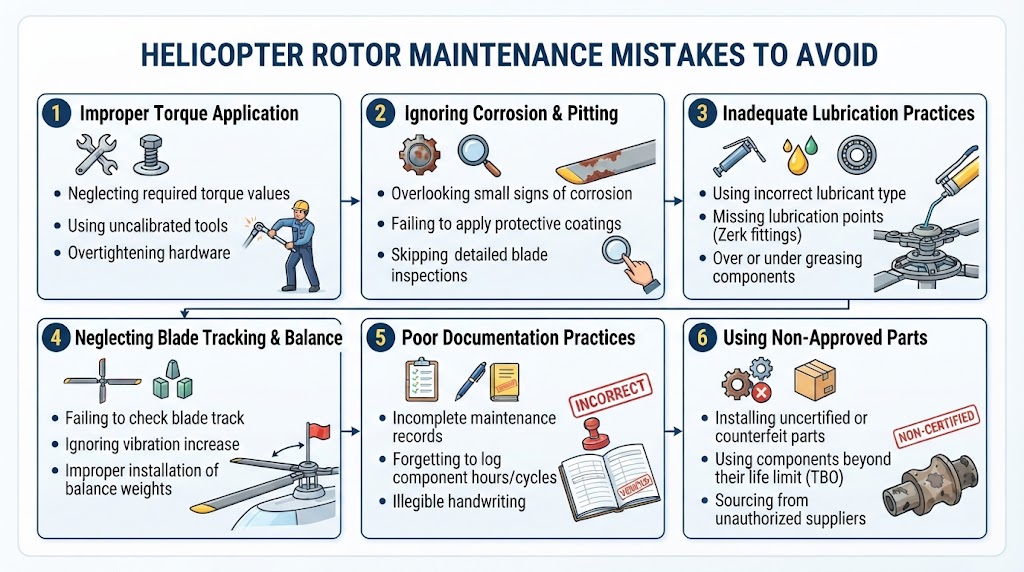
Helicopter rotor systems are among the most important components of a helicopter, making proper maintenance and inspection a critical part of responsible aircraft ownership. Rotor blades, hubs, bearings, controls, and related components must work together as intended.
Maintenance mistakes can occur when owners overlook documentation, delay inspections, ignore unusual aircraft behavior, or use components without confirming their suitability. Understanding these common mistakes can help helicopter owners and operators approach rotor maintenance more carefully and systematically.
Why Is Helicopter Rotor Maintenance Important?
The rotor system plays a central role in helicopter flight. It includes numerous components that require appropriate inspection, maintenance, and recordkeeping.
Depending on the helicopter, the rotor system may involve:
- Rotor blades
- Rotor hub
- Bearings
- Rotor controls
- Drive-related components
- Fasteners
- Associated hardware
- Supporting components
Each helicopter has its own maintenance requirements. Therefore, maintenance decisions should always be based on the applicable manufacturer’s documentation and appropriate aviation maintenance practices.
1. Ignoring Manufacturer Maintenance Documentation
One of the most important mistakes is failing to follow the documentation applicable to the specific helicopter and rotor system.
Manufacturer documentation can contain important information regarding:
- Inspections
- Maintenance
- Component limitations
- Service information
- Approved procedures
- Replacement components
- Configuration requirements
Generic aviation advice cannot replace aircraft-specific maintenance information.
When there is uncertainty, the appropriate documentation and qualified maintenance professionals should be consulted.
2. Skipping Required Inspections
Routine inspections are an important part of maintaining an aircraft.
A common mistake is assuming that an apparently normal rotor system does not require attention.
Depending on the helicopter and applicable requirements, maintenance programs may involve different types of inspections and checks.
Owners should maintain organized records showing:
- What was inspected
- When maintenance was performed
- What findings were recorded
- What corrective work was completed
- Which components were replaced
Inspection requirements vary, so owners should not rely on a generic schedule.
3. Overlooking Rotor Blade Condition
Rotor blades deserve careful attention because they are exposed to demanding operating conditions.
Potential areas of concern may include:
- Visible damage
- Surface deterioration
- Corrosion
- Cracks or defects
- Leading-edge condition
- Signs of previous repair
A casual visual check is not a substitute for an appropriate inspection.
If a pilot or owner notices something unusual, the aircraft should be evaluated according to the applicable maintenance procedures by an appropriately qualified professional.
4. Focusing Only on the Rotor Blades
Another mistake is treating the blades as the entire rotor system.
The rotor assembly can contain numerous interconnected components, including:
- Rotor hub
- Bearings
- Fasteners
- Controls
- Associated hardware
- Other system components
A maintenance program should consider the complete applicable system rather than focusing on only the most visible parts.
5. Ignoring Unusual Vibration
Changes in vibration can be an important maintenance observation.
Pilots may notice changes in:
- Vibration
- Noise
- Aircraft handling
- Control response
- Rotor behavior
These observations should not simply be dismissed as normal.
The appropriate response is to report the observation and have the helicopter evaluated through qualified maintenance procedures.
Trying to diagnose a rotor-system problem through guesswork can create unnecessary risk.
6. Using Incorrect Replacement Parts
Selecting a replacement component based solely on appearance or availability can create problems.
Two components may look similar while having different:
- Part numbers
- Specifications
- Applications
- Materials
- Configurations
- Manufacturer requirements
Before purchasing a replacement part, verify the information against the applicable documentation.
When compatibility is uncertain, seek professional guidance rather than assuming that a similar-looking component is acceptable.
7. Mixing Components Without Verifying Compatibility
Rotor systems are designed around specific configurations.
A component that works with one helicopter or rotor assembly may not necessarily be suitable for another.
Before replacing a component, consider:
- Helicopter model
- Rotor system
- Component part number
- Manufacturer
- Configuration
- Applicable documentation
Compatibility should be established through reliable technical information rather than visual comparison.
8. Neglecting Maintenance Records
Good records provide valuable information about an aircraft’s maintenance history.
Rotor-related records may contain information about:
- Inspections
- Repairs
- Component replacements
- Overhaul work
- Service history
- Previous findings
- Component identification
Poor recordkeeping can make it more difficult to understand the history of a rotor component.
Owners should keep applicable records organized and ensure that maintenance entries are properly documented.
9. Failing to Track Component History
Rotor components may have specific history and maintenance considerations.
Depending on the component, owners may need to understand information such as:
- Previous use
- Inspection history
- Maintenance performed
- Overhaul status where applicable
- Component identification
- Applicable limitations
Component requirements vary significantly, so owners should use the manufacturer’s applicable information rather than relying on generalized assumptions.
10. Delaying Action After Finding a Problem
A maintenance concern should not be ignored simply because the helicopter continues to operate.
If an inspection or operational observation identifies a potential issue, it should be appropriately documented and evaluated.
The proper approach generally involves:
- Recording the observation.
- Communicating it to the appropriate maintenance personnel.
- Consulting applicable documentation.
- Determining the appropriate maintenance action.
- Documenting completed corrective work.
The exact maintenance process depends on the helicopter and the nature of the finding.
11. Relying on Appearance Alone
A rotor component may appear acceptable from the outside while still requiring professional evaluation.
Photographs and casual observations cannot reliably establish:
- Internal condition
- Serviceability
- Material condition
- Previous repairs
- Complete maintenance history
- Compliance with applicable requirements
Visual appearance can be useful for identifying obvious concerns, but it should not be treated as proof that a component is suitable for service.
12. Using Improper Maintenance Practices
Rotor maintenance is not an area where improvised methods should be used.
Using inappropriate tools, procedures, materials, or techniques can affect aircraft components and maintenance quality.
Owners should ensure that maintenance is performed using:
- Appropriate technical documentation
- Suitable equipment
- Correct maintenance procedures
- Properly qualified personnel
Aircraft owners can play an important role in maintaining records and communicating observations, but technical maintenance should be handled according to applicable aviation requirements.
13. Neglecting Environmental Factors
The operating and storage environment can influence maintenance considerations.
Helicopters may be exposed to:
- Moisture
- Dust
- Salt
- Corrosive environments
- Temperature changes
- Outdoor storage conditions
Environmental exposure does not automatically indicate a problem, but it may influence inspection and maintenance considerations.
Owners should discuss relevant environmental conditions with qualified maintenance personnel and follow the applicable maintenance documentation.
14. Poor Communication Between Pilots and Maintenance Professionals
Pilots are often in a useful position to notice changes in aircraft behavior.
A pilot may observe:
- Unusual vibration
- New or unusual noises
- Changes in handling
- Unexpected control behavior
- Other differences from normal operation
These observations should be communicated clearly to maintenance personnel.
Useful information includes:
- What was observed
- When it occurred
- Whether it was repeated
- Under what circumstances it occurred
- Whether anything else seemed unusual
Clear communication can help maintenance professionals investigate the issue more effectively.
15. Ignoring Rotor System History When Buying a Helicopter
Rotor maintenance considerations should also be part of a helicopter purchase evaluation.
Potential buyers should review available information about:
- Rotor blade history
- Hub maintenance
- Component replacements
- Inspection records
- Repairs
- Overhaul information
- Maintenance documentation
A helicopter should not be evaluated solely on its appearance or overall flight hours.
Understanding the history of major components can provide valuable context before ownership changes.
16. Failing to Plan for Maintenance
Rotor maintenance should be part of an overall aircraft maintenance strategy.
Owners can improve organization by keeping track of:
- Upcoming inspections
- Maintenance records
- Component history
- Manufacturer information
- Previous findings
- Replacement planning
Good planning can help prevent maintenance from becoming a last-minute activity.
Helicopter Rotor Maintenance Checklist
Use this checklist as a general organizational guide:
- Review applicable manufacturer documentation.
- Keep inspection records organized.
- Track relevant component history.
- Review rotor blade condition through appropriate inspections.
- Consider the condition of the rotor hub and associated components.
- Report unusual vibration or noise.
- Verify replacement part numbers.
- Confirm component compatibility.
- Maintain accurate repair records.
- Consider environmental exposure.
- Communicate observations clearly to maintenance personnel.
- Address identified maintenance concerns appropriately.
- Use qualified aviation maintenance professionals.
- Keep applicable aircraft records current.
How to Build Better Rotor Maintenance Habits
Good maintenance habits begin with organization and consistency.
1. Know Your Aircraft
Understand the helicopter model, rotor system, and applicable documentation.
2. Keep Records Organized
Maintain relevant inspection, repair, replacement, and component records.
3. Pay Attention to Changes
Pilots and operators should take unusual vibration, noise, or handling changes seriously and report them appropriately.
4. Verify Replacement Components
Never assume that a similar-looking component is automatically suitable.
5. Follow Manufacturer Information
Use the documentation applicable to the particular helicopter and component.
6. Work With Qualified Professionals
Rotor-system maintenance should be handled according to applicable aviation requirements by appropriately qualified maintenance personnel.
7. Review Maintenance History Regularly
Understanding previous work can help owners and operators make better maintenance-planning decisions.
Rotor Maintenance Mistakes During Helicopter Ownership
Maintenance mistakes can happen at different stages of ownership.
During Routine Operation
Owners may overlook small changes in aircraft behavior or fail to communicate them.
During Maintenance Planning
An owner may forget to review applicable component history or upcoming maintenance requirements.
During Parts Purchasing
A buyer may order a component based on appearance rather than verifying the exact part number and compatibility.
During Recordkeeping
Incomplete records can make it difficult to establish the maintenance history of important components.
During Aircraft Sale or Purchase
Failure to review rotor-system documentation can leave buyers without a clear understanding of component history.
Recognizing these situations can help owners build a more organized maintenance process.
Questions to Ask Your Maintenance Professional
When discussing helicopter rotor maintenance, useful questions may include:
- What documentation applies to this rotor system?
- Are there any upcoming inspections?
- Are there component history items that need attention?
- What information should be recorded after maintenance?
- Is there anything unusual that requires further evaluation?
- Does a proposed replacement part match the required configuration?
- Are there environmental factors that deserve additional attention?
- Are there maintenance findings that should be monitored?
These questions can help owners better understand their aircraft without attempting to perform technical maintenance themselves.
Frequently Asked Questions
Q1. What are common helicopter rotor maintenance mistakes?
Common mistakes include ignoring manufacturer documentation, delaying inspections, overlooking unusual vibration, using incorrectly identified parts, neglecting maintenance records, and relying on visual appearance alone.
Q2. Why is rotor blade inspection important?
Rotor blades are critical components of the helicopter’s rotor system. Appropriate inspection can help identify conditions that require professional evaluation or maintenance.
Q3. How often should helicopter rotors be inspected?
There is no single inspection schedule that applies to every helicopter. Requirements depend on the helicopter, rotor system, components, manufacturer documentation, and applicable aviation requirements.
Q4. What should a pilot do if unusual vibration is noticed?
The observation should be communicated appropriately and evaluated through qualified maintenance procedures. Pilots should not attempt to diagnose or repair a rotor-system problem themselves.
Q5. Why are maintenance records important?
Records help establish what inspections, repairs, replacements, and other maintenance activities have occurred during the aircraft’s history.
Q6. Can similar-looking rotor parts be used as replacements?
Not necessarily. Appearance alone does not establish compatibility. The exact component should be verified against applicable technical information.
Q7. Why should qualified aviation maintenance professionals handle rotor maintenance?
Rotor systems are safety-critical aircraft components that require appropriate knowledge, procedures, equipment, and qualifications. Maintenance should follow applicable aviation requirements and manufacturer documentation.
Final Thoughts
Effective helicopter rotor maintenance requires more than occasionally checking the visible condition of the rotor blades. Owners and operators should pay attention to the entire rotor system, maintain accurate records, follow applicable manufacturer documentation, and communicate unusual aircraft behavior promptly. The most important mistakes to avoid include skipping inspections, ignoring vibration, using incorrectly identified components, overlooking maintenance history, and relying on assumptions instead of technical documentation. A well-organized maintenance approach, supported by appropriately qualified aviation professionals, can help helicopter owners better manage rotor-system care and maintain a clearer understanding of their aircraft’s maintenance history.

