
Introduction
Choosing the right jet and rotor services provider is an important decision for aircraft owners, operators, fleet managers, and aviation maintenance teams. Jets and rotorcraft are complex machines that require specialized inspection, repair, troubleshooting, documentation, and long-term maintenance planning. A poor service choice can lead to unexpected downtime, higher costs, incomplete records, reduced reliability, and safety concerns.
Jet systems and rotorcraft systems have different maintenance needs. Fixed-wing jet aircraft often require detailed engine, avionics, hydraulic, structural, and performance-related support, while helicopters and rotorcraft require careful attention to rotor systems, transmission components, vibration control, dynamic balancing, and operational stress. Because of this complexity, choosing a service provider should never be based only on price or availability. Aircraft owners and operators should ask the right questions before trusting any provider with their aircraft. A careful evaluation helps improve safety confidence, reduce downtime, protect aircraft value, and support reliable aviation operations.
Real-world Use Cases
A business jet operator may need quick turnaround maintenance before an important executive trip. In this situation, the service provider must be able to diagnose issues quickly, complete work properly, and provide clear documentation before the aircraft returns to service.
A helicopter operator may need rotor system inspection because rotor reliability directly affects safety and performance. A fleet manager may compare multiple providers to find one that can support different aircraft types, maintain records, and reduce downtime across the operation. An aircraft owner planning preventive maintenance may want a provider who can identify issues early instead of waiting for costly failures.
A corporate aviation client may also need dependable aircraft troubleshooting to keep travel schedules on track. These examples show why choosing the right jet and rotor service provider is essential for safe and efficient aircraft operations.
Evaluation Criteria for Choosing Jet and Rotor Services
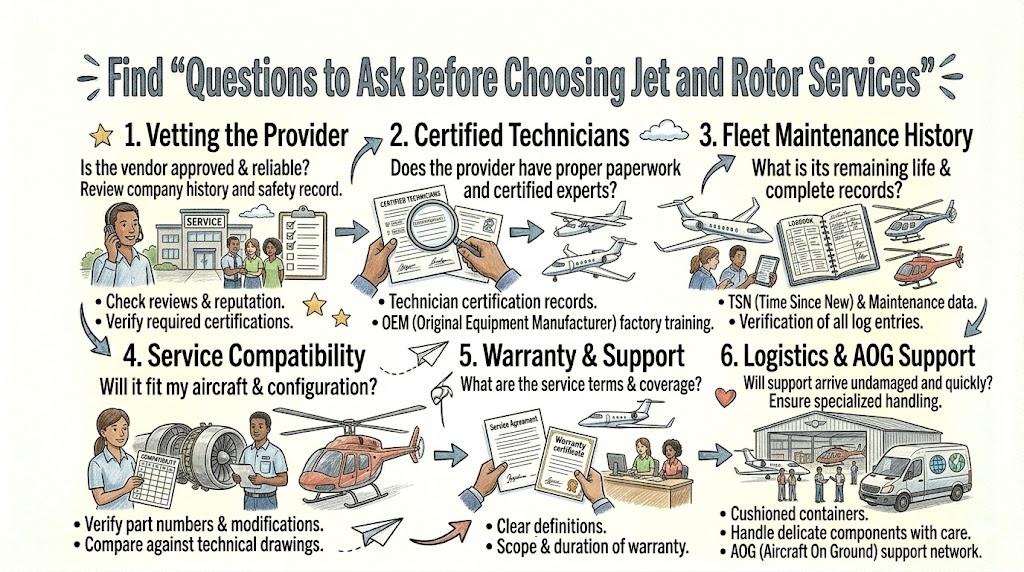
Before selecting a jet maintenance or rotorcraft maintenance provider, evaluate:
- Experience with your aircraft type
- Technician training and qualifications
- Jet and rotor system specialization
- Safety and compliance practices
- Inspection and troubleshooting capabilities
- Documentation and maintenance record quality
- Parts sourcing standards
- Turnaround time
- Emergency service support
- Preventive maintenance planning
- Pricing transparency
- Warranty or workmanship support
- Long-term fleet support capability
The best provider should combine technical skill, clear communication, reliable processes, and a strong safety-first mindset.
1- Does the Provider Have Experience with My Aircraft Type?
Aircraft experience matters because each jet or rotorcraft model has its own systems, maintenance requirements, inspection points, and operating characteristics. A provider familiar with your aircraft type can identify issues faster and recommend more accurate solutions.
For example, a business jet operator should choose a service team that understands the aircraft’s engine systems, avionics, hydraulics, and maintenance schedule. A helicopter operator should work with technicians who understand rotorcraft structures, rotor systems, and vibration-related concerns.
2- What Jet or Rotor Systems Do They Specialize In?
Not every aviation repair provider offers the same capabilities. Some may specialize in jet engine support, avionics, airframe inspection, rotor systems, hydraulic systems, or troubleshooting.
For example, if a helicopter has unusual vibration, the provider must understand rotor system support and diagnostic methods. If a jet has a performance or avionics issue, the provider should have the technical capability to troubleshoot that specific system accurately.
3- Are Technicians Properly Trained and Qualified?
Technician skill directly affects aircraft safety, repair quality, and long-term reliability. Qualified technicians understand inspection standards, repair procedures, safety practices, and aircraft-specific requirements.
For example, a maintenance team working on rotorcraft components must understand the importance of torque, alignment, dynamic balance, and inspection detail. Poor workmanship in these areas can create serious safety and performance issues.
4- What Safety and Compliance Standards Do They Follow?
A dependable aviation service provider should follow structured safety and compliance practices. This includes proper inspection procedures, approved maintenance methods, quality control, and accurate return-to-service practices.
For example, a fleet manager should ask how the provider ensures maintenance work is reviewed, documented, and completed according to required standards. Strong compliance practices reduce operational risk and improve confidence in the aircraft.
5- Do They Provide Inspection, Repair, Maintenance, and Troubleshooting Support?
A strong jet and rotor service provider should offer more than basic repair. Aircraft owners benefit when one provider can support inspections, scheduled maintenance, unscheduled repairs, troubleshooting, and preventive planning.
For example, if a corporate aircraft has a recurring system fault, the provider should not only repair the visible issue but also troubleshoot the root cause. Complete support saves time and reduces repeat maintenance events.
6- How Do They Handle Documentation and Maintenance Records?
Maintenance documentation is critical in aviation. Records show what work was performed, when it was completed, what parts were used, and who completed the service.
For example, an aircraft owner planning future resale or inspection review needs complete records. Poor documentation can reduce aircraft value, create compliance concerns, and make future troubleshooting more difficult.
7- What Is Their Turnaround Time for Service?
Downtime affects business schedules, charter operations, flight training, emergency missions, and private aircraft availability. A provider should give realistic turnaround estimates and communicate clearly if timelines change.
For example, a business jet operator with a tight travel schedule needs accurate expectations. A fast promise is not enough; the provider must balance speed with quality and safety.
8- Do They Use Approved Parts and Reliable Suppliers?
The quality of parts used in aircraft maintenance directly affects safety and reliability. A strong provider should source parts from trusted aviation suppliers and maintain proper documentation.
For example, if a rotorcraft component needs replacement, the provider should confirm part compatibility, traceability, and suitability for the aircraft. Using questionable parts can create safety risks and future maintenance problems.
9- Can They Support Emergency or Time-Sensitive Service Needs?
Aircraft issues do not always happen at convenient times. Operators may need urgent troubleshooting, rapid inspection, or time-sensitive maintenance support.
For example, a corporate aviation client may need a jet ready for an important trip within a limited time window. A provider with emergency support capability can help reduce disruption while still maintaining safety standards.
10- What Diagnostic Tools and Technical Capabilities Do They Have?
Modern aircraft systems often require advanced diagnostic tools, technical manuals, test equipment, and skilled interpretation. A provider should have the tools needed to identify problems accurately.
For example, avionics faults, engine performance issues, hydraulic problems, or rotor vibration concerns may require specialized equipment. Accurate diagnostics prevent unnecessary part replacement and reduce repeated maintenance visits.
11- Do They Offer Preventive Maintenance Planning?
Preventive maintenance helps aircraft owners identify potential issues before they become major problems. A strong provider should help plan inspections, component checks, service intervals, and future maintenance needs.
For example, a fleet manager can reduce downtime by planning maintenance around operational schedules instead of waiting for unexpected failures. Preventive planning improves reliability and cost control.
12- How Transparent Is Their Pricing and Service Scope?
Clear pricing and service scope prevent misunderstandings. A professional provider should explain labor, parts, inspection charges, troubleshooting fees, additional work approvals, and possible timeline changes.
For example, an aircraft owner should know whether a quote includes only inspection or also minor repairs, documentation, parts, and follow-up checks. Transparent pricing helps avoid surprise costs.
13- What Warranty or Workmanship Support Is Offered?
Warranty or workmanship support shows that a provider stands behind its service quality. Buyers should ask what support is available if an issue appears after maintenance.
For example, if a repair does not resolve a recurring problem, the owner should know how the provider handles follow-up evaluation. Clear support policies create trust and accountability.
14- Can They Support Long-Term Fleet Maintenance Needs?
Fleet operators need consistency, planning, documentation, and scalable support. A provider that can handle long-term fleet maintenance may offer better coordination, fewer delays, and more predictable service quality.
For example, a fleet manager operating both jets and rotorcraft may need one trusted partner who understands aircraft availability, maintenance scheduling, inventory planning, and record management.
Benefits of Asking the Right Questions
Asking the right questions before choosing jet and rotor services helps aircraft owners and operators:
- Improve safety confidence
- Reduce operational risk
- Minimize downtime
- Maintain better records
- Improve system reliability
- Control maintenance costs
- Protect aircraft value
- Improve repair quality
- Build stronger service partnerships
- Plan maintenance more effectively
A careful selection process helps ensure the service provider can support both immediate repairs and long-term aircraft reliability.
Informed vs Uninformed Aviation Service Selection
| Factor | Informed Service Selection | Uninformed Service Selection |
|---|---|---|
| Safety Confidence | Provider qualifications are reviewed | Safety may be assumed |
| Service Quality | Capabilities are matched to aircraft needs | Service fit may be uncertain |
| Downtime Control | Turnaround time and planning are discussed | Delays may become unexpected |
| Maintenance Documentation | Records process is confirmed | Records may be incomplete |
| Cost Predictability | Pricing and scope are clear | Surprise costs are more likely |
| Aircraft Reliability | Preventive planning is included | Recurring issues may continue |
| Long-Term Value | Aircraft records and condition are protected | Value may be affected later |
Practical Tips Before Choosing Jet and Rotor Services
Verify Provider Experience
Ask whether the provider has worked on your aircraft type, system, or operational category before. Experience with similar aircraft can improve troubleshooting accuracy and service quality.
Review Service Capabilities
Do not assume every provider can handle every system. Ask about jet maintenance, rotorcraft maintenance, inspections, avionics, engine support, structural repair, troubleshooting, and preventive maintenance.
Compare More Than Price
Price matters, but aviation repair services should be evaluated through safety, quality, documentation, reliability, and provider capability. The lowest-cost provider may not always offer the best long-term value.
Evaluate Safety and Documentation Practices
Ask how work is inspected, recorded, reviewed, and returned to service. Strong documentation helps protect compliance, resale value, and maintenance confidence.
Plan Preventive Maintenance
Work with a provider who helps schedule inspections and maintenance before problems become costly. Preventive planning reduces unexpected downtime.
Ask About Parts Sourcing
Confirm that parts are suitable, properly documented, and sourced from reliable aviation suppliers. This is especially important for safety-critical systems.
Build a Long-Term Service Relationship
A long-term service provider becomes familiar with your aircraft history, common issues, operating patterns, and maintenance needs. This can improve efficiency and trust over time.
Keep Communication Clear
A good provider should explain findings, options, timelines, costs, and risks in clear language. Good communication prevents confusion and supports better decisions.
Why Choosing Based Only on Price Can Be Risky
Choosing jet and rotor services based only on the lowest price can create problems later. Low-cost work may seem attractive upfront, but poor diagnostics, weak documentation, unqualified labor, or unreliable parts can lead to repeat repairs, downtime, and safety concerns.
Aircraft maintenance should always prioritize safety, technical capability, and long-term reliability. A slightly higher-quality service provider may save money over time by reducing repeat issues and protecting aircraft value.
How Preventive Maintenance Reduces Downtime
Preventive maintenance helps identify wear, system changes, fluid leaks, vibration concerns, electrical faults, and component issues before they become serious. For jets, this may involve engine checks, avionics inspections, hydraulic system reviews, and airframe evaluations. For rotorcraft, this may include rotor system inspections, vibration monitoring, gearbox checks, and structural assessments.
By planning maintenance ahead of time, operators can schedule service during less disruptive periods and avoid unexpected grounding. This is especially valuable for business aviation, charter operations, emergency services, flight schools, and fleet operators.
What Strong Aviation Service Communication Looks Like
A professional jet and rotor service provider should communicate clearly at each stage of the process. Before work begins, they should explain inspection scope, estimated cost, timeline, and possible findings. During service, they should update the owner or operator if additional issues are discovered. After service, they should provide clear documentation, explain completed work, and recommend future maintenance if needed.
Strong communication helps aircraft owners make informed decisions and avoid uncertainty during maintenance.
FAQs
1- What do jet and rotor services include?
Jet and rotor services may include inspection, maintenance, repair, troubleshooting, preventive planning, parts replacement, documentation, and system support. The exact services depend on the provider’s capabilities and the aircraft type.
2- How do I choose the right jet and rotor service provider?
Choose a provider with experience in your aircraft type, trained technicians, strong documentation practices, reliable parts sourcing, clear pricing, and a safety-first approach. Avoid selecting based only on low price.
3- Why are technician qualifications important?
Technician qualifications matter because aircraft systems are complex and safety-critical. Properly trained technicians reduce repair errors, improve troubleshooting accuracy, and support reliable aircraft operation.
4- What makes rotor system maintenance different?
Rotor system maintenance requires special attention to blades, hubs, transmission systems, vibration, balance, and dynamic components. Rotorcraft systems operate under unique stresses and need specialized expertise.
5- What should I ask about jet maintenance support?
Ask about engine support, avionics troubleshooting, hydraulic systems, airframe inspection, documentation, parts sourcing, turnaround time, and preventive maintenance planning.
6- Why are maintenance records important?
Maintenance records show what work was completed, what parts were used, and when service was performed. Good records support safety, compliance, resale value, and future troubleshooting.
7- How can a provider help reduce aircraft downtime?
A provider can reduce downtime through accurate diagnostics, preventive maintenance planning, reliable parts sourcing, clear scheduling, and efficient repair processes. Good communication also helps avoid unnecessary delays.
8- Why is preventive maintenance important?
Preventive maintenance helps identify problems before they become serious. It improves reliability, reduces unexpected failures, supports safety, and helps operators plan maintenance around flight schedules.
9- How important is pricing transparency?
Pricing transparency is very important because aircraft maintenance can involve labor, parts, inspections, troubleshooting, and additional findings. Clear scope and cost details help owners avoid surprise expenses.
10- What common mistakes should I avoid when choosing aviation services?
Common mistakes include choosing only by price, ignoring technician qualifications, skipping documentation review, not checking provider experience, overlooking parts sourcing, and failing to ask about turnaround time or preventive planning.
Conclusion
Choosing the right jet and rotor services provider is essential for safe, reliable, and cost-effective aircraft operations. Jets and rotorcraft require specialized knowledge, accurate diagnostics, qualified technicians, strong documentation, and dependable maintenance planning. Aircraft owners and operators should ask clear questions about experience, safety practices, service capabilities, turnaround time, parts sourcing, pricing, and long-term support before making a decision. The right provider can reduce downtime, improve system reliability, protect aircraft value, and build confidence in every flight. With careful evaluation and a safety-first mindset, aviation service selection becomes a smart investment in long-term operational success.

