
Introduction
Rotorcraft engineering is one of the most complex areas of aerospace design. Unlike fixed-wing aircraft that generate lift through stationary wings, helicopters and other rotorcraft depend on rotating blades, complex mechanical systems, and precise aerodynamic control to remain airborne. Every component must work together efficiently to achieve safe, reliable, and high-performance operations.
From rotor blade design and vibration management to transmission reliability and maintenance requirements, engineers face numerous challenges when developing and operating rotorcraft. These challenges require advanced engineering knowledge, continuous testing, and innovative technologies to improve safety, efficiency, and aircraft performance.
Understanding Rotorcraft Engineering
Rotorcraft engineering involves the design, development, testing, and maintenance of aircraft that generate lift through rotating rotor systems.
Examples of rotorcraft include:
- Helicopters
- Tiltrotor aircraft
- Autogyros
- Specialized vertical takeoff aircraft
Rotorcraft engineers must consider multiple interconnected systems, including:
- Rotor blades
- Transmission systems
- Engines
- Flight controls
- Aircraft structures
- Avionics
- Landing systems
- Safety equipment
Unlike conventional aircraft, rotorcraft must manage continuous mechanical movement and aerodynamic forces during every flight.
Why Rotorcraft Engineering Is More Challenging Than Fixed-Wing Aircraft
Rotorcraft face unique engineering challenges because the aircraft must create lift, control movement, and maintain stability through rotating components.
| Engineering Area | Fixed-Wing Aircraft | Rotorcraft |
|---|---|---|
| Lift Generation | Wings | Rotating rotor blades |
| Control | Flight surfaces | Rotor pitch and mechanical systems |
| Vibration | Lower | Higher due to rotating components |
| Mechanical Complexity | Moderate | Highly complex |
| Maintenance Requirements | Structured | More frequent inspections |
The combination of aerodynamic, mechanical, and structural requirements makes rotorcraft engineering especially demanding.
Common Rotorcraft Engineering Challenges
1. Rotor Blade Design and Performance
Rotor blades are among the most critical components of any helicopter. They must generate enough lift while maintaining strength, flexibility, and durability.
Engineers must carefully balance:
- Aerodynamic efficiency
- Blade weight
- Structural strength
- Material durability
- Operating conditions
Rotor blades experience constantly changing forces during flight, including:
- Lift forces
- Centrifugal forces
- Bending loads
- Airflow variations
Poor blade design can affect:
- Aircraft stability
- Fuel efficiency
- Flight performance
- Component lifespan
Modern rotorcraft often use advanced composite materials to improve strength while reducing weight.
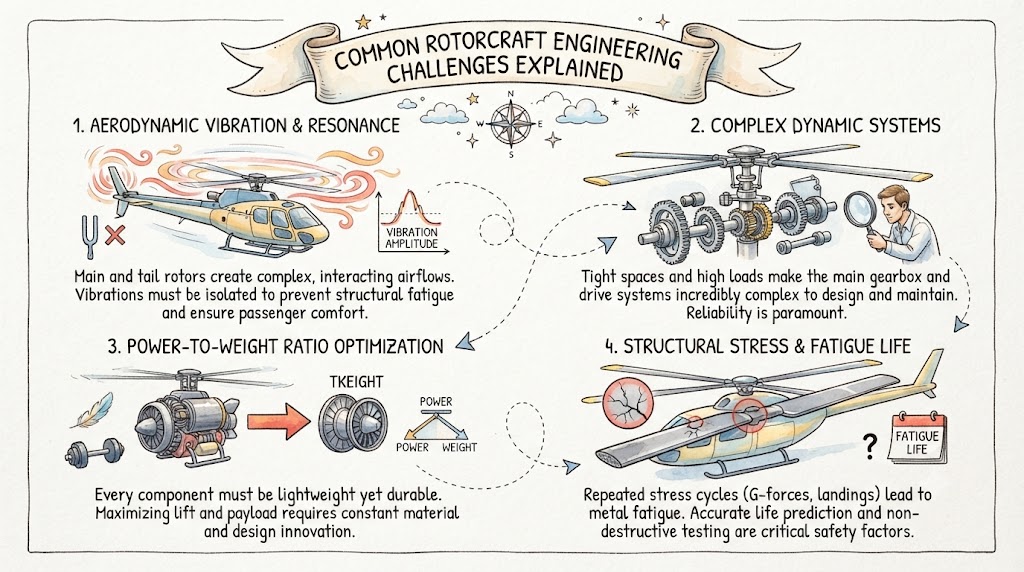
2. Vibration Management
Vibration is one of the biggest engineering challenges in rotorcraft.
Unlike fixed-wing aircraft, helicopters contain large rotating systems that naturally produce mechanical and aerodynamic vibrations.
Sources of vibration include:
- Rotor imbalance
- Blade tracking issues
- Transmission systems
- Engine operation
- Structural movement
Excessive vibration can lead to:
- Passenger discomfort
- Component fatigue
- Increased maintenance requirements
- Reduced equipment lifespan
Engineers use advanced balancing techniques, vibration monitoring systems, and improved materials to minimize these effects.
3. Weight and Balance Challenges
Weight management is critical in rotorcraft design.
Every additional kilogram affects:
- Payload capability
- Fuel efficiency
- Flight performance
- Range
- Hover capability
Engineers must carefully balance:
- Engine weight
- Rotor system weight
- Passenger capacity
- Fuel requirements
- Equipment installation
The center of gravity must remain within safe limits to ensure proper handling and control.
Poor weight distribution can negatively affect:
- Stability
- Maneuverability
- Takeoff performance
- Landing characteristics
4. Engine and Power System Integration
Rotorcraft engines must provide reliable power under demanding conditions.
Unlike many fixed-wing aircraft, helicopters require significant power during:
- Hover operations
- Vertical climbs
- Heavy payload missions
- High-altitude flights
Engineers must consider:
- Power output
- Fuel efficiency
- Temperature management
- Reliability
- Maintenance requirements
Power system challenges include:
- Maintaining consistent performance
- Managing heat generation
- Reducing fuel consumption
- Ensuring reliable operation
Proper engine integration is essential for safe and efficient rotorcraft performance.
5. Transmission System Complexity
The transmission system is one of the most technically demanding parts of a helicopter.
Its primary role is transferring engine power to:
- Main rotor
- Tail rotor
- Other mechanical systems
Transmission systems must operate under:
- High loads
- Continuous rotation
- Extreme mechanical stress
Engineering challenges include:
- Gear durability
- Lubrication management
- Heat control
- Noise reduction
- Reliability monitoring
A transmission failure can significantly impact aircraft safety, making inspection and maintenance essential.
6. Structural Design Challenges
Rotorcraft structures must be lightweight while remaining strong enough to withstand continuous stress.
Engineers must design structures capable of handling:
- Rotor forces
- Landing loads
- Weather conditions
- Repeated flight cycles
Modern rotorcraft increasingly use:
- Carbon fiber composites
- Advanced alloys
- Lightweight materials
These materials help improve performance while maintaining structural strength.
However, engineers must also consider:
- Material fatigue
- Repair requirements
- Long-term durability
- Manufacturing complexity
7. Flight Control System Challenges
Helicopters require highly precise control systems because pilots must manage multiple aircraft movements simultaneously.
Flight control systems manage:
- Pitch
- Roll
- Yaw
- Vertical movement
- Directional control
Engineering challenges include:
- Improving control response
- Reducing pilot workload
- Increasing stability
- Enhancing safety
Modern rotorcraft increasingly use advanced digital flight control systems to improve handling and reliability.
8. Thermal Management
Heat management is another major rotorcraft engineering challenge.
Aircraft systems generate heat from:
- Engines
- Transmissions
- Electrical systems
- Hydraulic components
Engineers must develop cooling solutions that maintain safe operating temperatures.
Effective thermal management helps:
- Protect components
- Improve reliability
- Reduce maintenance issues
- Extend service life
Poor heat control can accelerate wear and reduce system performance.
9. Noise Reduction Challenges
Rotorcraft are known for producing higher noise levels compared with many fixed-wing aircraft.
Noise comes from:
- Rotor blade movement
- Engine operation
- Mechanical systems
- Airflow interaction
Engineers work on:
- Improved blade designs
- Noise-reducing materials
- Better aerodynamic solutions
- Advanced propulsion systems
Reducing noise improves passenger comfort and helps address environmental concerns.
10. Maintenance and Reliability Challenges
Rotorcraft require specialized maintenance because of their complex mechanical systems.
Maintenance teams regularly inspect:
- Rotor blades
- Gearboxes
- Engines
- Transmission systems
- Flight controls
- Hydraulic systems
Common maintenance challenges include:
- Component wear
- Inspection complexity
- Replacement scheduling
- Aircraft downtime
- Operational costs
Predictive maintenance technologies are helping operators identify potential issues before failures occur.
Common Rotorcraft Maintenance Challenges
Maintaining a helicopter requires detailed attention to multiple systems.
Important maintenance activities include:
Rotor Inspections
Engineers check for:
- Cracks
- Surface damage
- Structural issues
- Wear patterns
Gearbox Monitoring
Transmission systems require careful monitoring because they operate under extreme loads.
Engine Maintenance
Regular inspections help maintain:
- Power reliability
- Fuel efficiency
- Safe operation
Documentation Management
Accurate maintenance records help track:
- Component history
- Inspection results
- Repair activities
- Replacement schedules
Modern Technologies Improving Rotorcraft Engineering
Technology continues to improve rotorcraft performance and safety.
Important advancements include:
Advanced Composite Materials
Composite materials provide:
- Lower weight
- Greater strength
- Improved durability
Predictive Maintenance Systems
Modern monitoring systems analyze aircraft data to detect:
- Component wear
- Performance changes
- Potential failures
Digital Monitoring Systems
Sensors provide information about:
- Engine performance
- Vibration levels
- Component health
Simulation and Testing
Engineers use advanced simulations to evaluate:
- Aerodynamics
- Structural performance
- Flight characteristics
These technologies help improve aircraft development and operational reliability.
How Engineers Improve Rotorcraft Performance
Rotorcraft engineers continuously work to improve:
Aerodynamic Efficiency
Better rotor designs help increase:
- Lift capability
- Fuel efficiency
- Flight performance
Weight Reduction
Lightweight materials improve:
- Range
- Payload capacity
- Efficiency
Better Propulsion Systems
Improved engines provide:
- Greater reliability
- Better fuel economy
- Increased performance
Advanced Control Systems
Modern controls improve:
- Stability
- Pilot workload
- Safety
Why Specialized Rotorcraft Expertise Matters
Rotorcraft engineering requires specialized knowledge because helicopters combine:
- Complex aerodynamics
- Mechanical systems
- Structural engineering
- Advanced electronics
- Safety-critical components
Successful rotorcraft development depends on collaboration between:
- Aerospace engineers
- Maintenance professionals
- Pilots
- Manufacturers
- Testing specialists
Continuous improvement helps make rotorcraft safer, more efficient, and more reliable.
Rotorcraft Engineering Checklist
During Aircraft Design
- Evaluate aerodynamic performance
- Analyze structural strength
- Test rotor systems
- Review weight balance
- Validate system integration
During Maintenance
- Inspect rotor components
- Monitor engine performance
- Check transmission systems
- Review maintenance records
- Evaluate component condition
Before Flight Operations
- Complete safety inspections
- Verify aircraft systems
- Review performance conditions
- Confirm operational readiness
Frequently Asked Questions
1. What makes rotorcraft engineering different from airplane engineering?
Rotorcraft engineering involves complex rotating systems, including rotor blades and transmissions, which create unique aerodynamic and mechanical challenges.
2. Why do helicopters experience more vibration?
Helicopters experience vibration because of rotating rotor systems, mechanical components, and changing aerodynamic forces during flight.
3. Why are rotor blades difficult to design?
Rotor blades must balance aerodynamic performance, strength, flexibility, weight, and durability while operating under changing flight conditions.
4. How does weight affect helicopter performance?
Weight influences payload capacity, fuel efficiency, range, and overall aircraft handling.
5. What role does the transmission system play?
The transmission transfers engine power to the rotor systems and must operate reliably under high mechanical loads.
6. Why is helicopter maintenance complex?
Rotorcraft contain highly integrated mechanical systems that require specialized inspections and maintenance procedures.
7. How do engineers reduce rotorcraft noise?
Engineers use improved blade designs, materials, and aerodynamic techniques to reduce noise generation.
8. What materials are used in modern rotorcraft?
Modern rotorcraft often use advanced composites, lightweight alloys, and specialized aerospace materials.
9. How does technology improve helicopter safety?
Digital monitoring, predictive maintenance, and advanced control systems help identify issues and improve operational safety.
10. Why is predictive maintenance important for helicopters?
Predictive maintenance helps detect potential problems early, reducing unexpected failures and improving aircraft availability.
Conclusion
Rotorcraft engineering requires a careful balance between performance, safety, reliability, and efficiency. From rotor blade design and vibration control to transmission systems and maintenance challenges, every aspect of helicopter engineering requires precision and expertise. Modern technologies, advanced materials, and improved monitoring systems continue to enhance rotorcraft capabilities and operational safety.
Understanding these engineering challenges helps aviation professionals and enthusiasts appreciate the complexity behind helicopter design and maintenance. As rotorcraft technology continues to evolve, engineering innovation will remain essential for creating safer, more efficient, and more reliable aircraft.

