
Introduction
Helicopters are among the most versatile aircraft in aviation because they can take off vertically, hover in place, and operate in environments where traditional fixed-wing aircraft cannot. The ability to perform these unique operations depends heavily on one critical component: the rotor blade system.
Rotor blades are not simply rotating wings. They are carefully engineered aerodynamic structures designed to generate lift, provide control, maintain stability, and optimize aircraft performance under different flight conditions.
Every element of rotor blade design, including airfoil shape, length, twist, material selection, and weight distribution, influences how effectively a helicopter can fly. A well-designed rotor system improves lift generation, enhances maneuverability, reduces vibration, and increases operational efficiency.
Understanding Rotor Blade Systems
A helicopter rotor system consists of rotating blades connected to a central hub. Unlike airplane wings that generate lift through forward movement, helicopter rotor blades create lift by rotating rapidly through the air.
The rotor system performs several important functions:
- Generates vertical lift
- Controls aircraft movement
- Provides stability
- Supports hovering capability
- Enables directional flight
A helicopter typically includes:
Main Rotor System
The main rotor produces the majority of the aircraft’s lift and controls vertical movement.
It allows the helicopter to:
- Take off vertically
- Hover
- Climb
- Descend
- Move forward and sideways
Tail Rotor System
The tail rotor manages the torque created by the main rotor.
Its functions include:
- Maintaining directional control
- Preventing unwanted rotation
- Helping pilots control yaw movement
Both rotor systems depend on carefully designed blades to operate effectively.
The Fundamentals of Rotor Blade Aerodynamics
Rotor blade performance depends on how blades interact with airflow.
When rotor blades rotate, they create aerodynamic forces that produce lift.
Important aerodynamic concepts include:
Angle of Attack
The angle of attack is the angle between the rotor blade and the incoming airflow.
It directly affects:
- Lift production
- Drag
- Aircraft control response
Increasing the angle of attack can increase lift, but excessive angles may reduce efficiency and create aerodynamic problems.
Relative Airflow
Rotor blades experience airflow caused by both:
- Their rotational movement
- Helicopter movement through the air
Understanding this airflow is essential for designing efficient blades.
Rotor Disc Area
The rotating blades create an imaginary circular area called the rotor disc.
A larger rotor disc can provide:
- Greater lift capability
- Better hovering performance
- Improved low-speed efficiency
How Rotor Blades Generate Lift
Rotor blades work similarly to aircraft wings, but with an important difference—they continuously rotate.
As blades move through the air:
- The airfoil shape creates pressure differences.
- Air moves faster over one side of the blade.
- The pressure difference produces aerodynamic lift.
- The combined lift from all blades supports the helicopter.
The efficiency of this process depends on blade design.
Poor blade design can result in:
- Reduced lift
- Increased drag
- Higher power requirements
- Lower aircraft performance
How Rotor Blade Design Affects Lift and Control
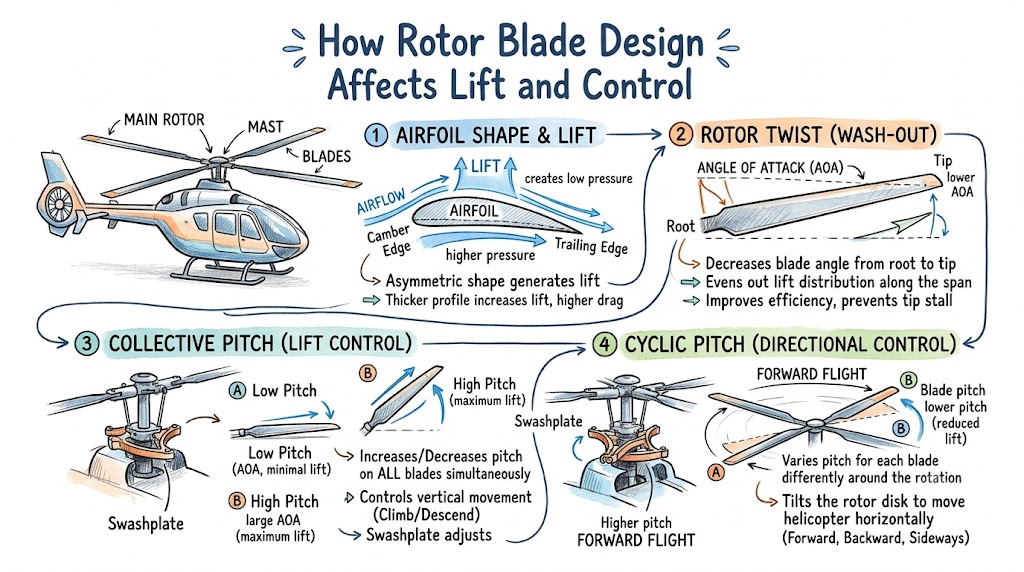
1. Blade Airfoil Design and Lift Efficiency
The airfoil shape of a rotor blade plays a major role in aerodynamic performance.
A well-designed airfoil helps achieve:
- Higher lift generation
- Lower drag
- Better energy efficiency
- Improved flight performance
Different helicopter missions may require different blade designs.
For example:
- Utility helicopters may prioritize lifting capability.
- High-speed helicopters may focus on reducing drag.
- Training helicopters may prioritize predictable handling.
The airfoil design determines how efficiently the rotor converts engine power into useful lift.
2. Blade Length and Rotor Performance
Rotor blade length directly affects the size of the rotor disc.
Longer blades can provide:
- Increased lift capability
- Improved hovering performance
- Better low-speed control
However, longer blades also create challenges:
- Higher structural loads
- Increased weight
- Greater mechanical stress
Engineers must balance blade size with aircraft requirements.
3. Blade Twist and Lift Distribution
Rotor blades experience different airflow conditions from the root to the tip.
The blade root moves slower than the blade tip, creating differences in aerodynamic forces.
Blade twist helps solve this problem.
A twisted blade design provides:
- More efficient lift distribution
- Improved aerodynamic performance
- Reduced energy losses
Without proper blade twist, some sections of the blade would operate inefficiently.
4. Blade Pitch and Helicopter Control
Blade pitch determines the angle of the rotor blade relative to airflow.
Changing blade pitch allows pilots to control helicopter movement.
Collective Pitch Control
Collective pitch changes the angle of all rotor blades together.
It controls:
- Overall lift
- Climb
- Descent
Increasing collective pitch increases lift, allowing the helicopter to rise.
Cyclic Pitch Control
Cyclic pitch changes the blade angle during rotation.
It allows pilots to:
- Tilt the rotor disc
- Move forward
- Move backward
- Move sideways
Rotor blade responsiveness directly affects helicopter maneuverability.
5. Blade Weight and Rotor Stability
Rotor blade weight influences aircraft stability and mechanical performance.
Proper weight distribution helps maintain:
- Smooth rotation
- Reduced vibration
- Better control response
- Lower mechanical stress
Uneven blade weight can create:
- Rotor imbalance
- Increased vibration
- Reduced component lifespan
Engineers carefully design blade structures to achieve the right balance between strength and weight.
6. Blade Materials and Performance
Modern rotor blades use advanced materials to improve performance.
Common materials include:
- Composite materials
- Lightweight alloys
- Reinforced structures
Composite materials provide benefits such as:
- Lower weight
- Greater durability
- Improved fatigue resistance
- Better aerodynamic shaping
Material selection influences:
- Aircraft efficiency
- Maintenance requirements
- Operating lifespan
Rotor Blade Design and Helicopter Control
Rotor blade design directly affects how pilots control helicopters.
Vertical Control
The rotor system controls altitude through lift adjustment.
Efficient blades allow:
- Smooth altitude changes
- Better hovering
- Improved climb performance
Directional Control
Rotor blade responsiveness influences:
- Forward movement
- Side movement
- Turning ability
A well-designed rotor system provides predictable control responses.
Stability Control
Rotor blade balance and aerodynamic efficiency contribute to:
- Stable flight
- Reduced vibration
- Better pilot handling
Rotor Blade Performance Factors
Hover Performance
Hovering is one of the most demanding helicopter operations.
During hover, the rotor must generate enough lift to support the aircraft without forward movement.
Blade design affects:
- Power requirements
- Lift efficiency
- Stability
Efficient rotor blades allow helicopters to hover with better performance.
Forward Flight Performance
During forward flight, rotor blades experience different aerodynamic conditions.
The advancing blade and retreating blade experience different airflow speeds.
Blade design helps manage:
- Lift differences
- Drag
- Control challenges
Good aerodynamic design improves forward flight efficiency.
High-Altitude Performance
At higher altitudes, air density decreases.
This affects:
- Lift generation
- Engine performance
- Rotor efficiency
Rotor blades designed for efficient airflow help helicopters maintain better performance in challenging environments.
Maneuverability and Pilot Control
Rotor blade responsiveness influences how quickly and smoothly a helicopter responds to pilot inputs.
Important factors include:
- Blade stiffness
- Weight
- Airfoil design
- Control system integration
A balanced rotor system improves pilot confidence and aircraft handling.
Common Rotor Blade Design Challenges
1. Vibration Management
Vibration is one of the biggest challenges in rotorcraft engineering.
Causes include:
- Blade imbalance
- Aerodynamic differences
- Mechanical stresses
Engineers reduce vibration through:
- Precise manufacturing
- Blade balancing
- Advanced materials
2. Aerodynamic Efficiency
Rotor blades must generate maximum lift while minimizing drag.
Challenges include:
- Managing airflow
- Reducing energy losses
- Improving efficiency
3. Structural Strength
Rotor blades experience significant forces during operation.
They must withstand:
- Rotation forces
- Weather conditions
- Mechanical stress
Strong materials and engineering analysis help maintain reliability.
4. Noise Reduction
Rotor blade movement creates aerodynamic noise.
Modern designs focus on:
- Improved blade tips
- Better airflow management
- Reduced vibration
Traditional Rotor Blades vs Advanced Rotor Technologies
| Feature | Traditional Rotor Blades | Advanced Rotor Blades |
|---|---|---|
| Materials | Conventional structures | Composite materials |
| Weight | Higher in some designs | Lightweight construction |
| Aerodynamics | Standard designs | Optimized airflow performance |
| Efficiency | Traditional performance | Improved energy efficiency |
| Control Response | Standard handling | Enhanced responsiveness |
| Maintenance | Conventional inspection | Advanced monitoring methods |
Modern Rotor Blade Technology
Technology continues to improve rotorcraft performance.
Modern developments include:
Computer-Aided Design
Engineers use advanced software to analyze:
- Airflow
- Structural stress
- Performance characteristics
Composite Manufacturing
Modern materials allow:
- Stronger structures
- Reduced weight
- Improved efficiency
Aerodynamic Simulation
Digital testing helps engineers optimize:
- Blade shape
- Lift generation
- Drag reduction
Importance of Rotor Blade Maintenance
Even the best rotor blade design requires proper maintenance.
Regular inspections help identify:
- Surface damage
- Cracks
- Material deterioration
- Balance problems
Maintenance activities include:
- Blade tracking
- Vibration checks
- Structural inspections
- Surface condition monitoring
Proper maintenance supports:
- Safety
- Reliability
- Performance
Choosing the Right Rotorcraft Components
Selecting suitable rotor components requires careful consideration.
Compatibility
Components must match:
- Aircraft specifications
- Rotor system requirements
- Manufacturer guidelines
Quality Standards
Important factors include:
- Material quality
- Manufacturing accuracy
- Reliability
Mission Requirements
Rotor systems should match aircraft usage, including:
- Transport operations
- Training flights
- Utility missions
- Specialized aviation tasks
Common Misunderstandings About Rotor Blade Design
Bigger Blades Always Mean Better Performance
Larger blades may increase lift capability, but they also increase weight and structural demands.
The best design depends on aircraft requirements.
More Engine Power Solves Performance Problems
Engine power is important, but rotor efficiency and aerodynamic design are equally critical.
Rotor Blades Only Affect Lift
Rotor blades influence:
- Control
- Stability
- Efficiency
- Safety
- Flight characteristics
Why Understanding Rotor Blade Design Matters
Knowledge of rotor blade engineering helps:
Pilots
Understand aircraft behavior and performance limitations.
Engineers
Develop better rotorcraft systems.
Maintenance Professionals
Identify performance-related issues.
Aviation Enthusiasts
Appreciate helicopter technology.
Why Aviation Professionals Follow JetAndRotor
Understanding rotorcraft technology requires access to reliable aviation information and engineering insights.
JetAndRotor provides knowledge about:
- Rotorcraft systems
- Helicopter technology
- Aviation engineering concepts
- Aircraft performance topics
Learning about rotor technology helps aviation professionals and enthusiasts better understand the complexity behind helicopter operations.
Rotor Blade Performance Checklist
Before Flight
✓ Inspect rotor blade condition
✓ Check for visible damage
✓ Review maintenance history
✓ Confirm rotor system condition
During Operation
✓ Monitor vibration levels
✓ Observe control response
✓ Follow aircraft limitations
During Maintenance
✓ Perform blade inspections
✓ Check balance and tracking
✓ Review component condition
Frequently Asked Questions
1. How do rotor blades generate helicopter lift?
Rotor blades generate lift by rotating through the air and creating aerodynamic forces similar to aircraft wings.
2. Why is rotor blade design important?
Rotor blade design affects lift efficiency, control response, stability, and overall helicopter performance.
3. How does blade pitch affect helicopter control?
Blade pitch changes the angle of the blades, allowing pilots to control altitude and aircraft movement.
4. Why are rotor blades twisted?
Blade twist helps distribute lift efficiently because different blade sections experience different airflow speeds.
5. What materials are used in modern rotor blades?
Modern rotor blades commonly use composite materials and lightweight structures for improved performance.
6. How does blade length affect helicopter performance?
Blade length affects rotor disc size, lift capability, hovering performance, and aircraft efficiency.
7. What causes rotor blade vibration?
Vibration can result from blade imbalance, aerodynamic differences, or mechanical issues.
8. How do rotor blades affect helicopter stability?
Properly designed blades improve balance, reduce vibration, and provide predictable control.
9. Why is rotor blade maintenance important?
Regular maintenance helps detect damage, maintain performance, and support flight safety.
10. How does technology improve rotor blade design?
Modern design tools, simulations, and advanced materials help create more efficient and reliable rotor systems.
Conclusion
Rotor blade design is one of the most important factors influencing helicopter lift, control, efficiency, and safety. Every element, from airfoil shape and blade twist to material selection and weight distribution, affects how effectively a rotorcraft performs. A well-engineered rotor system allows helicopters to hover efficiently, respond accurately to pilot inputs, and operate safely in demanding environments. As rotorcraft technology continues to advance, improvements in materials, aerodynamics, and engineering methods will continue to enhance helicopter performance.

