
Introduction
Modern aviation would not exist in its current form without jet propulsion. From commercial airliners connecting continents to military aircraft operating in demanding environments and business jets transporting passengers across long distances, jet engines have transformed the way people and goods move around the world.
Aircraft performance depends largely on propulsion. The ability to generate thrust efficiently determines how fast an aircraft can fly, how high it can climb, how far it can travel, and how much weight it can carry. Jet propulsion provides the power necessary to meet these demanding requirements.
The development of jet engines marked one of the most significant advancements in aerospace engineering. Compared with earlier propulsion technologies, jet engines enabled higher speeds, improved altitude capability, increased range, and greater operational flexibility.
Today, jet propulsion remains at the heart of high-performance aviation and continues to evolve through technological innovation.
What Is Jet Propulsion?
Jet propulsion is a method of generating thrust by accelerating air and exhaust gases through an engine.
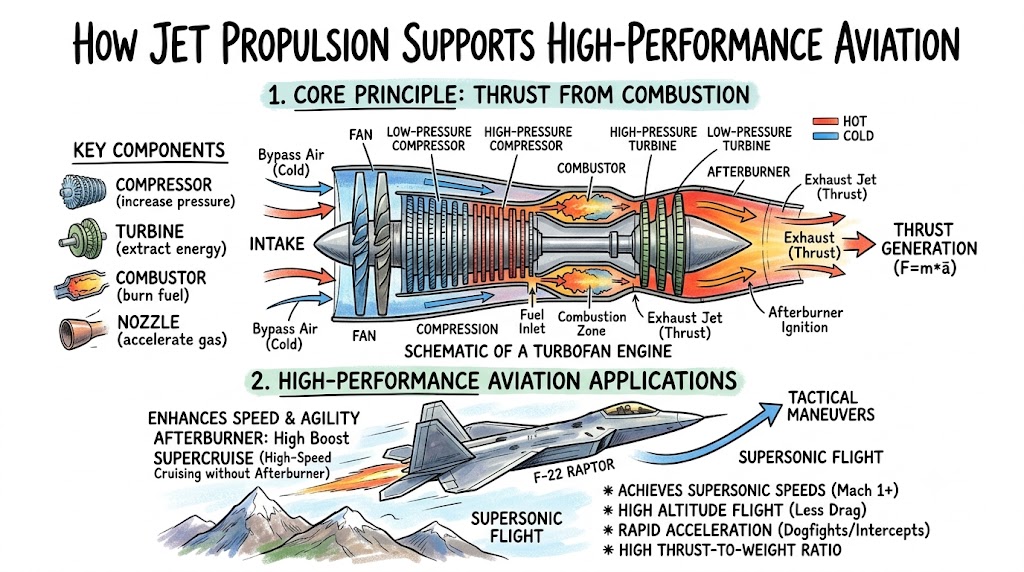
In simple terms, a jet engine works by:
- Drawing air into the engine
- Compressing the air
- Mixing fuel with compressed air
- Burning the fuel-air mixture
- Expanding hot gases
- Expelling gases through the exhaust
As the gases leave the engine at high speed, thrust is created, pushing the aircraft forward.
This continuous process allows aircraft to maintain flight while generating the power required for climbing, cruising, maneuvering, and carrying passengers or cargo.
The Basic Science Behind Jet Propulsion
Jet propulsion operates according to a fundamental principle of physics known as Newton’s Third Law of Motion.
The principle states:
For every action, there is an equal and opposite reaction.
When a jet engine expels gases rearward at high velocity, an equal force pushes the aircraft forward.
This reaction creates thrust.
The process involves:
- Air acceleration
- Energy conversion
- Momentum transfer
- Continuous thrust generation
Unlike some other propulsion systems, jet engines produce a steady flow of thrust that supports sustained high-speed flight.
Main Components of a Jet Engine
Understanding the major parts of a jet engine helps explain how propulsion works.
Air Intake
The air intake directs airflow into the engine.
Its design helps ensure smooth and efficient airflow under varying flight conditions.
Compressor
The compressor increases air pressure before combustion.
Compressed air contains more energy potential and improves combustion efficiency.
The compressor is one of the most important components in the engine.
Combustion Chamber
Inside the combustion chamber:
- Fuel mixes with compressed air
- Ignition occurs
- High-temperature gases are produced
This stage releases the energy that powers the engine.
Turbine
The turbine extracts energy from the hot gases.
This energy drives:
- Compressors
- Fans
- Engine accessories
The turbine plays a critical role in maintaining continuous engine operation.
Exhaust Nozzle
The exhaust nozzle accelerates gases as they leave the engine.
The high-speed exhaust stream generates thrust that propels the aircraft forward.
How Jet Engines Produce High Performance
Continuous Thrust Production
Jet engines provide continuous thrust throughout flight.
This steady power delivery supports:
- Takeoff
- Climb
- Cruise
- Maneuvering
- Long-distance travel
Continuous thrust is a major reason jet propulsion is well suited for modern aviation.
High-Speed Capability
Jet propulsion enables aircraft to operate at significantly higher speeds than many alternative propulsion systems.
High-speed capability improves:
- Travel efficiency
- Operational flexibility
- Long-distance transportation
- Mission effectiveness
This characteristic is particularly valuable in commercial and military aviation.
Efficient High-Altitude Operation
Many jet-powered aircraft operate at high cruising altitudes.
Benefits include:
- Reduced air resistance
- Improved fuel efficiency
- Smoother flight conditions
- Enhanced operational performance
Jet engines are specifically designed to perform effectively in these environments.
Long-Range Capability
Jet propulsion supports long-distance operations by providing efficient power generation over extended periods.
Long-range capability allows aircraft to:
- Connect distant cities
- Support global commerce
- Conduct international travel
- Perform strategic operations
Without jet propulsion, modern long-haul aviation would be significantly more difficult.
Heavy Payload Capability
Jet-powered aircraft can support substantial payload requirements.
These payloads may include:
- Passengers
- Cargo
- Fuel
- Specialized equipment
- Military systems
The ability to generate significant thrust enables aircraft to carry large loads while maintaining performance.
Types of Jet Engines Used in Aviation
Turbojet Engines
Turbojets represent one of the earliest forms of jet propulsion.
Characteristics include:
- Simple design
- High-speed capability
- Direct thrust generation
Turbojets played an important role in the development of modern aviation and remain historically significant.
Turbofan Engines
Turbofan engines are the most common jet engines used in commercial aviation today.
Benefits include:
- Improved efficiency
- Reduced noise
- Better fuel economy
- Strong performance
Most modern airliners rely on turbofan technology.
Turboprop Engines
Turboprops use turbine engines to drive propellers.
Advantages include:
- Efficiency at lower speeds
- Regional transportation capability
- Short-runway performance
Turboprops remain valuable for many specialized aviation applications.
Turboshaft Engines
Turboshaft engines are commonly used in helicopters.
Rather than producing direct thrust, they generate power that drives rotor systems.
Applications include:
- Civil helicopters
- Emergency services
- Military rotorcraft
- Offshore transportation
Why Commercial Aviation Relies on Jet Propulsion
Commercial airlines depend heavily on jet propulsion because it supports efficient transportation on a global scale.
Benefits include:
- Long-distance travel capability
- High passenger capacity
- Reliable operation
- Efficient scheduling
- Global connectivity
Jet-powered airliners have made international travel accessible to millions of people worldwide.
Without jet propulsion, modern airline networks would be significantly less efficient.
Jet Propulsion in Business Aviation
Business aviation benefits greatly from jet engine technology.
Advantages include:
- Faster travel
- Greater range
- Operational flexibility
- Access to distant destinations
- Reduced travel time
Business jets enable executives and organizations to travel efficiently while maintaining productivity.
The combination of speed and range makes jet propulsion particularly valuable in corporate aviation.
Jet Propulsion in Military Aviation
Military aviation places extremely high demands on propulsion systems.
Jet engines support:
- Fighter aircraft
- Transport aircraft
- Surveillance platforms
- Tanker aircraft
- Strategic mobility operations
Military missions often require:
- Rapid response
- High speed
- Long range
- Heavy payload capability
Jet propulsion provides the performance necessary to support these requirements.
Jet Propulsion vs Piston Engines
| Feature | Jet Engines | Piston Engines |
|---|---|---|
| Typical Use | Commercial and high-performance aircraft | General aviation and training aircraft |
| High-Speed Capability | Excellent | More limited |
| High-Altitude Performance | Excellent | Generally lower |
| Complexity | Higher | Lower |
| Power Generation | Continuous turbine process | Reciprocating process |
| Long-Distance Operations | Highly suited | Often more limited |
Both technologies remain important in aviation, but they serve different operational needs.
Advantages of Jet Propulsion
Greater Speed
Jet-powered aircraft can achieve higher speeds than many piston-powered aircraft.
Higher Altitude Capability
Jet engines perform efficiently at cruising altitudes commonly used in commercial aviation.
Long-Range Operations
Jet propulsion supports extended flight durations and global transportation networks.
Smooth Power Delivery
The turbine-based process provides consistent power output.
Scalability
Jet engines can be adapted for a wide range of aircraft sizes and missions.
Commercial Efficiency
Modern airline operations depend on the efficiency of jet propulsion systems.
Operational Reliability
Continuous technological improvements have increased engine reliability significantly.
Challenges and Limitations of Jet Engines
Despite their advantages, jet engines also present challenges.
Engineering Complexity
Modern turbine engines are highly sophisticated machines.
Maintenance Requirements
Regular inspections and maintenance are essential for safe operation.
Fuel Considerations
Fuel management remains an important operational factor.
Manufacturing Costs
Jet engines require advanced materials and precision engineering.
Environmental Concerns
The aviation industry continues working to improve environmental performance.
Noise Management
Engine manufacturers invest heavily in noise-reduction technologies.
Infrastructure Requirements
Jet aircraft often depend on specialized airport infrastructure and support systems.
How Modern Technology Improves Jet Propulsion
Improved Materials
Advanced materials help engines operate efficiently in demanding environments.
Digital Engine Monitoring
Modern systems continuously monitor engine performance.
Benefits include:
- Early issue detection
- Improved maintenance planning
- Enhanced reliability
Advanced Aerodynamics
Improved airflow management enhances efficiency and performance.
Better Fuel Efficiency
Engine designers continue pursuing improvements in fuel utilization.
Increased Reliability
Modern engineering techniques help reduce maintenance-related disruptions.
Noise Reduction Technologies
Advanced engine designs contribute to quieter aircraft operations.
Emissions Reduction Efforts
Manufacturers continue exploring methods to reduce environmental impact.
The Role of Jet Propulsion in Future Aviation
Jet propulsion remains central to future aviation development.
Emerging areas of focus include:
- Sustainable aviation initiatives
- Alternative fuels
- Hybrid propulsion systems
- Advanced engine architectures
- Improved efficiency technologies
- Environmental improvements
While aviation continues to evolve, jet engines are expected to remain a critical component of high-performance flight for years to come.
Common Misconceptions About Jet Engines
Jet Engines Only Work at High Altitude
Jet engines operate effectively throughout various phases of flight, including takeoff and landing.
All Jet Engines Are the Same
Different engine types are designed for specific missions and aircraft categories.
Faster Is Always Better
Aircraft performance involves balancing speed, efficiency, range, and operational requirements.
Jet Engines Never Require Maintenance
All aviation engines require regular inspection and maintenance.
Jet Aircraft Are Only Used by Airlines
Business aviation, military aviation, and specialized operations also rely heavily on jet propulsion.
Turboprops Are Outdated
Turboprops continue to provide excellent performance for many regional and specialized applications.
Why Understanding Jet Propulsion Matters
Knowledge of propulsion systems benefits:
Aviation Students
Understanding propulsion helps build foundational aviation knowledge.
Pilots
Pilots benefit from understanding engine operation and performance characteristics.
Engineers
Propulsion remains one of the most important areas of aerospace engineering.
Aircraft Owners
Knowledge supports informed operational and maintenance decisions.
Aviation Enthusiasts
Understanding propulsion enhances appreciation for aviation technology.
Aerospace Professionals
Propulsion expertise supports career development across the aerospace industry.
Questions to Ask When Learning About Aviation Engines
Consider exploring questions such as:
- What type of engine powers the aircraft?
- Why was that engine selected?
- How does thrust affect performance?
- How does altitude influence engine operation?
- What maintenance is required?
- How is efficiency measured?
- What technologies improve reliability?
- What future propulsion systems are being developed?
These questions help build a deeper understanding of aviation technology.
Frequently Asked Questions
1. What is jet propulsion?
Jet propulsion is a method of generating thrust by accelerating air and exhaust gases through an engine.
2. How does a jet engine produce thrust?
A jet engine compresses air, burns fuel, and expels high-speed exhaust gases that generate forward thrust.
3. Why are jet engines used in commercial aviation?
They provide the speed, range, altitude capability, and efficiency required for large-scale air transportation.
4. What is the difference between a turbojet and turbofan?
Turbofans include a large fan section that improves efficiency and reduces noise compared to traditional turbojets.
5. Are jet engines more powerful than piston engines?
Jet engines are generally better suited for high-speed and high-altitude operations.
6. Why do jet aircraft fly at high altitudes?
Higher altitudes often provide improved efficiency and reduced air resistance.
7. What fuels are used in jet engines?
Jet engines operate using specialized aviation fuels designed for turbine engines.
8. How reliable are modern jet engines?
Modern jet engines are highly reliable when maintained according to approved procedures.
9. What is a turbine engine?
A turbine engine uses rotating turbine components to extract energy from expanding gases.
10. Can helicopters use jet-engine technology?
Yes. Many helicopters use turboshaft engines, which are based on turbine technology.
11. What makes jet propulsion efficient?
Efficient energy conversion, continuous thrust generation, and advanced engine design contribute to performance.
12. Why do business jets use turbine engines?
Turbine engines provide the speed, range, and reliability required for business aviation.
13. How do jet engines support long-distance travel?
Their efficiency and sustained power output allow aircraft to travel long distances without frequent stops.
14. What are the main parts of a jet engine?
Major components include the intake, compressor, combustion chamber, turbine, and exhaust nozzle.
15. How is jet propulsion evolving?
Advancements focus on efficiency improvements, sustainability initiatives, alternative fuels, and environmental performance.
Conclusion
Jet propulsion represents one of the most important technological achievements in aviation history. By enabling higher speeds, greater altitudes, longer ranges, and improved payload capability, jet engines have transformed global transportation and aerospace operations. From commercial airliners and business jets to military aircraft and advanced rotorcraft systems, jet propulsion continues to support high-performance aviation across numerous applications. Ongoing advancements in materials, digital monitoring, fuel efficiency, and environmental technologies ensure that jet engines remain a critical part of modern aerospace innovation.

