
Introduction
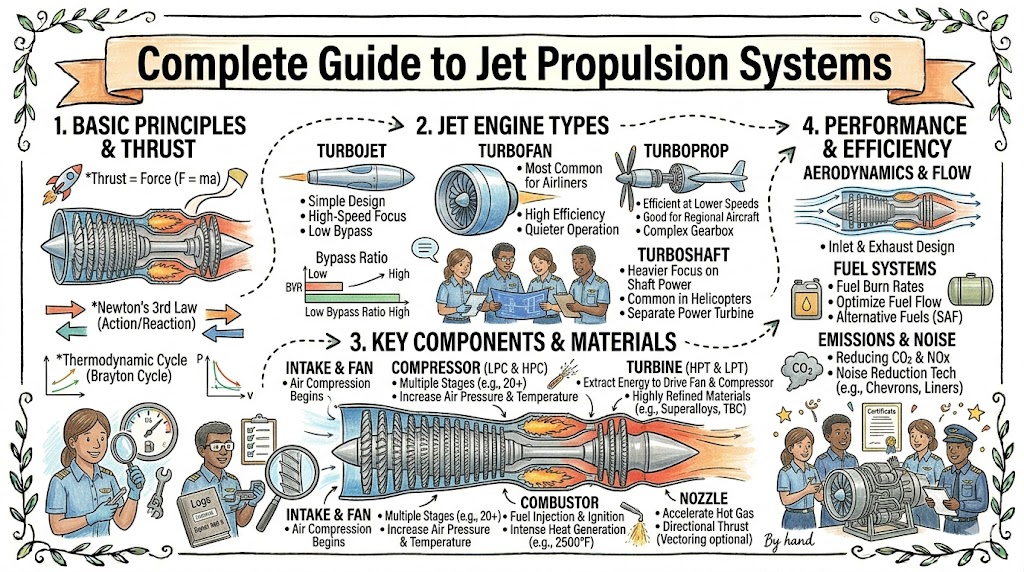
Jet propulsion systems are the heart of modern high-speed aviation. They allow aircraft to generate powerful thrust, fly at higher altitudes, cover long distances, and operate efficiently across commercial, business, military, and specialized aviation missions. Unlike piston engines that drive propellers directly, jet propulsion systems move aircraft forward by accelerating air and exhaust gases through the engine. This simple principle powers some of the most advanced aircraft in the world.
A jet propulsion system is not just one part. It is a coordinated system made of air intake sections, compressors, combustion chambers, turbines, exhaust nozzles, fuel systems, lubrication systems, cooling systems, and engine controls. Each part must work together with precision to produce safe and reliable thrust. For aviation students, pilots, maintenance learners, aircraft owners, jet operators, and aerospace enthusiasts, understanding jet propulsion helps explain why jet aircraft are fast, efficient, powerful, and technically advanced. It also shows why proper inspection and maintenance are essential for aircraft safety.
Real-world Use Cases
A student learning about aircraft propulsion may begin by understanding how air enters a jet engine, gets compressed, mixes with fuel, burns, and exits as high-speed exhaust. This helps explain how thrust works in a simple way.
A pilot may study jet engine performance to understand takeoff power, climb performance, fuel efficiency, and engine limitations. A maintenance team may inspect compressor blades, turbine sections, fuel nozzles, sensors, oil systems, and exhaust components to keep the engine reliable.
A business jet operator may focus on engine reliability because schedule delays can affect executive travel. An aerospace learner may compare turbojet and turbofan engines to understand why modern passenger jets mostly use turbofan designs. A helicopter operator may study turboshaft engines because many helicopters use turbine power to drive rotor systems.
Evaluation Criteria for Understanding Jet Propulsion Systems
To understand jet propulsion systems clearly, readers should evaluate:
- How thrust is created
- How air flows through the engine
- Main jet engine components
- Fuel combustion process
- Compressor and turbine roles
- Engine efficiency and fuel use
- Engine control systems
- Maintenance and inspection needs
- Safety-critical engine parts
- Differences between engine types
- Aircraft mission and propulsion choice
- Future propulsion technology trends
A strong understanding of jet propulsion begins with the basic airflow path and then moves into engine types, performance, safety, and maintenance.
What Jet Propulsion Means
Jet propulsion means moving an aircraft forward by pushing a high-speed stream of air or exhaust gases backward. This follows a basic action-and-reaction principle: when the engine accelerates air backward, the aircraft moves forward.
For example, when a jet aircraft takes off, its engines pull in air, compress it, mix it with fuel, ignite it, and release hot gases through the rear of the engine. This creates thrust that pushes the aircraft down the runway and into the sky.
Basic Principle of Thrust
Thrust is the force that moves an aircraft forward. In a jet engine, thrust is created by accelerating air through the engine and exhausting it at high speed.
A simple example is a balloon releasing air. When air rushes out one side, the balloon moves in the opposite direction. A jet engine works on a much more advanced version of this principle, using compression, combustion, and controlled exhaust flow to create powerful forward motion.
Main Components of a Jet Engine
A jet engine includes several major components that work together to produce thrust. These usually include:
- Air intake
- Compressor
- Combustion chamber
- Turbine
- Exhaust nozzle
- Fuel system
- Lubrication system
- Cooling system
- Engine control system
For example, if the compressor does not supply enough compressed air, combustion efficiency may drop. If the turbine is damaged, the engine may lose power or become unsafe. Each component plays a vital role in engine performance.
Air Intake System
The air intake system directs outside air into the engine smoothly and efficiently. It must provide clean, steady airflow to the compressor.
For example, during takeoff, the intake must handle large volumes of air without major airflow distortion. If airflow is disturbed, engine performance can be affected. This is why intake design is important for aircraft speed, engine efficiency, and safe operation.
Compressor Section
The compressor increases the pressure of incoming air before it reaches the combustion chamber. Higher-pressure air allows more efficient fuel burning and stronger thrust production.
For example, compressor blades spin at high speed to squeeze air into a smaller volume. In maintenance inspections, technicians check compressor blades for cracks, erosion, foreign object damage, or wear because compressor condition directly affects engine performance.
Combustion Chamber
The combustion chamber is where compressed air mixes with fuel and burns. This controlled burning produces hot, high-energy gases that drive the turbine and create thrust.
For example, fuel nozzles spray fuel into the combustion chamber, where it mixes with compressed air and ignites. If fuel flow is uneven or combustion is unstable, the engine may lose efficiency or experience performance issues.
Turbine Section
The turbine extracts energy from hot gases leaving the combustion chamber. This energy turns the compressor and other engine accessories.
For example, turbine blades operate in extremely hot and stressful conditions. Maintenance teams inspect turbine blades carefully for cracks, heat damage, erosion, and deformation. A healthy turbine is essential for safe and reliable engine operation.
Exhaust Nozzle
The exhaust nozzle controls how hot gases leave the engine. It accelerates the exhaust flow and helps produce thrust.
For example, in a simple jet engine, gases exit the nozzle at high speed, pushing the aircraft forward. Nozzle design affects engine efficiency, thrust output, noise, and performance at different speeds and altitudes.
Turbojet Engines
A turbojet engine is one of the earliest and simplest forms of jet propulsion. It produces thrust mainly by accelerating exhaust gases through the engine.
Turbojets are effective at high speeds but are generally less fuel-efficient and louder than modern turbofan engines. For example, some older military or high-speed aircraft used turbojets because they were suitable for fast flight, but modern passenger aircraft usually prefer turbofan technology.
Turbofan Engines
A turbofan engine uses a large fan at the front of the engine to move additional air around the engine core. This improves fuel efficiency, reduces noise, and provides strong thrust.
Most modern commercial and business jets use turbofan engines. For example, a business jet benefits from turbofan propulsion because it offers a balance of speed, range, efficiency, and passenger comfort.
Turboprop Engines
A turboprop engine uses a turbine engine to drive a propeller. Instead of producing most thrust from exhaust gases, it creates most of its thrust through the propeller.
Turboprops are commonly used for regional aircraft, utility aircraft, and shorter routes. For example, a turboprop may be more efficient than a jet on short flights where runway access, fuel economy, and operating cost are important.
Turboshaft Engines
A turboshaft engine is similar to a turboprop, but instead of driving a propeller for forward thrust, it produces shaft power to drive a rotor system or other mechanical equipment.
Many helicopters use turboshaft engines. For example, a helicopter operator relies on turboshaft power to turn the main rotor and tail rotor. This makes turboshaft engines essential in rotorcraft aviation.
Afterburners
An afterburner adds extra fuel into the exhaust stream to create additional thrust for short periods. It is mostly used in military and high-performance aircraft.
For example, a fighter aircraft may use an afterburner during rapid acceleration or demanding maneuvers. However, afterburners consume large amounts of fuel, so they are not commonly used in commercial aviation.
Fuel System in Jet Propulsion
The fuel system delivers the right amount of fuel to the engine at the right time and pressure. It includes fuel pumps, filters, lines, valves, nozzles, and control systems.
For example, during takeoff, the engine needs higher fuel flow to produce more thrust. During cruise, fuel flow is managed for efficiency. Any contamination, blockage, or fuel control issue can affect engine safety and performance.
Cooling and Lubrication Systems
Jet engines operate at high temperatures and speeds, so cooling and lubrication are essential. Lubrication reduces friction in bearings and moving parts, while cooling helps protect engine components from heat damage.
For example, oil systems must be monitored for pressure, temperature, and contamination. Maintenance teams regularly inspect oil filters, seals, lines, and cooling passages to prevent engine wear or failure.
Engine Control Systems
Modern jet engines use advanced control systems to manage fuel flow, thrust, temperature, pressure, and engine performance. These systems help pilots operate engines safely and efficiently.
For example, an engine control system can adjust fuel flow based on altitude, temperature, throttle position, and engine condition. This reduces pilot workload and improves engine reliability.
Jet Propulsion Efficiency
Efficiency in jet propulsion means producing the required thrust while using fuel wisely. Turbofan engines are generally more efficient for commercial and business aviation because they move large volumes of air with less fuel consumption than older turbojet designs.
For example, an airline or business jet operator wants engines that provide strong performance while controlling fuel burn. Better efficiency reduces operating costs and supports longer flight range.
Common Maintenance Needs
Jet engine maintenance is essential for safety and reliability. Common maintenance needs include:
- Compressor blade inspection
- Turbine blade inspection
- Fuel nozzle cleaning
- Oil system checks
- Sensor testing
- Vibration monitoring
- Exhaust inspection
- Filter replacement
- Engine control checks
- Foreign object damage inspection
For example, if a maintenance team detects unusual vibration, they may inspect rotating components before the issue becomes more serious.
Safety and Inspection Requirements
Jet engines must be inspected regularly because they operate under extreme heat, pressure, and rotational speed. Safety inspections help detect wear, cracks, leaks, overheating, vibration, or damaged parts.
For example, technicians may use visual inspections, borescope inspections, performance trend monitoring, and oil analysis to evaluate engine condition. Regular inspection helps prevent unexpected failures and supports safe flight operations.
Future Trends in Jet Propulsion
Jet propulsion continues to evolve with new technologies focused on efficiency, lower emissions, reduced noise, improved materials, and smarter engine monitoring.
Future trends may include:
- More efficient turbofan designs
- Advanced lightweight materials
- Hybrid-electric propulsion research
- Sustainable aviation fuel compatibility
- Improved digital engine monitoring
- Predictive maintenance systems
- Quieter engine designs
For example, advanced sensors can help maintenance teams detect performance changes earlier, reducing downtime and improving safety.
Benefits of Jet Propulsion Systems
Jet propulsion systems help aircraft:
- Generate strong thrust
- Fly faster and higher
- Support long-distance travel
- Improve aircraft performance
- Carry passengers and cargo efficiently
- Operate in commercial aviation
- Support business and military missions
- Improve reliability when maintained properly
- Enable modern aerospace innovation
- Reduce travel time across long routes
Jet propulsion is one of the main reasons modern aviation can connect cities, countries, and continents efficiently.
Turbojet vs Turbofan Engines
| Factor | Turbojet Engine | Turbofan Engine |
|---|---|---|
| Speed | Strong at high speeds | Efficient across common jet speeds |
| Fuel Efficiency | Lower for many modern uses | Better for commercial and business jets |
| Noise | Generally louder | Usually quieter |
| Common Use | Older jets, high-speed aircraft | Modern airliners and business jets |
| Thrust Source | Mostly exhaust gases | Fan airflow plus engine core |
| Passenger Comfort | Less common today | Better suited for passenger aircraft |
Turboprop vs Turboshaft Engines
| Factor | Turboprop Engine | Turboshaft Engine |
| Main Function | Drives a propeller | Drives a rotor or shaft system |
| Common Aircraft | Regional and utility airplanes | Helicopters and rotorcraft |
| Efficiency | Good for short routes | Good for rotorcraft power needs |
| Thrust Output | Propeller creates thrust | Rotor system creates lift and control |
| Use Case | Short regional flights | Helicopter operations |
Jet Propulsion vs Piston Engine Propulsion
| Factor | Jet Propulsion | Piston Engine Propulsion |
| Power Output | High thrust and speed | Lower power for smaller aircraft |
| Aircraft Type | Jets, turboprops, helicopters | Small general aviation aircraft |
| Altitude Performance | Strong at higher altitudes | More limited |
| Maintenance Needs | Specialized turbine maintenance | Piston engine maintenance |
| Best Use | High-speed and long-distance travel | Training, personal, and short flights |
Performance-Focused vs Efficiency-Focused Propulsion
| Factor | Performance-Focused Propulsion | Efficiency-Focused Propulsion |
| Main Goal | Maximum thrust and speed | Lower fuel burn and range efficiency |
| Common Use | Military, high-speed missions | Commercial and business aviation |
| Fuel Use | Higher during peak output | Better managed over long flights |
| Noise | May be higher | Often reduced |
| Maintenance Focus | Stress and heat management | Reliability and operating cost control |
Practical Tips for Understanding Jet Engine Basics
Follow the Airflow Path
The easiest way to understand a jet engine is to follow the airflow: intake, compression, combustion, turbine, and exhaust. This sequence explains how thrust is created.
Learn the Main Components First
Before studying advanced topics, understand the intake, compressor, combustion chamber, turbine, nozzle, fuel system, and engine controls.
Compare Engine Types by Use Case
Turbojets, turbofans, turboprops, and turboshafts are built for different missions. Compare them based on aircraft type, speed, efficiency, and operating environment.
Understand Thrust and Fuel Efficiency Together
More thrust is not always better if fuel efficiency suffers. Aircraft operators balance performance, range, operating cost, and mission needs.
Study Maintenance Basics
Jet engine reliability depends on inspection, lubrication, fuel quality, temperature control, and monitoring. Maintenance is as important as design.
Avoid Common Misconceptions
Not all jet engines work the same way. Turbofans, turboprops, and turboshafts are all turbine-based, but they serve different aircraft needs.
Continue Learning Through Systems Thinking
Jet propulsion connects aerodynamics, thermodynamics, materials, control systems, fuel systems, and safety engineering. Students should study how these systems work together.
Common Jet Engine Misconceptions
Many beginners think all jet engines are the same, but different engines are designed for different missions. A turbofan is not the same as a turbojet, and a turboshaft is not designed to push an aircraft forward directly.
Another misconception is that jet engines only need fuel and ignition to work. In reality, safe jet operation depends on airflow, compression, combustion stability, turbine health, lubrication, cooling, engine controls, and inspections.
FAQs
1- What is jet propulsion?
Jet propulsion is a method of moving an aircraft forward by accelerating air or exhaust gases backward. This creates thrust, which pushes the aircraft forward through the air.
2- How do jet engines create thrust?
Jet engines pull in air, compress it, mix it with fuel, ignite the mixture, and release high-speed gases through the exhaust. This backward flow of gases creates forward thrust.
3- What are the main parts of a jet engine?
The main parts include the air intake, compressor, combustion chamber, turbine, exhaust nozzle, fuel system, lubrication system, cooling system, and engine control system.
4- What is the difference between turbojet and turbofan engines?
A turbojet creates thrust mainly from exhaust gases, while a turbofan uses a large fan to move extra air around the engine core. Turbofans are generally more efficient and quieter for modern passenger aircraft.
5- What is the difference between turboprop and turboshaft engines?
A turboprop uses turbine power to drive a propeller, while a turboshaft uses turbine power to drive a rotor or mechanical shaft. Turboshaft engines are commonly used in helicopters.
6- Are jet engines fuel-efficient?
Modern turbofan engines are designed for better fuel efficiency than older turbojet designs. Efficiency depends on engine type, aircraft mission, altitude, speed, and operating conditions.
7- What maintenance do jet engines need?
Jet engines need inspections of compressor blades, turbine sections, fuel systems, oil systems, sensors, exhaust areas, and engine controls. Regular maintenance helps prevent failures and improves reliability.
8- Why are jet engine safety inspections important?
Jet engines operate under extreme heat, pressure, and speed. Safety inspections help detect cracks, wear, overheating, vibration, leaks, and component damage before they become serious problems.
9- What are common jet engine problems?
Common issues may include fuel flow problems, compressor damage, turbine wear, oil leaks, sensor faults, vibration, overheating, and foreign object damage. Proper inspection helps detect these issues early.
10- What is the future of jet propulsion technology?
The future of jet propulsion focuses on better efficiency, lower noise, improved materials, cleaner fuels, smarter engine monitoring, hybrid technologies, and predictive maintenance systems.
Conclusion
Jet propulsion systems are essential to modern aviation because they provide the thrust, speed, altitude capability, and efficiency needed for commercial, business, military, and specialized aircraft operations. By understanding how air intake, compression, combustion, turbine energy, exhaust flow, fuel control, cooling, and lubrication work together, students and aviation professionals can better appreciate aircraft performance and safety. Different engine types such as turbojets, turbofans, turboprops, and turboshafts serve different aviation missions, making propulsion choice an important engineering decision. Proper maintenance, inspection, and monitoring are just as important as engine design because reliability depends on every component working correctly. As aerospace technology continues to improve, jet propulsion will remain a major foundation of aircraft innovation and safe high-performance flight.

