
Introduction
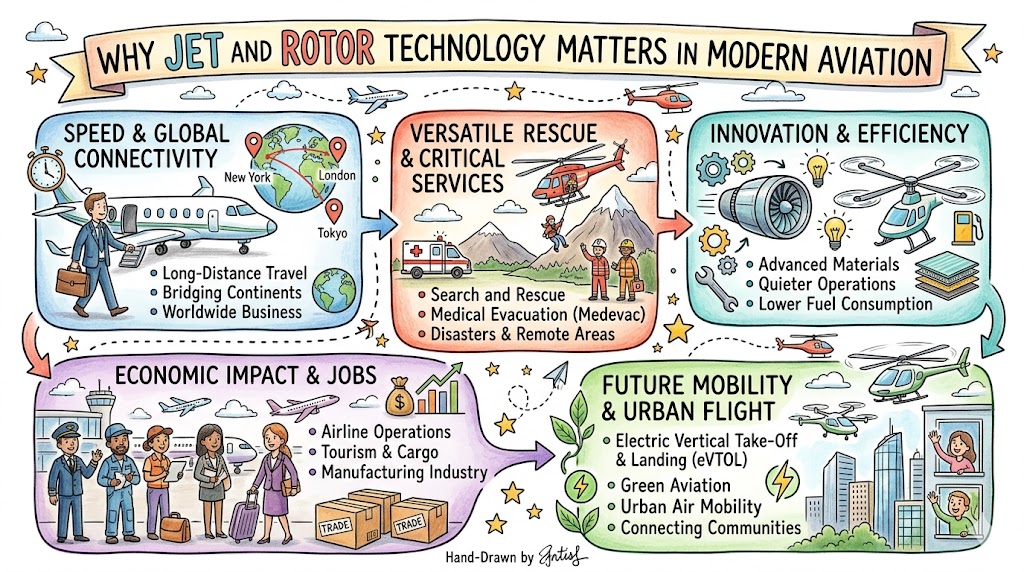
Modern aviation relies on advanced propulsion systems and rotor mechanisms to deliver speed, efficiency, maneuverability, and operational versatility. Jet engines and rotor systems are the backbone of today’s aerospace industry, enabling everything from commercial airline travel and private jets to helicopters, VTOL aircraft, and emerging urban air mobility solutions. Understanding the role of these technologies is essential for pilots, engineers, aviation students, and enthusiasts alike.
Jet and rotor technologies determine how aircraft perform in the air, how efficiently they use fuel, how safely they operate, and how adaptable they are for various missions. From fixed-wing commercial airplanes that travel thousands of miles to rotorcraft providing vertical lift in urban or remote areas, these systems define the capabilities of modern aviation. As technology evolves, innovations such as hybrid propulsion, tiltrotor systems, and electric VTOL aircraft are expanding what is possible in flight, making a strong grasp of jet and rotor principles critical for professionals and students.
Real-World Use Cases
Jet and rotor technologies underpin a wide variety of aviation applications:
- Commercial airlines rely on jet propulsion for fast, long-distance travel.
- Helicopter operations use rotor technology for vertical takeoff, landing, and hovering.
- Military aircraft combine high-speed jets and advanced rotors for rapid deployment and maneuverability.
- Private jets utilize jet engines for efficiency, reliability, and comfort.
- Cargo and logistics operations employ rotorcraft for flexible transport solutions.
- Emergency medical and search-and-rescue missions depend on rotorcraft mobility.
- Emerging urban air mobility (UAM) leverages electric rotors and hybrid systems for short-distance travel.
- UAV and drone applications incorporate miniaturized jet or rotor propulsion for varied missions.
- Regional and remote operations benefit from rotorcraft landing in tight areas.
- Aerospace research uses rotor and jet technologies for innovation in efficiency and hybrid propulsion.
Evaluation Criteria for Aviation Technology
Operators, engineers, and students should evaluate key aspects of jet and rotor systems:
- Engine efficiency and thrust-to-weight ratio
- Rotor lift efficiency, stability, and responsiveness
- Fuel consumption and environmental impact
- Noise and vibration reduction
- Maintenance and operational costs
- Safety features and redundancy systems
- Reliability under operational stress
- Technological innovation and integration
- Certification and regulatory compliance
- Operational versatility and performance envelope
Best for
This guide is ideal for aviation engineers, pilots, aerospace students, rotorcraft and jet enthusiasts, and aviation professionals seeking to understand the significance of propulsion and rotor technologies in modern aircraft.
Not Ideal for
This content is not intended for general travel advice or non-technical aviation audiences. It focuses specifically on technology, engineering principles, and operational impacts.
How Jet and Rotor Technology Shapes Modern Aviation
1- Jet Propulsion Fundamentals
Jet engines generate high-speed thrust by expelling air at high velocity, enabling aircraft to travel long distances efficiently. They are fundamental to commercial airlines, private jets, and military aircraft, offering reliability and consistent performance.
2- Rotorcraft Technology Essentials
Rotor systems provide vertical lift, hover capability, and maneuverability, allowing helicopters and VTOL aircraft to operate in areas where runways are not available. Rotorcraft are critical for rescue missions, urban mobility, and remote operations.
3- Efficiency and Performance
Modern jet and rotor designs enhance fuel efficiency, payload capacity, and range, enabling operators to balance performance with operational costs.
4- Safety and Reliability
Propulsion and rotor systems incorporate redundancy, rigorous testing, and regular maintenance protocols, ensuring safe operation under a variety of conditions.
5- Noise and Environmental Impact
Technological advances reduce noise pollution and emissions, contributing to environmentally responsible aviation.
6- Operational Versatility
Jet and rotor technologies allow aircraft to perform diverse missions, including passenger transport, cargo delivery, emergency response, and military operations.
7- Emerging Innovations
Hybrid propulsion, tiltrotor aircraft, and electric VTOL systems combine vertical lift and forward thrust, expanding possibilities for urban mobility and energy-efficient aviation solutions.
Comparison Table: Jet Engines vs Rotor Systems
| Feature | Jet Engines | Rotor Systems | Aviation Impact |
|---|---|---|---|
| Lift/Thrust | Forward thrust, relies on aerodynamic lift | Vertical and forward lift | Determines aircraft type and operational use |
| Speed | High-speed flight | Moderate speed | Jets are for long-range, rotors for maneuverable operations |
| Maneuverability | Limited in tight spaces | High, including hover | Rotorcraft excel in confined environments |
| Efficiency | Long-distance fuel efficiency | Hover and short-distance efficiency | Each optimized for different flight regimes |
| Operational Use | Commercial, private, military fixed-wing | Helicopters, VTOL, UAM | Defines mission profiles |
| Maintenance Complexity | High, specialized components | Moderate, requires balancing | Impacts operational cost and reliability |
Tips for Aviation Students and Professionals
- Study aerodynamics, propulsion, and rotor dynamics.
- Compare engine types, rotor designs, and performance metrics.
- Understand safety and maintenance requirements.
- Stay updated on emerging propulsion and rotor innovations.
- Analyze operational case studies of jet and rotor aircraft.
- Explore hybrid and electric propulsion applications.
- Evaluate certification and regulatory standards.
- Consider environmental impact and efficiency improvements.
- Learn material science for rotors and engines.
- Join aviation research communities or rotorcraft forums.
Common Mistakes to Avoid
- Ignoring rotor or engine maintenance best practices.
- Underestimating fuel consumption and efficiency impacts.
- Overlooking noise and vibration reduction technologies.
- Failing to account for load capacity and aerodynamic limits.
- Confusing rotor performance with fixed-wing dynamics.
- Neglecting regulatory compliance for propulsion systems.
- Not understanding hybrid or emerging propulsion systems.
- Failing to integrate technology into operational planning.
- Overlooking environmental impact of propulsion choices.
- Ignoring historical performance trends and data.
Frequently Asked Questions
- Why is jet technology important in aviation?
Jet engines provide thrust, speed, and efficiency, enabling long-distance, high-speed fixed-wing flight. - What is the primary purpose of rotor technology?
Rotors provide vertical lift and maneuverability, allowing helicopters and VTOL aircraft to hover and operate in confined spaces. - How do jet and rotor systems differ in efficiency?
Jets excel at high-speed forward flight, while rotors excel at vertical lift and hovering. - Are rotor systems complex to maintain?
Yes. Rotors require precise balancing, inspections, and high-quality materials. - What safety features are critical in propulsion systems?
Redundancy, structural integrity, and maintenance protocols ensure reliable operation under stress. - How does technology impact environmental performance?
Advances reduce fuel consumption, emissions, and noise, improving aviation sustainability. - Can hybrid and tiltrotor systems combine jet and rotor advantages?
Yes. They allow vertical lift plus high-speed forward flight, expanding operational versatility. - Why should students study both jet and rotor technology?
Understanding both provides a comprehensive view of aerodynamics, propulsion, and flight dynamics. - How does propulsion choice affect operational capabilities?
Jets favor speed and range, rotors provide hover and maneuverability. - What are emerging trends in jet and rotor technology?
Innovations include electric VTOL, hybrid propulsion, tiltrotor aircraft, and lightweight composite materials.
Conclusion
Jet and rotor technologies are cornerstones of modern aviation, defining the performance, safety, and versatility of both fixed-wing and rotorcraft aircraft. They enable a wide range of operations, from commercial air travel and corporate jets to helicopters, VTOLs, and emerging urban mobility solutions. Understanding the principles, applications, and innovations in jet and rotor technology is essential for aviation professionals, engineers, and students, as these systems continue to shape the future of flight. Modern aviation innovation relies on these technologies to provide efficient, safe, and adaptable flight capabilities.

