
Introduction
Effective aircraft maintenance is the backbone of safe, reliable, and efficient flight operations. For aviation teams managing jets and rotorcraft, a structured maintenance program ensures airworthiness, regulatory compliance, and optimal performance. Without a comprehensive checklist, critical components can be overlooked, leading to downtime, costly repairs, and operational risks.
This guide provides aviation teams with a detailed jet and rotor maintenance checklist, covering inspections, preventive measures, safety checks, and best practices to keep aircraft performing at their highest standard.
Real-World Use Cases
Proper maintenance benefits various operational scenarios:
- Corporate aviation teams performing scheduled jet inspections
- Helicopter operators monitoring rotor blade and hub condition
- Charter and air taxi operators tracking fleet readiness
- Maintenance crews preparing for FAA audits and inspections
- Aviation teams implementing preventive maintenance schedules
- Flight departments ensuring engine and avionics reliability
- Operators managing rotor and jet system overhauls
- Safety officers verifying airworthiness and compliance
- Fleet managers minimizing downtime and operational disruptions
- Pilots and engineers confirming all critical systems are operational before flight
Evaluation Criteria for Aviation Teams
To ensure maintenance effectiveness, aviation teams should evaluate:
- FAA and manufacturer compliance for all procedures
- Technician certifications and experience
- Specialization in aircraft types and models
- Availability of hangars and maintenance facilities
- Scheduling efficiency and repair turnaround times
- Access to approved replacement parts
- Detailed documentation and maintenance tracking systems
- Emergency repair and Aircraft on Ground (AOG) readiness
- Implementation of safety management protocols
- Historical fleet reliability and operational data
Best for
This guide is best suited for corporate aviation maintenance teams, charter operators, helicopter maintenance crews, and fleet managers seeking a structured approach to jet and rotor maintenance.
Not Ideal for
This guide is not intended for casual pilots or hobbyists who do not operate jets or rotorcraft fleets, as it focuses on professional maintenance operations.
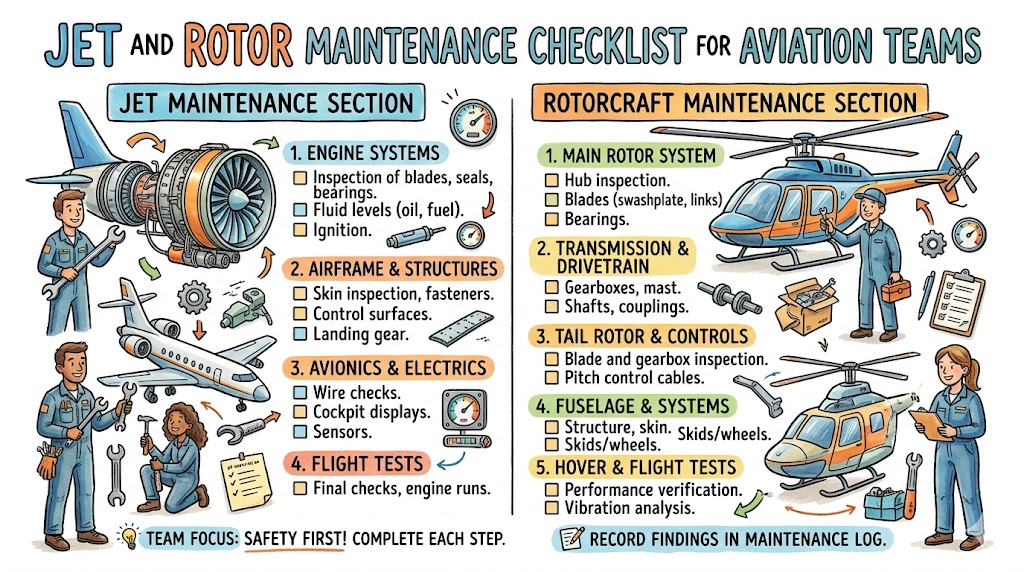
Jet and Rotor Maintenance Checklist
1- Airframe and Fuselage Inspection
- Check for cracks, corrosion, and structural integrity
- Inspect control surfaces and hinges
- Verify fasteners, rivets, and panel attachments
- Examine paint and protective coatings for wear
2- Engine and Propulsion Systems
- Inspect engine mounts and accessory components
- Check fuel system, oil levels, and fluid quality
- Examine turbines, compressors, and combustion components
- Monitor engine performance parameters and diagnostics
3- Rotor and Propeller Systems (Rotorcraft Specific)
- Inspect main and tail rotor blades for cracks or wear
- Examine rotor hubs, bearings, and pitch control mechanisms
- Lubricate moving components per manufacturer specs
- Verify rotor balance and vibration levels
4- Avionics and Electrical Systems
- Test navigation, communication, and autopilot systems
- Inspect wiring, connectors, and power distribution units
- Verify instrument calibration and functionality
- Update software and firmware as required
5- Hydraulic and Landing Gear Systems
- Inspect landing gear struts, tires, and brakes
- Check hydraulic lines, actuators, and pressure levels
- Test emergency retraction and extension systems
- Monitor fluid quality and reservoirs
6- Safety Equipment
- Verify fire suppression systems and extinguishers
- Inspect emergency locator transmitters (ELTs) and signaling devices
- Check life vests, flotation devices, and first aid kits
- Inspect seat belts and restraint systems
7- Cabin and Interior Systems
- Inspect seats, seat tracks, and panels
- Test lighting, ventilation, and climate control
- Verify communication and entertainment systems
- Maintain cleanliness and structural integrity
Comparison Table: Jet vs Rotorcraft Maintenance Focus
| Component | Jet Aircraft | Rotorcraft | Key Considerations |
|---|---|---|---|
| Engines | Turbine and accessory systems | Turboshaft or piston | Engine monitoring and oil analysis |
| Propulsion | Jet intake and exhaust | Main and tail rotors | Blade integrity, pitch control, balance |
| Airframe | Fuselage, wings, control surfaces | Fuselage, rotor mounts, tail boom | Structural integrity and corrosion prevention |
| Hydraulics | Brakes, actuators, landing gear | Rotor pitch control, landing gear | Fluid quality, leak prevention |
| Avionics | Flight management, navigation, comms | Flight instruments, radios | Calibration, software updates |
| Safety | Fire suppression, ELTs | Fire suppression, ELTs, flotation | Compliance and emergency readiness |
Tips for Aviation Teams
- Follow FAA and manufacturer-recommended maintenance schedules
- Maintain accurate logs of inspections and repairs
- Conduct pre-flight and post-flight inspections diligently
- Use diagnostic tools and engine monitoring systems
- Schedule preventive maintenance to minimize downtime
- Train technicians on aircraft-specific systems
- Maintain spare parts inventory for critical components
- Implement safety protocols and emergency response plans
- Coordinate rotor and jet inspections efficiently
- Review fleet performance metrics regularly
Common Mistakes to Avoid
- Skipping scheduled inspections or deferring repairs
- Using non-certified parts or unqualified technicians
- Ignoring rotor balance and vibration monitoring
- Failing to update avionics calibration or software
- Poor documentation of maintenance history
- Neglecting minor wear that escalates to risk
- Overlooking emergency systems checks
- Delaying preventive maintenance
- Insufficient training for new maintenance staff
- Focusing solely on cost over safety and compliance
Frequently Asked Questions
- Why is a maintenance checklist critical for aviation teams?
It ensures all critical jet and rotor systems are inspected, reducing risks and operational downtime. - What are the most safety-critical components?
Engines, rotor blades, landing gear, flight controls, and avionics are essential for safe flight. - How often should rotorcraft blades be inspected?
Before each flight and during scheduled maintenance, checking for cracks, corrosion, and wear. - Are jet and rotor maintenance requirements different?
Yes. Jets focus on turbine and airframe systems, while rotorcraft emphasize rotor blade and hub integrity. - Can maintenance be in-house or outsourced?
Both are viable; in-house teams need certified technicians, while outsourced providers must meet FAA standards. - How should spare parts be managed?
Maintain critical components inventory, including engines, rotors, avionics, and hydraulic systems. - Do avionics require software updates?
Yes, to ensure accuracy, compliance, and reliability. - What is the role of preventive maintenance?
Prevents unexpected failures, improves fleet efficiency and reliability. - Are maintenance logs required for compliance?
Absolutely. Accurate logs are essential for FAA inspections and certifications. - How can aviation teams minimize downtime?
By scheduling regular inspections, maintaining spare inventory, and using a detailed checklist.
Conclusion
A jet and rotor maintenance checklist is essential for aviation teams to ensure safe, reliable, and compliant operations. By systematically inspecting engines, rotors, airframe, avionics, hydraulics, and safety systems, teams can reduce downtime, prevent failures, and maintain optimal aircraft performance. Proper planning, thorough documentation, and strict adherence to FAA regulations ensure efficient fleet management and operational excellence.

