
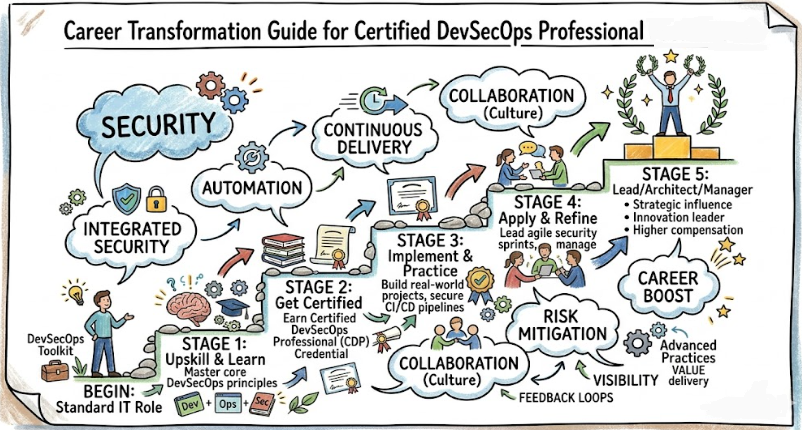
Introduction
The Certified DevSecOps Professional certification is designed for engineers and technical leaders who want to build secure delivery practices into real software systems, not just study security as a side topic.
This guide is for working professionals who need clarity on value, difficulty, prerequisites, and long-term career fit. It matters today because modern teams are expected to deliver fast, automate deeply, and still maintain strong security controls across code, pipelines, infrastructure, containers, and cloud services.
If you are trying to decide whether DevSecOpsSchool is the right place to learn this path, this guide will help you make that decision with a practical and career-focused lens.
What is the Certified DevSecOps Professional?
Certified DevSecOps Professional represents a practical certification path focused on integrating security into every phase of software delivery. It exists to help professionals move beyond siloed security thinking and learn how secure engineering works inside modern CI/CD, infrastructure automation, cloud operations, and platform teams. Instead of teaching only theory, it emphasizes how secure coding, scanning, policy enforcement, secrets handling, container hardening, and compliance fit into real production workflows. In enterprise environments, that matters because security is no longer a final approval gate. It has become part of how teams build, release, monitor, and improve systems every day.
Who Should Pursue Certified DevSecOps Professional?
This certification is useful for DevOps engineers, SREs, platform engineers, cloud professionals, security engineers, and even data professionals who operate pipelines and platforms. Beginners can use it to understand how security connects with delivery, while experienced engineers can use it to formalize and deepen production-grade practices.
It is also valuable for managers who want to lead secure platform transformation and need better technical judgment when evaluating teams, tools, and delivery risk. For professionals in India and global markets, the certification is relevant because organizations everywhere are trying to reduce release friction while strengthening governance, security posture, and operational reliability.
Why Certified DevSecOps Professional is Valuable and Future-Ready
Certified DevSecOps Professional is valuable because it builds skills that survive tool changes. Vendors, scanners, cloud services, and orchestration tools may evolve, but secure software delivery, policy automation, dependency management, secrets protection, and runtime accountability remain core business needs.
Enterprise demand continues to grow because teams need engineers who can connect development speed with security discipline instead of treating them as opposing goals. From a career point of view, this certification offers strong return on time because it supports movement into platform security, cloud security, secure automation, release engineering, and leadership roles where secure delivery is a core expectation.
Certified DevSecOps Professional Certification Overview
The program is delivered through the official course page for Certified DevSecOps Professional and is hosted on devsecopsschool.com. In practical terms, the certification path is structured to validate applied understanding of secure software delivery rather than narrow tool memorization.
Candidates are expected to understand workflows, controls, automation logic, and engineering trade-offs across development, build, test, deploy, and operations stages. The ownership and structure are aligned to professional training environments where learners need guided progression, hands-on exposure, and assessment that reflects real work. That makes the certification useful not only for passing an exam, but for improving on-the-job execution.
Certified DevSecOps Professional Certification Tracks & Levels
A logical way to approach this certification path is through foundation, professional, and advanced levels. The foundation level builds core understanding of DevSecOps principles, secure CI/CD, basic scanning, and workflow integration. The professional level focuses on applying those practices in production environments, including policy enforcement, secrets management, container security, cloud controls, and pipeline security.
The advanced level aligns with senior engineers and architects who must design scalable security patterns, influence platform decisions, and lead enterprise adoption. These levels also map well to career growth across DevOps, SRE, cloud security, platform engineering, and even cost-aware and compliance-aware operational roles.
Complete Certified DevSecOps Professional Certification Table
| Track | Level | Who it’s for | Prerequisites | Skills Covered | Recommended Order |
|---|---|---|---|---|---|
| DevSecOps Core | Foundation | Beginners, junior DevOps engineers, developers entering security-aware delivery | Basic Linux, Git, scripting, CI/CD awareness | DevSecOps basics, secure SDLC, basic scanning, pipeline concepts, secrets awareness | Start here |
| DevSecOps Delivery | Professional | DevOps engineers, SREs, cloud engineers, platform engineers | Foundation-level understanding of CI/CD, containers, cloud basics | Secure pipelines, container security, IaC security, policy checks, vulnerability handling, compliance workflows | After Foundation |
| DevSecOps Architecture | Advanced | Senior engineers, architects, technical leads, security leaders | Professional-level delivery experience, enterprise platform exposure | Security architecture, governance design, platform security, enterprise controls, audit readiness, scalable automation | After Professional |
| Cloud Security Alignment | Professional | Cloud and platform engineers building secure cloud-native systems | Containers, Kubernetes, cloud basics, CI/CD familiarity | Cloud guardrails, workload security, image trust, runtime controls, identity boundaries | Parallel with Professional |
| Secure Platform Leadership | Advanced | Managers, lead engineers, platform owners | Production delivery ownership, security collaboration experience | Operating model design, team enablement, control mapping, risk reduction strategy | After Advanced Core |
Detailed Guide for Each Certified DevSecOps Professional Certification
Certified DevSecOps Professional – Foundation Level
What it is
This level validates that a candidate understands the purpose of DevSecOps and can explain how security should be integrated into the software delivery lifecycle. It checks whether the learner can connect development, operations, and security practices into one practical workflow.
Who should take it
This level is a strong fit for junior DevOps engineers, developers moving into DevOps, cloud support engineers, and security learners who want to understand delivery pipelines. It is also useful for managers who need a solid working picture of secure delivery without going too deep too early.
Skills you’ll gain
- Understanding of secure SDLC principles
- Awareness of security checkpoints in CI/CD
- Basics of secrets handling and access hygiene
- Introduction to code, dependency, and image scanning
- Understanding of collaboration between development, operations, and security teams
Real-world projects you should be able to do
- Add basic security checks into a CI pipeline
- Review a build workflow and identify weak security points
- Create a simple secure release checklist for engineering teams
- Document how security testing fits into deployment stages
Preparation plan
- In 7–14 days, focus on core concepts, DevSecOps vocabulary, and how pipelines work end to end.
- In 30 days, add hands-on practice with CI/CD workflows, basic scanning, and secrets management basics.
- In 60 days, reinforce learning with small projects, incident examples, and architecture discussions so you build practical judgment rather than only theoretical recall.
Common mistakes
Candidates often focus only on tools and ignore workflow design.
Many also study security in isolation without understanding developer experience, release speed, and automation trade-offs. Another common mistake is skipping hands-on practice and assuming conceptual reading is enough.
Best next certification after this
- Same-track option: Certified DevSecOps Professional – Professional Level
- Cross-track option: SRE-focused reliability certification
- Leadership option: Secure platform or engineering management certification
Certified DevSecOps Professional – Professional Level
What it is
This level validates production-ready ability to implement DevSecOps controls in real delivery systems. It focuses on automation, enforcement, remediation thinking, and the practical integration of security into release pipelines, cloud platforms, and container workflows.
Who should take it
This level is ideal for working DevOps engineers, SREs, platform engineers, cloud engineers, and security practitioners who already participate in software delivery. It suits professionals who want to move from awareness to implementation and become trusted contributors in secure release processes.
Skills you’ll gain
- Secure CI/CD pipeline design
- Vulnerability management in delivery workflows
- Container and image security practices
- Infrastructure as Code security checks
- Policy enforcement and compliance alignment
- Secrets, access, and artifact trust management
Real-world projects you should be able to do
- Build a secure CI/CD pipeline with automated policy checks
- Add container image scanning and deployment gates
- Integrate IaC scanning into infrastructure provisioning workflows
- Design secrets rotation and storage standards for engineering teams
- Create remediation flow for critical vulnerabilities before release
Preparation plan
- In 7–14 days, revise DevSecOps fundamentals and identify the core security controls used in modern pipelines.
- In 30 days, build hands-on labs around CI/CD, containers, secrets, and scanning.
- In 60 days, work on end-to-end secure delivery scenarios where you design controls, review failures, and explain trade-offs between speed, reliability, and governance.
Common mistakes
A frequent mistake is treating every security failure as a hard release block without understanding severity and business context. Some candidates also memorize tool commands but cannot explain why controls are placed at specific stages. Others ignore incident response and remediation ownership, which weakens their production readiness.
Best next certification after this
- Same-track option: Certified DevSecOps Professional – Advanced Level
- Cross-track option: Cloud security or MLOps governance certification
- Leadership option: Platform architecture or engineering leadership certification
Certified DevSecOps Professional – Advanced Level
What it is
This level validates the ability to design and lead DevSecOps adoption at scale. It moves beyond implementation and focuses on architecture, governance, operating model design, platform enablement, audit readiness, and sustainable enterprise adoption.
Who should take it
This level is best for senior DevOps engineers, principal platform engineers, cloud architects, security architects, and technical leaders. It is especially relevant for professionals responsible for standards, reusable platforms, control design, or organization-wide transformation.
Skills you’ll gain
- Enterprise DevSecOps architecture design
- Security control standardization across teams
- Platform security patterns and governance models
- Risk-based policy design and exception handling
- Audit support, reporting logic, and compliance integration
- Leadership communication for secure engineering transformation
Real-world projects you should be able to do
- Design a secure golden pipeline for multiple teams
- Build enterprise guardrails for cloud and Kubernetes platforms
- Create governance patterns for secure infrastructure provisioning
- Define security exception and approval workflows at scale
- Lead modernization of legacy release processes into secure automated delivery
Preparation plan
- In 7–14 days, review advanced architecture concepts and identify common enterprise DevSecOps pain points.
- In 30 days, study platform patterns, policy enforcement models, and multi-team governance design.
- In 60 days, practice scenario-based thinking, architecture reviews, and leadership communication so you can justify decisions in both technical and business terms.
Common mistakes
Senior candidates often over-focus on architecture diagrams and under-explain operational realities. Another mistake is ignoring adoption strategy, team enablement, and workflow usability. Some also assume advanced means tool complexity, when in practice it means stronger judgment, better design decisions, and more scalable control patterns.
Best next certification after this
- Same-track option: Security architecture specialization
- Cross-track option: FinOps or DataOps governance certification
- Leadership option: Engineering management or platform leadership certification
Choose Your Learning Path
DevOps Path
If your main goal is better delivery speed, automation quality, and release consistency, start with foundation and move quickly into the professional level. DevOps engineers benefit most when they learn how security controls can support reliability instead of slowing teams down. This path is ideal for those building CI/CD, infrastructure automation, and container-based delivery. The value comes from learning how to design safer releases without breaking developer productivity. Over time, this path can open doors to platform engineering and secure automation leadership roles.
DevSecOps Path
This is the most direct path for professionals who want security deeply integrated into engineering rather than handled as a separate review function. Start with foundation if your background is mixed, then move into professional and advanced levels as your production experience grows. This path suits engineers who want to own secure pipelines, image trust, secrets protection, policy checks, and governance design. It is especially strong for professionals moving from security operations into modern cloud-native engineering. The result is stronger career positioning in organizations that need practical security builders, not only policy reviewers.
SRE Path
SRE professionals should pursue this certification when they want to connect resilience and security more effectively. Reliability without secure delivery creates hidden risk, and security without operability creates friction and unstable platforms. This path helps SREs understand how release gates, secrets handling, artifact integrity, and policy controls affect incident prevention and response. It is most useful for engineers responsible for production stability, service ownership, and deployment confidence. Combined with reliability knowledge, DevSecOps certification makes an SRE more effective in high-trust platform environments.
AIOps Path
AIOps professionals should use this certification to strengthen the security side of automated operational intelligence. As observability systems become more automated, the integrity of telemetry pipelines, access controls, model inputs, and operational workflows becomes more important. This path helps AIOps practitioners understand how secure delivery supports trustworthy automation. It is relevant for those managing event pipelines, automated response logic, and cross-platform operational tooling. Security awareness improves confidence in automated systems and reduces the chance of unsafe operational actions.
MLOps Path
MLOps professionals benefit from DevSecOps knowledge because machine learning pipelines also depend on secure code, trusted artifacts, controlled environments, and governance-aware release processes. This path is useful when you manage model packaging, deployment automation, data access boundaries, and runtime environments. It helps professionals think more carefully about supply chain security, secrets, infrastructure controls, and reproducibility. In real organizations, MLOps is increasingly expected to meet security and compliance standards similar to application engineering. That makes this path highly practical for long-term platform maturity.
DataOps Path
DataOps teams often focus on movement, quality, and orchestration of data, but secure workflow design is just as important. This path helps data engineers understand how secrets, pipeline controls, dependency trust, infrastructure security, and access management affect data operations. It is especially useful in regulated environments where data lineage, compliance, and change control matter. Professionals on this path can use DevSecOps certification to improve platform hygiene and reduce operational risk. It also strengthens collaboration with security, cloud, and platform teams that support shared infrastructure.
FinOps Path
FinOps practitioners may not build pipelines every day, but they increasingly work with cloud governance, platform standards, and operational policies that intersect with secure engineering. This path helps them understand how secure automation, cloud access boundaries, and governance controls influence cost, risk, and platform efficiency. It is useful for professionals who want to contribute to policy-aware cloud operations and responsible platform design. As organizations mature, cost, compliance, and security decisions become connected. That makes DevSecOps understanding surprisingly valuable for cloud-financial decision makers.
Role → Recommended Certified DevSecOps Professional Certifications
| Role | Recommended Certifications |
|---|---|
| DevOps Engineer | Foundation Level, Professional Level |
| SRE | Foundation Level, Professional Level |
| Platform Engineer | Professional Level, Advanced Level |
| Cloud Engineer | Foundation Level, Professional Level, Cloud Security Alignment |
| Security Engineer | Professional Level, Advanced Level |
| Data Engineer | Foundation Level, Professional Level |
| FinOps Practitioner | Foundation Level, Secure Platform Leadership |
| Engineering Manager | Professional Level, Advanced Level, Secure Platform Leadership |
Next Certifications to Take After Certified DevSecOps Professional
Same Track Progression
Same-track progression is best for professionals who want deep specialization in secure delivery and platform security. After completing the professional level, the next step should be advanced architecture, governance, or cloud-native security specialization. This builds stronger authority in secure platform design, control standardization, and enterprise operating models. It is the right path for those who want to become senior DevSecOps engineers, security architects, or platform leaders responsible for organization-wide practices.
Cross-Track Expansion
Cross-track expansion helps professionals broaden their impact beyond secure delivery into adjacent areas like SRE, cloud, MLOps, or DataOps. This matters because modern systems are interconnected, and engineering decisions often affect reliability, data governance, automation quality, and cloud cost. Expanding into nearby tracks improves decision-making and makes a professional more adaptable to changing team structures. It is a strong move for engineers who want to become platform generalists with depth in security.
Leadership & Management Track
Leadership progression is the right move for professionals who want to guide teams, define standards, and shape delivery culture. After Certified DevSecOps Professional, a leadership-oriented certification path should focus on engineering management, platform transformation, governance design, and risk communication. This does not mean leaving technical work behind. It means learning how to turn technical knowledge into repeatable team practices, clearer decisions, and scalable operating models that support both speed and control.
Training & Certification Support Providers for Certified DevSecOps Professional
DevOpsSchool
DevOpsSchool is often positioned as a practical training provider for engineers who want hands-on, implementation-oriented learning rather than only theoretical certification preparation. Its strength usually lies in helping learners connect automation, cloud, delivery workflows, and operational thinking in a structured way. For someone preparing for Certified DevSecOps Professional, this kind of environment can be useful because DevSecOps is not an isolated security topic. It requires understanding how development, release engineering, infrastructure, and runtime operations connect. A provider like this is most helpful when it offers guided labs, mentor-led explanations, and production-style examples that help candidates build judgment, not just memorize tools or exam phrases.
Cotocus
Cotocus can be useful for learners who want training support that connects cloud, automation, and operational engineering with practical implementation needs. For a DevSecOps learner, a provider in this space becomes helpful when it explains how secure delivery fits into broader engineering systems such as provisioning, monitoring, release control, and environment consistency. The real value comes when candidates are trained to think in workflows, not isolated features. A support provider should help professionals understand how policy, pipeline design, secrets handling, and compliance checks affect delivery quality. That kind of guidance can improve both certification readiness and actual workplace performance after the learning program is complete.
Scmgalaxy
Scmgalaxy is generally most relevant for professionals who want strong grounding in SCM, CI/CD, release workflows, and automation practices that support modern DevSecOps. Since secure software delivery starts with version control discipline, pipeline maturity, and repeatable release engineering, a provider with this orientation can help learners build the right base. For certification preparation, this matters because many candidates underestimate how much DevSecOps depends on clean engineering process design. Strong support should help learners understand not only what to secure, but where controls naturally fit in developer workflows. That makes preparation more realistic and reduces the gap between study and production execution.
BestDevOps
BestDevOps is often viewed as a provider that supports practical learning around DevOps ecosystems, tooling, automation patterns, and production-style workflows. For Certified DevSecOps Professional preparation, such a provider can be valuable when it frames security as part of delivery architecture rather than a separate domain. Learners benefit most when they are shown how secure coding, dependency trust, image validation, policy checks, and secrets handling become part of daily engineering work. A good support experience should also explain trade-offs clearly, such as how to balance release speed with control depth. That makes the learning journey more useful for real projects and enterprise responsibilities.
devsecopsschool.com
devsecopsschool.com is highly aligned to this certification topic because its focus is directly connected with DevSecOps education and secure delivery learning paths. For learners, that alignment matters because topic clarity often improves course relevance, mentoring quality, and certification structure. A focused provider can better organize learning around secure CI/CD, container security, IaC scanning, governance, and enterprise practices without diluting the path. It can also help candidates understand the difference between awareness, implementation, and architectural ownership. That is important for professionals who are not just looking to pass an assessment, but who want to improve how they design, automate, and govern secure delivery systems in real organizations.
sreschool
sreschool can be especially useful for professionals approaching DevSecOps from a reliability and operations background. Many SREs already understand incident response, automation, observability, and production ownership, but they may need stronger structure around secure delivery and policy-driven release workflows. A provider with SRE relevance can help bridge that gap by showing how security and reliability reinforce each other. For example, secure artifact flow, secrets management, deployment safety, and change control all have direct impact on production confidence. This makes such a provider valuable for SREs who want to expand their technical range without losing the reliability mindset that already defines their role.
aiopsschool
aiopsschool can support learners who want to understand how secure engineering principles affect automated operations and intelligent platform behavior. While AIOps and DevSecOps are different domains, they meet in areas such as access governance, telemetry integrity, workflow automation, and operational trust. For certification learners, this connection becomes useful when organizations begin automating response patterns and cross-platform operations. A provider with AIOps context can help engineers think about how secure delivery practices support trustworthy automation. That broader systems view is increasingly important in enterprise environments where operational intelligence depends on clean pipelines, controlled changes, and reliable platform foundations.
dataopsschool
dataopsschool can be a helpful support provider for professionals who operate data pipelines, orchestration systems, and analytics environments that need stronger security discipline. Data workflows often include shared infrastructure, sensitive data movement, automated jobs, and multiple access boundaries, so DevSecOps knowledge becomes very relevant. A provider with DataOps awareness can help candidates understand how security controls apply to data engineering delivery, not just application delivery. That includes infrastructure control, secrets usage, dependency risk, and operational traceability. This perspective is especially useful for engineers who work across cloud, platform, and data responsibilities and need a more complete view of secure pipeline design.
finopsschool
finopsschool can add value for learners who want to understand the relationship between secure cloud operations, governance, and cost-aware platform decisions. FinOps is not a direct substitute for DevSecOps, but the two intersect in policy design, cloud access boundaries, operational efficiency, and governance maturity. For certification learners, this connection is useful because secure engineering choices often influence cloud usage patterns, control overhead, and platform standardization. A provider with FinOps perspective can help professionals think more broadly about how architecture, security, and cost come together in enterprise environments. That makes certification learning more strategic and more relevant for cross-functional decision-making.
Frequently Asked Questions (General – 12 Questions)
1. Is Certified DevSecOps Professional difficult for beginners?
It can be challenging at first, but it becomes easier if you already know basic DevOps, Linux, Git, and CI/CD concepts.
2. How much time do I need to prepare?
Most learners need around 30 to 60 days, depending on their background and daily study time.
3. Do I need coding experience?
Basic scripting and automation knowledge are helpful, but you do not need to be an expert developer.
4. Is this certification only for security engineers?
No, it is useful for DevOps engineers, SREs, cloud engineers, platform engineers, and managers too.
5. Is the certification worth the effort?
Yes, especially if you want stronger skills in secure delivery, cloud security, and platform engineering.
6. Should I learn DevOps before DevSecOps?
Yes, basic DevOps knowledge helps you understand how security fits into delivery workflows.
7. Can this certification help in cloud security roles?
Yes, it supports roles related to cloud security, secure automation, and policy enforcement.
8. Is it useful for enterprise jobs?
Yes, enterprise teams value professionals who can balance speed, security, and compliance.
9. Will the certification become outdated quickly?
No, because the core concepts remain useful even when tools change.
10. Is it useful for managers?
Yes, it helps managers understand secure delivery and make better platform decisions.
11. Can I prepare without real project experience?
Yes, but hands-on labs and small practice projects will help a lot.
12. What should I study after this certification?
You can go deeper into DevSecOps or expand into SRE, cloud, MLOps, DataOps, or leadership.
FAQs on Certified DevSecOps Professional (8 Focused Q&A)
1. How is it different from a DevOps certification?
It focuses more on security in CI/CD, infrastructure, containers, and cloud workflows.
2. What practical skills will I gain?
You will learn secure pipelines, secrets handling, scanning, policy checks, and delivery risk reduction.
3. Is it useful for Kubernetes and container security?
Yes, it is very relevant for modern cloud-native and container-based environments.
4. Can it help reduce release risk?
Yes, it helps teams catch security issues earlier and improve release confidence.
5. Is it useful for service companies and product companies?
Yes, both can benefit from better secure delivery practices and stronger engineering standards.
6. What is the biggest learning mistake?
The biggest mistake is focusing only on tools and ignoring workflow design.
7. Should I stop at professional level or go advanced?
Go advanced if you want architecture, governance, or leadership-level responsibilities.
8. Is it worth it if my company is still new to DevSecOps?
Yes, it can help you bring structured secure delivery practices into a growing team.
Final Thoughts: Is Certified DevSecOps Professional Worth It?
Certified DevSecOps Professional is worth it for professionals who want to become more effective in modern software delivery, not just more credentialed. Its real value comes from helping you think clearly about how secure engineering should work inside pipelines, platforms, cloud environments, and operating teams. If you only want a quick certificate, the impact will be limited.
But if you want stronger judgment, broader technical relevance, and better career options across DevOps, SRE, platform engineering, and cloud security, it is a sensible investment. The best candidates for this path are people who want to reduce risk without reducing delivery quality. That balance is exactly what strong engineering teams need.

