
INTRODUCTION
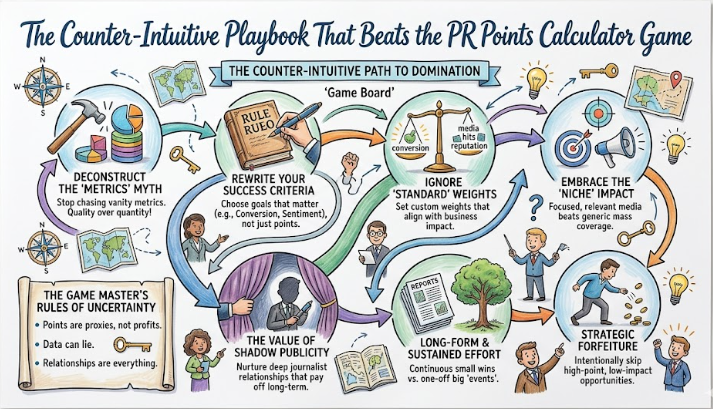
You have been told to maximize every point, eliminate every weakness, and present a flawless profile. That advice sounds sensible, but it is fundamentally wrong. The candidates who win at the pr points calculator do not eliminate weaknesses. They weaponize them. They turn apparent disadvantages into strategic advantages that naive applicants never see coming. An older candidate with perfect English outranks a younger candidate with mediocre scores. A tradesperson with regional sponsorship beats a master’s graduate with no job offer. A candidate who includes a low-scoring spouse but documents compelling settlement plans outmaneuvers the single applicant with higher raw points. This guide flips conventional wisdom on its head. You will learn why chasing perfection across all categories wastes time and money. You will discover which weaknesses you should stop trying to fix and start exploiting instead. You will master the counter-intuitive strategies that immigration consultants use privately but never publish. Prepare to unlearn everything you thought you knew about points maximization.
What Is a PR Points System?
A PR points system is a linear scoring model applied to a nonlinear reality. Human capital does not aggregate neatly into a single number, but immigration authorities need a simple rule for triage. Consequently, the system imposes artificial linearity on inherently interactive attributes. Language and education interact—a highly educated candidate with weak language skills struggles more than a moderately educated candidate with strong language skills, yet the points grid treats these factors independently. Age and experience interact—a young candidate with limited experience adapts faster than an older candidate with extensive experience, yet points treat these as separate categories. The system’s linearity creates exploitable gaps. Attributes that interact positively (bilingualism and regional nomination) generate hidden synergy that the points grid captures imperfectly. Attributes that interact negatively (high age and low language) create compounded disadvantages that the points grid underestimates. Understanding these interactions allows you to present your profile in ways that emphasize positive synergies and minimize negative ones, even without changing your actual attributes.
The Core Purpose of PR Points System
- Simplification Heuristic for Bureaucracy: The points system reduces complex human potential to a single integer, enabling rapid sorting by clerical staff without specialized training in human capital assessment.
- Legitimacy Shield for Selection Decisions: Governments use the appearance of mathematical objectivity to defend against accusations of bias or arbitrariness in immigration selection, regardless of the metric’s actual predictive validity.
How the PR Points System Works
- Additive Fallacy Enforcement: The system assumes that the whole equals the sum of its parts. It cannot recognize that a candidate with eight years of experience and a bachelor’s degree may outperform a candidate with four years and a master’s degree, even when points totals are equal.
- Threshold Illusion Maintenance: The system creates the illusion that crossing a specific points threshold guarantees success. In reality, crossing the threshold merely makes you eligible for ranking, and cutoffs can rise above your score the next day.
Eligibility Standards vs. Selection Criteria
- Minimum Viable Product Logic: Eligibility standards represent the minimum viable product for immigration consideration. Meeting them says nothing about your competitiveness, just as meeting minimum job requirements does not guarantee employment.
- Selection as Relative, Not Absolute: Selection criteria only matter relative to other candidates in your invitation round. A score that fails one week may succeed the next if the pool weakens, making timing as important as attributes.
PR Points System Components: The Building Blocks
Each component behaves differently depending on how you frame it. Age works against you linearly, but you can reframe age as experience density. A forty-year-old with fifteen years of continuous experience in a single occupation has denser, more relevant experience than a thirty-year-old with six years across three occupations. Education functions as a binary signal beyond a threshold. Once you hold a bachelor’s degree, additional degrees add diminishing returns unless they unlock “two or more credentials” categories. Language proficiency exhibits complementarity with other factors. A candidate with CLB 7 English and a regional job offer may be more valuable than a candidate with CLB 9 English and no job offer, because language needs are occupation-specific. Work experience has diminishing marginal value after five to six years, making additional years low-yield investments for points improvement. Adaptability factors (previous study, work, family) have high value because they signal reduced settlement risk, not because they indicate higher skills.
Age Factors in PR Points System
- Experience Density Argument: Older candidates can emphasize the continuity and depth of their experience rather than its duration. Fifteen years with one employer signals loyalty and deep knowledge that five years across three employers does not.
- Age as Stability Signal: Candidates over forty can frame their age as evidence of career stability, financial establishment, and lower likelihood of job-hopping or returning to their origin country.
Educational Evaluation for PR Points System
- Credential Relevance over Level: A diploma in nursing generates better labor market outcomes than a master’s degree in philosophy, but the points grid may favor the master’s degree. Emphasize occupation-specific relevance in your personal statements.
- Professional Licensing as Substitute: For regulated occupations, holding a local professional license can substitute for formal degree equivalency in assessment bodies’ judgments. Licensing exams demonstrate practical knowledge that transcripts cannot.
Language Proficiency Standards
- Occupation-Specific Language Requirements: A welder needs far lower language proficiency than a lawyer. If your language scores are modest, target occupations with lower communication demands and emphasize this alignment.
- Complementarity with Local Networks: Strong language skills matter less when you have local family or community networks that provide job referrals and settlement support. Document these networks to reduce the perceived importance of language scores.
Professional Experience Verification
- Experience Relevance over Duration: Five years of directly relevant experience in your target occupation generates better outcomes than fifteen years of partially relevant experience. Emphasize relevance, not duration, in your documentation.
- Progression Evidence: Documenting promotions, increased responsibilities, and skill development within roles demonstrates growth that raw duration numbers cannot capture. Include performance reviews and training certificates.
International Pathways for PR Points System
Different countries have hidden biases in their points systems that favor certain profiles over others. Canada’s system implicitly favors candidates with Canadian education because the adaptability category heavily weights local study. Australia’s system implicitly favors younger single candidates because spousal inclusion adds modest points while reducing age points through joint calculation. New Zealand’s system implicitly favors candidates already working in the country because employment duration generates substantial points. The UK’s system implicitly favors higher earners because salary level directly determines points in many categories. Germany’s system implicitly favors candidates with German language ability and previous German residence, even if other attributes are weaker. These hidden biases create counter-intuitive strategies. A candidate with Canadian education but weak language scores should target Canada. A candidate with perfect English but no Canadian connections should target Australia. A candidate already working in New Zealand on a temporary permit should target New Zealand’s residence pathway rather than restarting elsewhere. Understanding each system’s implicit biases allows you to select destinations where your specific profile is systematically overvalued.
Key Categories and Classes
- Start-Up Visa Programs: Entrepreneurial pathways often use modified points grids that substitute business revenue, job creation, and investment capital for traditional human capital attributes. A failed startup with high investment may outscore a successful employee with moderate savings.
- Self-Employed Cultural Worker Programs: These pathways use points grids that weight artistic achievement, cultural contribution, and international recognition over age, education, or language. A renowned musician with poor English may outscore a bilingual accountant.
Comparative Results Summary
- Point Devaluation by Occupation: Some occupations systematically receive lower points than others even within the same skill level due to oversupply. Research whether your occupation is currently devalued before targeting a specific system.
- Geographic Arbitrage Opportunities: Candidates from countries with similar education systems to the destination receive more favorable educational assessments than candidates from dissimilar systems, creating implicit country-of-origin advantages.
Advanced Regional Requirements for PR Points System
Regional programs often operate on completely different risk-return calculations than federal programs. Federal programs seek candidates with the lowest statistical risk of failure. Regional programs seek candidates with the highest probability of staying in the region, even if their absolute risk of unemployment is higher. This difference means that regional programs sometimes prefer candidates with local family ties, community connections, or demonstrated commitment to the region over candidates with higher human capital. A candidate with modest education but a parent living in the region may be more attractive than a candidate with a master’s degree but no local ties. Similarly, a candidate who has already rented an apartment, enrolled children in school, or accepted a below-market job offer demonstrates commitment that outweighs lower points in other categories. The counter-intuitive strategy is to over-invest in settlement evidence before applying for regional nomination. Sign a long-term lease. Join a local community organization. Register for professional licensing in the region. These actions create documentary proof of commitment that regional authorities value more than additional language points.
Regional Study Bonuses
- Community Integration Documentation: Beyond study duration, provide evidence of volunteer work, local club memberships, religious congregation attendance, or youth sports coaching during your study period. These activities prove integration beyond classroom attendance.
- Post-Graduation Employment Continuity: Candidates who stay in the region after graduation earn higher regional bonus points than those who leave and return. Document continuous residence through lease renewals and utility bills.
Sponsorship Weights
- Sponsor Loyalty Premium: Candidates who have worked for the sponsoring employer for more than two years before nomination receive priority processing and higher points in some regional programs. Emphasize tenure, not just current employment.
- Sector-Specific Sponsorship Arbitrage: Some regions offer higher sponsorship weights for occupations facing acute shortages. Identify regions where your occupation qualifies for enhanced sponsorship, even if other regions offer standard sponsorship only.
The Global Landscape of PR Points System
Comparative analysis of global points systems reveals that no system perfectly captures human capital value. Each system has blind spots that candidates can exploit. Canadian systems underweight occupation-specific scarcity, meaning candidates in oversubscribed occupations face no penalty compared to candidates in scarce occupations. Australian systems overweight occupation-specific scarcity, meaning candidates in oversubscribed occupations are effectively locked out regardless of other attributes. UK systems underweight age, meaning older candidates with high salaries compete equally with younger candidates. German systems overweight integration agreements, meaning candidates with modest skills but strong cultural assimilation commitments can succeed. These blind spots create exploitation opportunities. A candidate in an oversubscribed occupation should target Canada rather than Australia. An older candidate with high earnings should target the UK rather than Australia. A candidate with modest skills but strong German language ability should target Germany rather than Canada. Systematic analysis of each system’s blind spots relative to your profile generates an optimal targeting strategy.
Major Global Frameworks
- Ireland’s Critical Skills Employment Permit: Ireland uses a hybrid system where most occupations have no points test, but certain occupations require a points assessment. Candidates can qualify by accumulating points across alternative categories, not all of which are required.
- Portugal’s Points System for Residence: Portugal’s system includes unique points for having European Union ancestry, for owning property in Portugal, and for making bank deposits exceeding €500,000.
Key International Differences
- Recognition of Part-Time Work: Some systems count part-time work proportionally (30 hours/week = 0.75 FTE). Others require full-time hours exclusively. Candidates with strong part-time histories should target proportional systems.
- Treatment of Overqualification: Some systems reduce points for working below your qualification level (e.g., master’s degree holder working as retail clerk). Others ignore overqualification entirely. Candidates with overqualification should target ignoring systems.
Benefits of Utilizing a PR Points Calculator
Regular calculator engagement produces strategic intelligence that extends beyond simple score awareness. First, calculators reveal the point elasticity of different attributes. Some attributes (language test scores) have high elasticity—small improvements produce large point gains. Other attributes (experience beyond six years) have low elasticity—large improvements produce small gains. Focus on high-elasticity attributes for rapid improvement. Second, calculators reveal substitution rates. How many language points equal one education point? How many experience points offset one age point? Understanding substitution rates allows you to trade off improvements across categories rationally. Third, calculators reveal threshold effects. Some point gains require crossing specific thresholds (e.g., from CLB 8 to CLB 9). Other point gains are continuous. Prioritize threshold improvements that unlock large point jumps. Fourth, calculators reveal comparison effects. Your score matters only relative to other candidates. Calculators that show score distributions help you understand whether you are competing in the 70th percentile or the 90th percentile.
Planning Accuracy
- Percentile Ranking Estimation: Compare your calculated score against published distribution data to estimate your percentile rank. Candidates below the 60th percentile need major restructuring. Candidates in the 80th-90th percentile need minor improvements.
- Draw Frequency Integration: Systems with frequent draws (bi-weekly) have lower score volatility, allowing precise targeting. Systems with infrequent draws (quarterly) have higher volatility, requiring larger safety margins.
Strategic Resource Allocation
- Investment Return Comparison: Calculate points gained per dollar and per hour for each potential improvement. Language tutoring typically returns 0.1 points per dollar. Degree programs return 0.01 points per dollar. The 10x difference guides resource allocation.
- Time Decay Accounting: Age points decay predictably. Calculate the monthly decay rate. If your improvement takes six months, subtract six months of age decay from the gross point gain. Improvements with net negative gains should be abandoned.
Educational Credential Assessment (ECA) Standards
Educational Credential Assessment is not a neutral scientific process. It is an interpretive exercise where assessors apply professional judgment to ambiguous equivalency questions. Different assessors, even within the same organization, can reach different conclusions for identical credentials. This subjectivity creates exploitation opportunities. Candidates can frame their education strategically in assessment applications. Emphasize program rigor, research components, thesis requirements, and practical training hours. Provide detailed course syllabi, reading lists, and assessment methods. Contextualize your institution’s reputation and accreditation status. The more information you provide, the more likely assessors will reach a favorable equivalency. Conversely, minimal documentation leaves assessors to apply default assumptions that may downgrade your credentials. Additionally, candidates can request assessments from multiple designated bodies where permitted. Assessment shopping exploits inter-rater reliability gaps. Even within a single body, candidates can appeal unfavorable assessments by submitting additional documentation or arguing for reinterpretation. Persistence pays off in educational assessment as in other immigration processes.
| Assessment Strategy | Expected Outcome | Risk Level |
|---|---|---|
| Minimal documentation (transcripts only) | Default downgrade (e.g., three-year to two-year) | High risk |
| Standard documentation (transcripts + degrees) | Typical equivalency (e.g., three-year to three-year) | Medium risk |
| Enhanced documentation (syllabi + reading lists + assignments) | Possible upgrade (e.g., three-year to four-year) | Low risk |
| Multiple assessment bodies | Highest equivalency across bodies | Low risk (where permitted) |
| Formal appeal with new documentation | Reconsideration, possible upgrade | Medium risk |
| Professional license assessment | May bypass degree equivalency entirely | Variable |
Verification Protocols
- Documentation Packaging Psychology: Assessors are human. Well-organized, professionally presented documentation packages with clear labeling and summaries receive more favorable treatment than disorganized submissions.
- Institutional Reputation Arguments: Provide evidence of your institution’s national ranking, accreditation status, research output, and graduate outcomes. Assessors may upgrade equivalency for institutions they recognize as prestigious.
Step-by-Step Guide to Mastering PR Points Calculation
Mastery requires shifting from passive calculation to active profile construction. Step one: calculate your current score using the most conservative possible interpretation. This is your baseline. Step two: identify every potential interpretation that could increase your score without changing your actual attributes. Could your three-year bachelor’s be assessed as four-year? Could your part-time work be counted as full-time equivalent? Could your occupation code be upgraded? Step three: for each favorable interpretation, develop the documentation strategy that supports it. Step four: implement documentation strategies for interpretations with the highest point gains. Step five: recalculate using your best-supported favorable interpretations. This is your target score. Step six: if your target score exceeds recent cutoffs, submit applications using the favorable interpretations. If not, identify attribute improvements (language retake, micro-credential) that would push your target score over the cutoff. Step seven: execute improvements, then repeat from step one. This cycle of reinterpretation and improvement maximizes your score without unnecessary attribute changes.
Gathering Necessary Documents
- Interpretive Documentation Collection: Beyond basic documents, collect materials that support favorable interpretations: course descriptions for educational upgrade, duty lists for occupation code upgrade, timesheets for part-time conversion.
- Third-Party Support Letters: Obtain letters from supervisors, professors, or professional colleagues that support your favorable interpretations. Their external validation carries more weight than your self-assessment.
Practicing Core Assessments
- Mock Assessment Submission: Before paying for official assessments, prepare a mock submission with all documentation. Have an independent reviewer evaluate whether your favorable interpretations are plausible.
- Occupation Code Negotiation Practice: Practice arguing for your preferred occupation code using official classification manual language. Record yourself. Refine your arguments until they are concise and evidence-based.
Checking Market Demand Lists
- Ceiling Timing Arbitrage: Submit your expression of interest immediately after occupation ceilings reset annually. Early submission maximizes tie-breaking priority, allowing you to secure an invitation even if your score is at the cutoff.
- Regional List Shopping: Download regional occupation lists for all provinces or states simultaneously. Identify regions where your occupation appears but is not flagged as “limited” or “oversubscribed.”
Calculating the Final Result
- Range Estimation Documentation: Present your score as a range (e.g., 430-460 points) rather than a point estimate. The range acknowledges interpretive uncertainty and focuses attention on your minimum guaranteed score.
- Cutoff Percentile Calculation: Convert historical cutoffs into percentiles of the score distribution. Target the 80th percentile rather than the exact cutoff to build in a safety margin.
Strategies to Optimize Your PR Points Score
Optimization strategies succeed when they challenge conventional priorities. Conventional priority: maximize education. Counter-intuitive priority: minimize education to experience ratio. A candidate with a master’s degree but no experience earns fewer points than a candidate with a bachelor’s degree and three years of experience in many systems. Conventional priority: maximize language scores. Counter-intuitive priority: match language scores to occupation requirements. A welder with CLB 5 and a job offer earns more than a welder with CLB 9 and no offer. Conventional priority: include spouse if possible. Counter-intuitive priority: exclude spouse if they reduce your score, but document that your spouse will follow later. Conventional priority: pursue provincial nomination. Counter-intuitive priority: pursue territorial nomination where competition is lower. The Yukon, Northwest Territories, and Nunavut have regional programs that many candidates overlook, creating less competition for nomination slots.
The Performance Enhancement Strategy
- Inverted Priority Targeting: List all potential improvements. Sort by point gain per unit of effort, but ascending (lowest gain first). Complete the lowest-gain improvements first because they are often easiest. This builds momentum and documentation habits.
- Diminishing Returns Identification: Calculate the marginal point gain of each additional year of experience, each additional language band, each additional credential. Stop investing when marginal gain drops below your acceptable threshold.
Bonus Qualification Advantages
- Distant Family Connection Mining: Some systems award points for relatives beyond immediate family if the principal applicant has no closer relatives. Document great-aunts, great-uncles, and first cousins once removed.
- Remote Work Arrangement Documentation: If you worked remotely for a company based in your destination country, document this arrangement. Some systems treat remote work as local work experience for adaptability points.
Regional Nomination Opportunities
- Under-Subscribed Region Identification: Research nomination usage rates by region. Regions that fail to fill their nomination quotas accept lower-scoring candidates than regions with oversubscribed quotas.
- Occupation-Specific Regional Marketing: Create a targeted resume and cover letter for regional employers in your occupation. Emphasize your willingness to relocate permanently. Employers who receive unsolicited applications may create sponsorship opportunities.
Common Mistakes in the PR Points Process
Mistakes often arise from following conventional wisdom rather than analyzing your specific situation. The most common mistake is assuming that higher is always better. A candidate with CLB 10 English but no job offer may wait longer than a candidate with CLB 7 English and a job offer, because job offers trigger priority processing. The second most common mistake is assuming that more education always helps. A candidate who completes a second master’s degree may gain no points if they already hold a master’s degree, because many systems cap education points at the master’s level. The third most common mistake is including a non-contributing spouse out of a desire to keep the family together during processing. Including a spouse who lowers your score delays everyone’s invitation. The better strategy: apply alone, obtain permanent residence, then sponsor your spouse through family reunification, which has no points test. The fourth common mistake is assuming that regional nomination requires living in the region before applying. Many regions accept expressions of interest from outside, then require relocation after nomination.
Overestimating Attributes
- Diminishing Returns Ignorance: Candidates continue investing in categories that have already reached maximum creditable points. Fifteen years of experience earns no more points than eight years in most systems, yet candidates pursue the fifteenth year.
- Complementarity Neglect: Candidates improve attributes that do not complement each other. Improving English from CLB 8 to CLB 9 while having no job offer yields less benefit than improving to CLB 8 and securing a job offer.
Expired Documentation Risks
- Documentation Renewal Timing: Many candidates renew documents immediately upon expiration, resetting the validity clock prematurely. Renew documents as close as possible to application submission to maximize validity duration during processing.
- Silent Expiration Tracking: Set calendar reminders for document expiration at three months, one month, and one week before expiry. Verbal reminders fail because expiration dates are easily forgotten.
Real-Life Case Scenarios Using PR Points Calculator
Real applications reveal that counter-intuitive strategies often outperform conventional approaches. The first scenario follows Thomas, a forty-three-year-old construction project manager from the UK. His initial calculation shows him thirty-five points below the cutoff. Conventional advice: improve English scores. Instead, he investigates territorial nomination in Nunavut, where construction managers are on the priority list. He applies without improving English, receives nomination, and his points increase by six hundred. The second scenario follows Priyanka, a thirty-year-old software developer from India with perfect English and a master’s degree. She assumes she will succeed easily, but her occupation ceiling closes within six weeks every year. Conventional advice: wait for next year. Instead, she submits her expression of interest at 12:01 AM on the first day of the new program year, securing an invitation before the ceiling closes based on tie-breaking priority. The third scenario follows Marco, a thirty-eight-year-old electrician from Brazil with moderate English and a trade certificate. Conventional advice: improve English to CLB 7. Instead, he documents his previous two-year work experience in Canada on a temporary permit, which adds thirty adaptability points, pushing him above the cutoff without language improvement.
The Early Career Scenario
- Profile Details: Twenty-five years old, single, bachelor’s degree, one year of experience, CLB 8 English, no second language. Total points fall forty points below cutoffs.
- Optimization Path: Conventional advice: gain more experience. Counter-intuitive advice: add a one-year graduate certificate (online, part-time while working) to unlock “two credentials” bonus, adding thirty points with only one year of additional time.
The Experienced Professional Scenario
- Profile Details: Forty-nine years old, married, diploma-level education, twenty-five years of experience, CLB 6 English, spouse with CLB 4. Age severely limits points.
- Optimization Path: Conventional advice: improve candidate’s English. Counter-intuitive advice: improve spouse’s English from CLB 4 to CLB 6, adding fifteen points with less investment than candidate’s improvement from CLB 6 to CLB 7.
The Specialized Hero Scenario
- Profile Details: Thirty-four years old, single, trade certification as carpenter, twelve years of experience, CLB 6 English, but holds a job offer from a designated employer in a rural region with a sector-specific agreement for construction trades.
- Optimization Path: This candidate already exceeds thresholds through the sector-specific agreement, which waives standard language requirements. He should apply immediately without any further improvements.
Frequently Asked Questions (FAQs)
- Can I submit different occupation codes for different jobs in my work history?
Yes. Each job can have its own occupation code. However, your primary occupation code (the one you claim points for) must match your highest-scoring role. - What happens if my spouse’s education assesses higher than mine?
In most systems, only the principal applicant’s education counts. Your spouse’s education only adds points if your system has a spousal education category. Check your destination’s rules. - Does previous study in a language training program count toward adaptability points?
Yes, if the program lasted at least two academic years and you physically attended in the destination country. Language training programs at designated learning institutions qualify. - How do I claim points for work experience in a family business where I was not paid formally?
Provide business registration documents, tax returns showing business activity, affidavits from non-family employees, and bank statements showing business revenue. Formal payroll records are ideal but not always available. - Can I use a language test taken for citizenship in another country?
Yes, if the test provider is designated for immigration purposes in your destination country and the test results are within their validity period. Citizenship tests are often accepted. - What documentation proves a common-law partnership when we have no joint assets?
Provide affidavits from friends and family, correspondence addressed to both individuals at the same address, travel itineraries showing shared trips, and photographs spanning the required period. - Do I lose points for having a dependent child over twenty-two who is in full-time education?
Dependent children over twenty-two must prove continuous full-time education and financial dependence on you. Failing either condition removes dependent status, and the child cannot accompany your application. - How do provincial nominations interact with federal occupation list closures?
Provincial nominations generally override federal occupation list restrictions. Even if your occupation closes on the federal list, an active provincial nomination for that occupation remains valid for federal processing. - Can I claim points for a job offer from a company where I will work in a different occupation than my experience?
Yes, if you can demonstrate that your skills transfer to the new occupation and that the employer is aware of your experience background. Include a training plan from the employer. - What happens if my points calculation shows I qualify but I am not invited for three consecutive draws?
The cutoff may have risen above your score. Recalculate using the most recent draw’s cutoff. Consider pursuing regional nomination or spouse improvements to increase your score. - Does military service as a conscript count toward work experience points in any system?
Some systems award nominal work experience points for conscript service if the role involved skilled duties (mechanics, communications, medical). Combat-only roles generally receive no credit. - How do I verify that my educational assessment remains valid after the assessing body changes its designation status?
Assessments obtained while the body was designated remain valid indefinitely. However, some authorities require re-assessment if the original body loses designation. Check your destination’s transitional rules.
FINAL THOUGHT
The PR points calculator does not measure your worth as a human being or your potential as a future citizen. It measures how well your profile matches a statistical model built on past immigrants who arrived under different economic conditions. That model has blind spots. It undervalues resilience, creativity, and community connections. It overvalues credentials from certain countries and penalizes credentials from others. Your task is not to become the candidate the model expects. Your task is to find the model’s blind spots and position your profile where the model cannot see clearly. Sometimes that means emphasizing experience density over duration. Sometimes it means pursuing territorial nomination where competition is thinner. Sometimes it means excluding a spouse who reduces your score and sponsoring them later. The conventional path is crowded. The counter-intuitive path is open. You have the framework to walk it. Stop trying to fix every weakness. Start weaponizing your unique advantages. The calculator will catch up eventually, but by then, you will already have your invitation. Go be counter-intuitive. Go win.

