
Introduction
Modern enterprises are rapidly adopting AI-driven systems to improve software delivery, infrastructure management, and operational reliability. However, as machine learning models move into production environments, organizations face new challenges such as model monitoring, system reliability, data drift, and operational complexity.
This is where MLOps and AIOps Integration for Intelligent Automation becomes essential. By combining Machine Learning Operations (MLOps) with Artificial Intelligence for IT Operations (AIOps), enterprises can build fully automated, intelligent, and self-healing digital ecosystems.
This integration helps organizations not only deploy ML models efficiently but also ensure that the underlying infrastructure remains stable, observable, and optimized at all times.
What Is MLOps?
MLOps (Machine Learning Operations) is the practice of managing the lifecycle of machine learning models in production. It focuses on:
- Model training and versioning
- Continuous integration and deployment of ML models
- Monitoring model performance
- Managing data pipelines
- Ensuring reproducibility and governance
MLOps bridges the gap between data science and production systems, ensuring that ML models remain reliable and scalable in real-world environments.
What Is AIOps?
AIOps (Artificial Intelligence for IT Operations) uses machine learning and automation to improve IT operations. It focuses on:
- Infrastructure monitoring
- Anomaly detection
- Event correlation
- Root cause analysis
- Automated incident response
AIOps helps IT teams manage complex systems by turning raw operational data into actionable insights.
Why MLOps and AIOps Need to Work Together
On their own, MLOps and AIOps solve different problems. MLOps focuses on machine learning systems, while AIOps focuses on infrastructure and operations. However, in modern cloud-native environments, these two areas are deeply interconnected.
Integration is necessary because:
- ML models depend on stable infrastructure
- Infrastructure performance can be impacted by ML workloads
- Data pipelines require continuous monitoring
- Model failures can trigger system-level incidents
- Operational insights improve ML reliability
Together, they create a unified intelligence layer for enterprise systems.
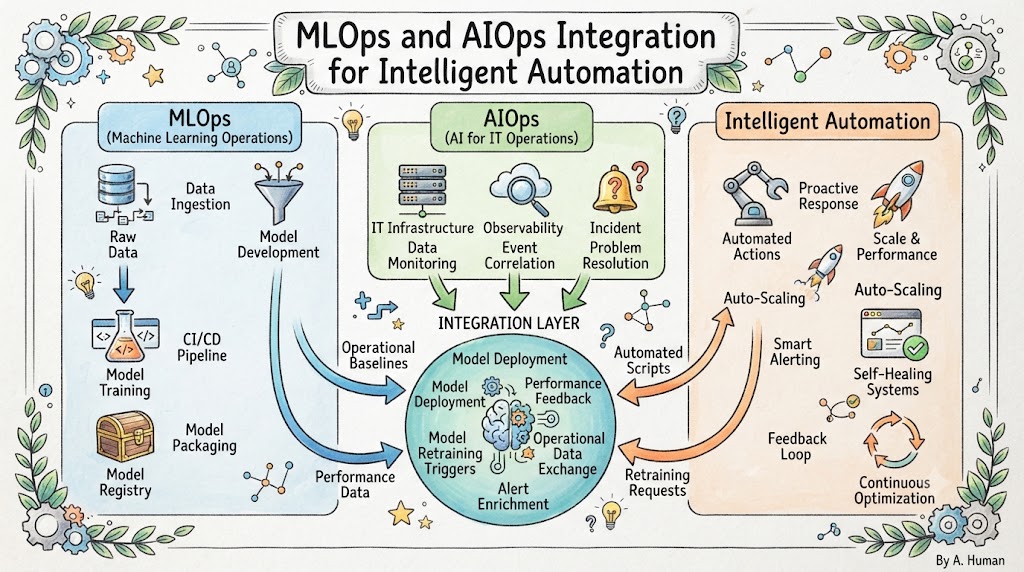
How MLOps and AIOps Integration Works
Data Flow Monitoring
AIOps platforms monitor infrastructure and data pipelines that feed ML models, ensuring reliability and performance.
Model Performance Tracking
MLOps systems track model accuracy, drift, and degradation over time.
Event Correlation
AIOps correlates infrastructure issues with ML model behavior to identify root causes.
Automated Remediation
If anomalies are detected, automated workflows can retrain models, scale infrastructure, or restart services.
Continuous Feedback Loop
Insights from production systems are fed back into ML pipelines for continuous improvement.
Key Benefits of Integration
Organizations adopting MLOps and AIOps Integration for Intelligent Automation gain several advantages:
- End-to-end system observability
- Faster detection of infrastructure and model issues
- Reduced downtime and operational risk
- Improved model reliability in production
- Automated incident response and remediation
- Better collaboration between data science and DevOps teams
This integration creates a unified ecosystem for intelligent automation.
MLOps vs AIOps vs Integrated Systems
| Aspect | MLOps | AIOps | Integrated MLOps + AIOps |
|---|---|---|---|
| Focus | ML lifecycle | IT operations | Full-stack intelligence |
| Monitoring | Model performance | Infrastructure health | End-to-end observability |
| Automation | Model deployment | Incident response | Unified automation |
| Goal | Reliable ML systems | Reliable IT systems | Intelligent enterprise systems |
The integration provides a holistic view of both application and infrastructure intelligence.
Real-World Use Cases
E-Commerce Personalization Systems
An e-commerce platform uses ML models for product recommendations. AIOps monitors infrastructure performance while MLOps tracks model accuracy. When latency increases, AIOps detects the issue and triggers scaling, ensuring uninterrupted recommendations.
Financial Fraud Detection
A banking system uses ML models for fraud detection. MLOps monitors model drift, while AIOps detects infrastructure anomalies affecting transaction processing. Together, they ensure real-time fraud detection without system downtime.
SaaS Platform Optimization
A SaaS provider uses ML for user behavior prediction. AIOps identifies server bottlenecks, while MLOps retrains models based on new usage patterns. This ensures accurate predictions and stable performance.
Key Technologies Enabling Integration
- Kubernetes for container orchestration
- OpenTelemetry for unified observability
- Prometheus and Grafana for monitoring
- MLflow for model lifecycle management
- Datadog and Dynatrace for AIOps insights
- Cloud platforms like AWS, Azure, and Google Cloud
These tools enable seamless integration between ML systems and operational infrastructure.
Challenges in MLOps and AIOps Integration
Data Silos
ML and IT operations data often exist in separate systems.
Complexity of Pipelines
Managing both ML pipelines and infrastructure pipelines increases complexity.
Skill Gaps
Teams require expertise in both machine learning and IT operations.
Monitoring Difficulties
Tracking both model performance and system health simultaneously can be challenging.
Automation Risks
Incorrect automation can lead to cascading failures if not properly governed.
Structured AIOps Training and MLOps education help address these challenges effectively.
Role in DevOps and SRE Environments
For DevOps teams, this integration improves deployment stability and system monitoring. For SRE teams, it enhances reliability metrics like MTTR, MTTD, and SLO compliance.
Together, they ensure that both applications and infrastructure operate efficiently and reliably.
Career Opportunities in MLOps and AIOps
The convergence of MLOps and AIOps is creating strong demand for professionals in:
- MLOps engineering
- AIOps engineering
- DevOps automation
- SRE architecture
- AI infrastructure management
Professionals can build strong careers through structured AIOps Course, AIOps Training, and certification programs focused on intelligent automation.
Why MLOps and AIOps Integration Matters
As enterprises adopt AI at scale, systems are becoming more interconnected and complex. Without integration, organizations risk fragmented visibility and slower incident response.
By combining MLOps and AIOps, enterprises achieve:
- Unified observability across ML and infrastructure systems
- Faster issue detection and resolution
- Smarter automation and scaling decisions
- Improved reliability of AI-driven applications
This integration is essential for building next-generation intelligent enterprises.
Final Thoughts
MLOps and AIOps integration represents the future of intelligent automation in enterprise IT environments. By combining machine learning lifecycle management with AI-driven operations intelligence, organizations can build systems that are not only scalable but also self-monitoring and self-healing.
As adoption increases, professionals skilled in AIOps Training and modern ML operations will play a critical role in shaping the future of intelligent enterprise systems.

