
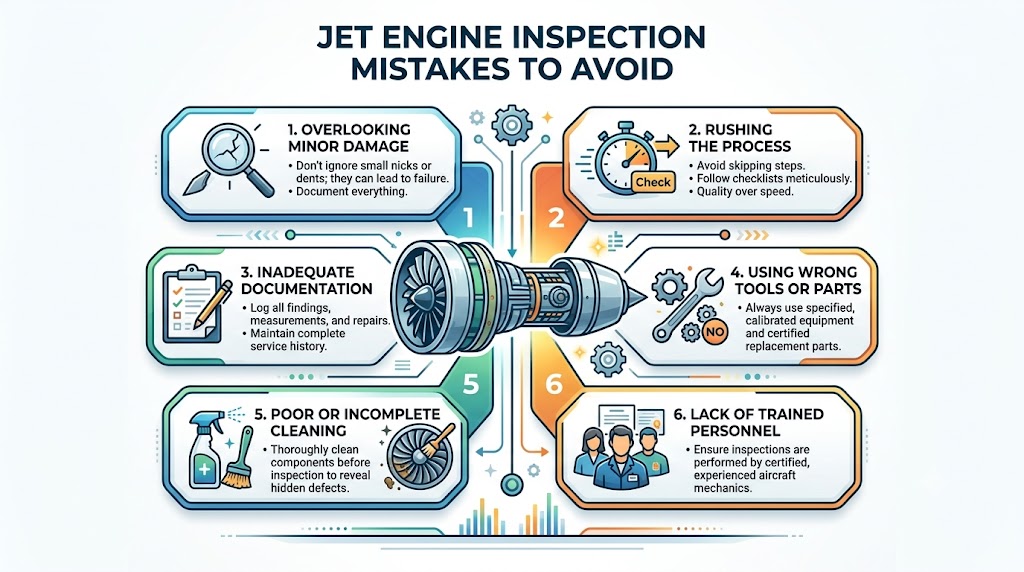
Jet engine inspection is a disciplined maintenance activity where small oversights can have serious consequences. Unlike many mechanical systems, turbine engines operate with high temperatures, rotational speeds, tight clearances, complex airflow paths, and components exposed to fatigue and thermal stress.
A reliable inspection is therefore not simply a visual search for obvious damage. It requires the correct maintenance data, inspection intervals, tools, access procedures, qualified personnel, accurate measurements, and careful interpretation of findings. FAA guidance recognizes visual, structural, and dimensional inspection as distinct parts of engine maintenance, while manufacturer instructions and applicable airworthiness requirements determine the specific inspection criteria for a particular engine.
This guide examines the most common jet engine inspection mistakes, why they happen, what risks they create, and how maintenance organizations and operators can build a more disciplined inspection process.
Important: Jet engine inspection and maintenance should be performed only by appropriately qualified and authorized personnel using the applicable current maintenance data, inspection equipment, and regulatory procedures. The guidance below is educational and does not replace the engine manufacturer’s maintenance manual or applicable airworthiness requirements.
Why Jet Engine Inspection Requires More Than a Visual Check
A turbine engine contains multiple sections that experience very different operating conditions:
- Fan or inlet section
- Compressor stages
- Combustion section
- Turbine stages
- Exhaust system
- Bearings and bearing compartments
- Lubrication system
- Fuel system
- Accessories and gearboxes
- Structural cases and mounts
Damage may appear as cracking, erosion, corrosion, distortion, overheating, coating deterioration, foreign-object damage, rubbing, liberated material, or dimensional degradation.
More importantly, damage that looks minor may have significance that cannot be determined from appearance alone.
For example, an experienced inspector does not simply ask:
“Does this component look damaged?”
The better questions are:
- What component is affected?
- What type of damage is present?
- Where is it located?
- Is the location significant?
- Is the damage within the manufacturer’s allowable limits?
- Has the condition changed since the previous inspection?
- Is another inspection method required?
- Does the finding require additional disassembly?
- Does an applicable service bulletin or airworthiness directive change the inspection requirement?
That mindset separates a documented inspection from a meaningful inspection.
1. Using Outdated Maintenance Data
One of the most fundamental inspection mistakes is working from maintenance information that is no longer current.
Engine maintenance documentation can change through:
- Manual revisions
- Service bulletins
- Service instructions
- Airworthiness directives
- Temporary revisions
- Engineering instructions
- Inspection program changes
- Manufacturer notifications
EASA specifically emphasizes that maintenance data must be controlled and kept up to date, including verification of document amendment status.
The FAA likewise requires operators to identify applicable airworthiness directives for the aircraft, engine, propeller, and installed appliances and comply with their requirements.
Why this mistake matters
An inspection can be performed perfectly according to an obsolete procedure and still fail to satisfy the current requirement.
Better practice
Before beginning an inspection, confirm:
- Correct engine model
- Correct engine variant or configuration
- Correct maintenance manual revision
- Applicable inspection program
- Current mandatory instructions
- Relevant AD status
- Relevant manufacturer instructions
- Applicable component-specific requirements
Never assume that the procedure used during the previous inspection is automatically the correct procedure for the next one.
2. Treating Every Engine Inspection as the Same
A common error among inexperienced maintenance teams is applying a generic inspection mindset to different engine models.
Two turbine engines may have broadly similar architectures while having very different:
- Inspection access points
- Damage limits
- Inspection intervals
- Component life limits
- Borescope requirements
- Measurement procedures
- Non-destructive inspection requirements
- Removal criteria
The applicable engine maintenance data controls the actual inspection.
What experienced inspectors recognize
The engine model is only the beginning.
The inspection may also depend on:
- Engine serial number
- Configuration
- Modification status
- Installed components
- Operating history
- Previous findings
- Cycles and hours
- Special inspection requirements
Therefore, inspection planning should be configuration-specific rather than generic.
3. Relying Only on Visual Inspection
Visual inspection is valuable, but it has limitations.
FAA powerplant guidance describes engine inspection in categories including:
- Visual inspection
- Structural inspection
- Dimensional inspection
Different inspection methods reveal different types of defects.
A component may look acceptable while requiring another inspection method to determine its condition.
Depending on the approved maintenance procedure, appropriate inspection methods may include:
- Visual inspection
- Borescope inspection
- Dimensional measurement
- Fluorescent penetrant inspection
- Eddy-current inspection
- Magnetic-particle inspection
- Ultrasonic inspection
- Radiographic inspection
The mistake
An inspector sees no obvious defect and concludes that the component is serviceable.
The better approach
Ask:
What inspection method does the approved maintenance data require for this component and suspected defect?
The answer should come from the applicable technical data—not from convenience.
4. Treating Borescope Inspection as a Quick Camera Check
Borescope inspection can provide valuable access to internal engine areas without extensive disassembly, but simply inserting a camera and taking a few images is not an adequate inspection philosophy.
The FAA’s visual inspection guidance highlights the importance of appropriate borescope equipment, access locations, inspection intervals, environmental conditions, and inspection limits.
Common mistakes include:
- Incomplete coverage
- Poor image quality
- Incorrect access point
- Insufficient lighting
- Failure to document findings
- Failure to compare with previous inspections
- Ignoring difficult-to-view areas
- Misinterpreting deposits as damage
- Failing to follow specified inspection limits
A useful principle
Borescope inspection is a defined inspection procedure, not merely an imaging exercise.
The inspection should establish what areas need examination, what defects are being sought, what limits apply, and how findings are documented.
5. Ignoring Inspection Environment and Equipment Limitations
Inspection equipment has operating limitations.
For example, FAA guidance for borescope inspections includes temperature considerations because excessive temperatures can damage inspection equipment.
Other practical factors can affect inspection quality:
- Lighting
- Camera resolution
- Probe diameter
- Probe articulation
- Access geometry
- Cleanliness
- Temperature
- Equipment calibration
- Image quality
- Operator familiarity with the equipment
The mistake
Assuming that having a sophisticated inspection device automatically produces a reliable inspection.
The reality
Equipment capability and inspection quality are not the same thing.
A high-quality camera used incorrectly can produce less useful evidence than a simpler system operated according to the approved procedure by a trained inspector.
6. Failing to Review Previous Inspection Findings
An engine inspection should not always be treated as an isolated event.
Previous inspection records can provide valuable context.
Consider a recurring finding such as:
- Minor erosion
- Coating deterioration
- FOD indications
- Tip wear
- Thermal distress
- Oil contamination
- Surface cracking
- Unusual deposits
The critical question is not merely whether the condition exists today.
It is also:
Has the condition changed?
Why trend information matters
A finding that remains stable may have a different maintenance implication from one that is progressively worsening.
Good records allow inspectors to compare:
- Location
- Appearance
- Measurements
- Severity
- Operating time
- Engine cycles
- Previous corrective actions
This turns inspection records into a source of maintenance intelligence rather than paperwork.
7. Using the Wrong Damage Limits
One of the most dangerous inspection errors is applying an incorrect allowable limit.
A component may have different criteria for:
- Cracks
- Nicks
- Dents
- Erosion
- Corrosion
- Distortion
- Tip clearance
- Wear
- Coating loss
- Thermal damage
The acceptable limit may depend on the precise component, location, geometry, or engine configuration.
The mistake
Using a remembered value or a generic industry number.
Better practice
Use the applicable current technical data for the exact component and configuration.
Do not substitute:
- Personal experience
- Another engine’s limits
- An old manual
- A similar-looking component
- An internet discussion
- An unofficial reference
for the controlling maintenance information.
8. Confusing “Within Limits” With “No Further Attention Needed”
A component being within a published allowable limit does not necessarily mean that the inspection is finished.
An experienced maintenance decision considers:
- Current condition
- Rate of deterioration
- Location
- Operating environment
- Previous findings
- Related components
- Required follow-up
- Applicable inspection interval
FAA guidance notes that continued service near certain maximum limits may not always be economically or operationally desirable because deterioration can affect performance or remaining life.
Practical lesson
An allowable condition and an ideal condition are not necessarily identical.
The approved data determines what is permissible, while engineering and maintenance judgment determine what additional action may be appropriate within the authorized framework.
9. Ignoring Adjacent Components
A defect rarely exists in a vacuum.
If an inspection identifies an abnormal condition in one area, the inspector should determine whether the approved procedure requires examination of related or adjacent components.
For example, evidence of:
- FOD
- Excessive rubbing
- Thermal distress
- Oil leakage
- Vibration
- Foreign material
- Component deterioration
may justify additional inspection according to the applicable maintenance instructions.
The mistake
Repairing or recording the visible finding without investigating the reason it occurred.
Better question
What could have caused this condition, and what other components could have been affected?
This is one of the most valuable habits in experienced maintenance.
10. Missing the Difference Between Cause and Symptom
Suppose an inspection identifies unusual wear.
The wear itself is a symptom.
The underlying cause might involve:
- Alignment
- Clearance
- Lubrication
- Foreign-object ingestion
- Component deterioration
- Operating conditions
- Installation problems
- Another upstream or downstream failure
Simply addressing the visible wear without establishing whether additional inspection is required can allow the underlying problem to remain.
Better inspection mindset
Think in three layers:
Finding → Cause → Consequence
For example:
Finding: abnormal rubbing
Cause: requires investigation under applicable maintenance data
Consequence: potentially related component damage
This approach reduces the risk of treating symptoms while overlooking the broader condition.
11. Failing to Verify Inspection Tool Calibration
Inspection results are only as reliable as the equipment and methods used to produce them.
Measurement-sensitive inspections may depend on:
- Calibrated measuring equipment
- Correct adapters
- Correct gauges
- Appropriate inspection probes
- Approved NDI equipment
- Reference standards
- Equipment condition
Common mistake
Using a tool because it “looks good” or because it was used recently.
Better practice
Inspection equipment should be controlled according to the organization’s approved procedures, including applicable calibration and serviceability requirements.
If a measurement matters to an airworthiness decision, measurement integrity matters just as much as inspector judgment.
12. Failing to Recognize When Specialized Inspection Is Required
Not every defect can be conclusively evaluated through visual inspection.
Structural or material-related concerns may require an approved non-destructive inspection method.
FAA maintenance guidance identifies several inspection techniques for detecting structural failures and dimensional conditions, including magnetic-particle, dye-penetrant, eddy-current, ultrasonic, and radiographic methods.
The mistake
Trying to resolve a potentially significant structural indication through visual judgment alone.
Better practice
When the maintenance data calls for a specific inspection technique, use that technique through appropriately qualified personnel and equipment.
Do not downgrade a required inspection because the initial visual appearance looks acceptable.
13. Overlooking Safety-Critical Rotating Parts
Turbine engines contain highly stressed rotating components.
These can include:
- Compressor rotors
- Turbine rotors
- Disks
- Shafts
- Blades
- Other critical rotating hardware
Inspection requirements for such components can be particularly important because damage can have consequences beyond simple performance degradation.
FAA guidance specifically addresses in-service inspection of safety-critical turbine engine parts at piece-part opportunities.
Recent FAA airworthiness action also illustrates how additional inspections of critical rotating parts can be introduced when an unsafe condition is identified.
Practical lesson
Do not assume that a normal inspection interval is the only requirement.
Always establish whether additional mandatory inspection requirements apply to the particular engine and component.
14. Failing to Check Airworthiness Directives
Airworthiness directives are not simply recommendations.
The FAA describes ADs as legally enforceable rules intended to correct unsafe conditions affecting products including aircraft engines.
An inspection program that does not properly account for applicable ADs can therefore create both technical and regulatory problems.
A disciplined review should consider:
- Engine model
- Engine series
- Serial number applicability
- Installed configuration
- AD effective requirements
- Compliance status
- Repetitive inspection requirements
- Required terminating actions
- Approved alternative compliance provisions where applicable
The exact requirements depend on the applicable authority and jurisdiction.
15. Treating Service Bulletins as Automatically Mandatory—or Automatically Optional
Service bulletins require careful interpretation.
A service bulletin may contain important manufacturer recommendations, but whether compliance is mandatory depends on the applicable regulatory framework and how the instruction is incorporated into the aircraft or engine’s approved maintenance requirements.
FAA powerplant guidance notes that service bulletins are important maintenance information but are not automatically mandatory unless made so through applicable requirements such as an AD or an authorized inspection program.
The mistake
Using one of two extremes:
“Every service bulletin is mandatory.”
or:
“Service bulletins are never important.”
Neither is a sound maintenance philosophy.
16. Poor Inspection Documentation
A technically good inspection can lose much of its long-term value if the documentation is weak.
Useful inspection records should provide enough information to establish:
- What was inspected
- Which engine was inspected
- When it was inspected
- Which maintenance data was used
- What findings were identified
- What measurements were obtained where applicable
- What corrective action was taken
- What follow-up was required
- Who performed or approved the work as required
Weak documentation often looks like:
“Engine inspected—OK.”
That statement provides very little useful history.
Stronger documentation captures the actual maintenance event and applicable requirements without adding unsupported conclusions.
Good documentation also helps the next inspector understand the engine’s history.
17. Failing to Photograph or Preserve Useful Inspection Evidence
Where the applicable procedure and organization allow it, images can be valuable for:
- Comparing progressive damage
- Supporting technical evaluation
- Documenting findings
- Communicating with engineering
- Supporting maintenance decisions
- Establishing historical condition
However, images should not replace required measurements or inspections.
Important distinction
A photograph is evidence of appearance, not automatically proof of serviceability.
A high-resolution image can document a finding while still requiring dimensional or structural evaluation.
18. Ignoring Contamination and Cleanliness
Inspection quality can be compromised by:
- Oil
- Carbon deposits
- Dirt
- Fuel residue
- Corrosion products
- Foreign material
- Other deposits
An experienced inspector understands that deposits can sometimes obscure the underlying condition.
At the same time, cleaning procedures themselves must follow approved maintenance instructions because improper cleaning can damage coatings, finishes, seals, or components.
The correct principle
Clean enough to inspect—but only using an approved method appropriate to the component.
Avoid improvising cleaning chemicals, tools, or procedures.
19. Rushing Because the Engine Is Needed Back in Service
Schedule pressure is a real operational challenge.
Aircraft availability, dispatch requirements, customer expectations, and maintenance deadlines can create pressure to complete inspections quickly.
That pressure can lead to:
- Reduced inspection coverage
- Incomplete records
- Skipped secondary checks
- Poor documentation
- Premature closure of findings
A mature maintenance organization recognizes
Schedule pressure is not an inspection criterion.
If a finding requires additional evaluation, the inspection process should follow the applicable technical and regulatory requirements rather than an arbitrary return-to-service deadline.
20. Allowing Confirmation Bias to Influence Inspection
Confirmation bias can occur when inspectors already expect the engine to be serviceable.
For example:
“This engine has never had a serious problem, so this inspection will probably be routine.”
That expectation can unconsciously influence attention.
Better approach
Begin with the inspection criteria, not the expected outcome.
Ask:
- What defects are we specifically looking for?
- Which areas have historically shown deterioration?
- What changed since the previous inspection?
- What evidence supports the conclusion?
- What would make us stop and investigate further?
A disciplined checklist can help reduce assumption-driven inspection.
21. Failing to Consider Engine Operating History
Inspection intervals are important, but operating history can provide additional context.
Relevant history may include:
- Flight hours
- Engine cycles
- Operating environment
- Previous maintenance
- Abnormal events
- FOD exposure
- Overtemperature events
- Overspeed events
- Unusual vibration
- Oil-related findings
- Previous component replacement
The exact significance of each event depends on the engine and applicable maintenance instructions.
Why history matters
Two engines with the same accumulated hours may not have experienced identical operating conditions.
Inspection planning should therefore consider the information required by the applicable maintenance program rather than relying on a single hour or cycle figure.
22. Treating Inspection Findings as Independent
An experienced inspector looks for relationships.
For example:
Finding A + Finding B + Finding C
may provide more information than each finding individually.
A combination of:
- abnormal deposits,
- unusual wear,
- vibration history,
- and previous component findings
may warrant a different investigation path than any one finding alone.
This is why maintenance records, previous inspection reports, engine trend information, and technical history can be valuable when they are available and relevant.
23. Not Escalating Ambiguous Findings
One of the most important professional habits is knowing when not to make a final decision alone.
An unusual indication may not fit neatly into:
- Serviceable
- Unserviceable
There may be uncertainty.
That is precisely when the correct response is to follow the organization’s approved escalation process and applicable technical data.
Possible escalation paths may involve:
- Senior inspection personnel
- Engineering
- Approved maintenance organization personnel
- Manufacturer technical support
- Design approval holder
- Regulatory authority, where required
Experienced judgment is not pretending to know everything.
It is recognizing when a finding exceeds the available evidence or authority.
24. Skipping Independent Verification Where Required
Some maintenance activities require independent inspection, duplicate inspection, or other forms of verification depending on the applicable maintenance organization, aircraft, task, and regulatory framework.
The mistake is treating verification as paperwork.
Verification should answer:
- Was the task actually completed?
- Was the correct component installed?
- Were required steps performed?
- Were critical conditions verified?
- Is the resulting configuration correct?
Independent verification is particularly valuable where an error could have serious consequences.
25. Forgetting the Post-Inspection Configuration Check
Inspection does not end when the defect assessment is complete.
Where components, access panels, plugs, connectors, or other hardware have been disturbed, the approved procedure may require restoration and verification.
Common areas requiring careful attention can include:
- Access panels
- Inspection plugs
- Connectors
- Locking devices
- Safetying
- Fasteners
- Fluid lines
- Sensors
- Wiring
- Seals
The exact requirements must come from the applicable maintenance data.
The lesson
An inspection is not complete until the aircraft or engine is correctly restored and the required verification has been performed.
26. Common Jet Engine Inspection Mistakes at a Glance
| Mistake | Why It Happens | Potential Consequence | Better Practice |
|---|---|---|---|
| Using outdated manuals | Poor document control | Incorrect inspection | Verify current maintenance data |
| Relying only on visual inspection | Convenience | Hidden defects missed | Use required inspection methods |
| Incorrect damage limits | Memorization or assumptions | Wrong serviceability decision | Verify exact applicable limits |
| Incomplete borescope coverage | Time pressure | Internal damage missed | Follow defined coverage requirements |
| Ignoring previous findings | Poor records | Deterioration trend missed | Compare inspection history |
| Poor documentation | Inspection treated as paperwork | Weak traceability | Record meaningful findings |
| Ignoring ADs | Incomplete compliance review | Regulatory and safety exposure | Verify applicability and status |
| Improper tool use | Lack of equipment control | Invalid measurements | Use appropriate controlled equipment |
| Rushing the inspection | Schedule pressure | Reduced inspection quality | Protect inspection integrity |
| Failing to escalate | Overconfidence | Incorrect technical decision | Follow escalation procedures |
| Ignoring adjacent components | Narrow inspection mindset | Secondary damage missed | Investigate according to approved data |
| Poor post-maintenance verification | Premature task closure | Configuration errors | Complete required restoration checks |
A Practical Jet Engine Inspection Workflow
A disciplined inspection can be organized into several broad stages.
Stage 1: Prepare
Before the inspection:
- Identify the exact engine configuration.
- Review applicable maintenance data.
- Confirm inspection requirements.
- Review relevant history.
- Confirm required tooling.
- Verify equipment status.
- Establish appropriate work conditions.
Stage 2: Establish the Inspection Scope
Determine:
- What components must be inspected?
- What access points are required?
- What inspection method is specified?
- What defects are being sought?
- What limits apply?
- What additional inspections could be triggered by findings?
This prevents the inspection from becoming an improvised visual exercise.
Stage 3: Perform the Inspection
Follow the applicable approved procedure.
Maintain attention to:
- Coverage
- Inspection quality
- Correct equipment
- Correct measurement technique
- Cleanliness
- Documentation
- Finding identification
Do not skip difficult areas simply because they are inconvenient to access.
Stage 4: Evaluate Findings
For every significant finding, establish:
- What was observed?
- Where is it located?
- What inspection method identified it?
- What limit applies?
- Is additional inspection required?
- Is there relevant previous history?
- Is escalation required?
This creates a structured decision process.
Stage 5: Correct or Escalate
If the condition is clearly addressed by the applicable maintenance instructions, follow those instructions.
If the condition is ambiguous:
Stop → document → consult the appropriate technical authority → proceed according to approved instructions.
Do not create an unofficial repair or acceptance criterion simply to close the work package.
Stage 6: Restore and Verify
Complete the required:
- Reassembly
- Installation checks
- Safetying
- Configuration checks
- Functional checks
- Documentation
- Independent inspections, where required
The precise requirements depend on the task and approved maintenance data.
How to Improve Jet Engine Inspection Quality
1. Build a Controlled Documentation Process
Maintain reliable control over:
- Manuals
- Revisions
- ADs
- Service information
- Inspection programs
- Engineering instructions
Document control is not administrative overhead; it is part of maintenance quality.
2. Use Finding-Based Thinking
Instead of recording:
“Inspection satisfactory.”
capture meaningful information about actual findings and inspection results.
This improves future maintenance decisions.
3. Trend Recurring Findings
Where appropriate, compare current findings with previous records.
Look for:
- Increasing damage
- Changing location
- Faster deterioration
- Recurring contamination
- Repeated component issues
Trend information can make inspections more predictive.
4. Train Inspectors on Interpretation, Not Just Equipment
Owning a borescope or NDI system does not create inspection expertise.
Training should address:
- Inspection technique
- Defect recognition
- Equipment limitations
- Documentation
- Applicable technical data
- Escalation procedures
- Human factors
5. Protect Inspectors From Unreasonable Schedule Pressure
Maintenance planning should provide realistic time for:
- Inspection
- Evaluation
- Documentation
- Additional investigation
- Technical consultation
A compressed schedule should never become an informal reason for reducing inspection scope.
Inspection Decision Framework
When a finding is discovered, a useful high-level framework is:
| Question | Purpose |
|---|---|
| What exactly was found? | Establish objective evidence |
| Where is it located? | Determine component significance |
| How was it detected? | Understand inspection confidence |
| What limit applies? | Determine technical acceptability |
| Has it appeared before? | Identify trends |
| Is it getting worse? | Assess progression |
| Could other components be affected? | Consider secondary effects |
| Is another inspection required? | Avoid premature closure |
| Does an AD or mandatory instruction apply? | Verify compliance |
| Is the finding within the inspector’s authority? | Determine escalation |
| What must be documented? | Preserve traceability |
This framework helps prevent the common mistake of jumping directly from finding to acceptance.
Signs of a Weak Inspection Process
An organization should investigate its inspection process if it frequently sees:
- Repeated documentation corrections
- Missing inspection images
- Unclear findings
- Frequent manual-revision confusion
- Unexplained repeat defects
- Inconsistent inspection results between personnel
- Calibration discrepancies
- Late discovery of applicable requirements
- Findings discovered after return to service
- Heavy dependence on individual memory
- Pressure to close findings quickly
These are not necessarily evidence of an unsafe condition by themselves, but they are useful indicators that the maintenance process deserves review.
Jet Engine Inspection Checklist
Use this as a high-level process checklist, not as a substitute for the applicable engine maintenance manual.
Documentation
- Correct engine identified
- Configuration verified
- Current maintenance data confirmed
- Applicable inspection program reviewed
- Relevant AD status checked
- Relevant manufacturer instructions reviewed
- Previous inspection history reviewed
Equipment
- Required inspection equipment available
- Equipment serviceability confirmed
- Calibration status verified where applicable
- Correct accessories and adapters available
- Inspection environment appropriate
Inspection
- Required inspection areas identified
- Correct inspection method used
- Required access points covered
- Measurements performed where required
- Findings documented accurately
- Images captured where appropriate
- Adjacent areas evaluated when required
Evaluation
- Correct damage limits verified
- Previous findings compared
- Progressive deterioration considered
- Additional inspection requirements considered
- Ambiguous findings escalated appropriately
Completion
- Required corrective action completed
- Components restored correctly
- Required verification performed
- Maintenance records completed
- Follow-up requirements identified
- Return-to-service requirements satisfied by authorized personnel
The Most Important Lessons
Several principles consistently separate disciplined engine inspection from superficial inspection.
1. The manual is not optional background reading
The applicable maintenance data defines the inspection requirements and acceptance criteria.
2. A camera does not replace inspection judgment
Borescope inspection is useful only when the correct areas, equipment, technique, and limits are applied.
3. A finding should trigger questions
Do not stop at identifying damage. Determine what it means and whether further investigation is required.
4. History matters
Previous inspection findings can reveal deterioration patterns that are difficult to recognize from a single inspection.
5. Measurement quality matters
When serviceability depends on a measurement, the integrity of the measurement process matters as much as the number itself.
6. Uncertainty should trigger escalation
An experienced inspector does not force an uncertain finding into a convenient answer.
7. Documentation is part of maintenance quality
A finding that is poorly documented becomes a problem for the next inspector.
8. Compliance must be actively managed
ADs, maintenance data, revisions, and mandatory inspection requirements need deliberate verification rather than assumptions.
Final Recommendation
Jet engine inspection should be treated as an evidence-based maintenance process rather than a routine visual exercise. The biggest risks often come from seemingly small process failures: outdated technical data, incomplete inspection coverage, incorrect limits, weak documentation, inadequate equipment control, or failure to escalate an uncertain finding.
A strong inspection program combines current maintenance data, qualified personnel, appropriate inspection methods, controlled equipment, historical context, accurate documentation, and disciplined technical judgment. FAA and EASA guidance both emphasize the importance of appropriate maintenance data and inspection practices, while specific engine requirements remain dependent on the applicable manufacturer and regulatory documentation

