
Introduction
A helicopter’s rotor system is one of its most important flight-critical systems, combining multiple components that work together to produce lift, control, and stability. Main rotor blades, hubs, pitch-control components, swashplates, shafts, bearings, and tail rotor assemblies all operate under demanding mechanical and aerodynamic conditions. For operators, understanding what to observe during routine inspections can help identify abnormalities before they become larger maintenance concerns. A careful rotor-system review also helps pilots communicate useful information to maintenance personnel. However, an operator-level checklist is not a substitute for the helicopter manufacturer’s approved inspection procedures or qualified maintenance evaluation.
Why Rotor System Condition Matters
The rotor system performs the fundamental work of keeping a helicopter airborne and controllable. The main rotor provides lift and contributes to directional and attitude control, while the tail rotor or applicable anti-torque system helps manage yaw.
Because these systems operate continuously during flight, their condition can influence:
- Lift production
- Aircraft control
- Vibration
- Handling characteristics
- Flight performance
- Component reliability
- Passenger and crew comfort
- Operational safety
Rotor-system problems may develop gradually or appear following an unusual event such as foreign object contact, hard landing, abnormal vibration, or another mechanical occurrence.
For operators, the objective is not to diagnose every possible defect. It is to recognize abnormal conditions, document them accurately, and ensure that appropriate maintenance personnel evaluate them when necessary.
Understanding the Helicopter Rotor System
Helicopter rotor systems vary significantly according to aircraft design, manufacturer, engine configuration, and operating category.
A typical helicopter may include several major rotor-system components.
Main Rotor Blades
Main rotor blades generate lift and are exposed to aerodynamic forces, vibration, environmental conditions, and rotational loads.
Main Rotor Hub
The hub connects the rotor blades to the rotor system and transfers loads and power through the assembly.
Blade Grips
Where applicable, blade grips connect individual blades to the rotor hub and participate in blade pitch changes.
Swashplate
The swashplate transfers pilot control inputs to mechanisms that change rotor-blade pitch.
Pitch Links
Pitch links connect control mechanisms to applicable rotor components and help transmit pitch-control movement.
Main Rotor Shaft
The main rotor shaft transfers rotational power to the rotor assembly.
Bearings
Various bearing arrangements may support rotating or moving components, depending on helicopter design.
Tail Rotor
The tail rotor on conventional designs helps counter main rotor torque and provides directional control.
Tail Rotor Hub and Pitch Mechanism
These components connect and control the tail rotor blades.
The specific configuration varies considerably, so operators should always use documentation applicable to their particular helicopter.
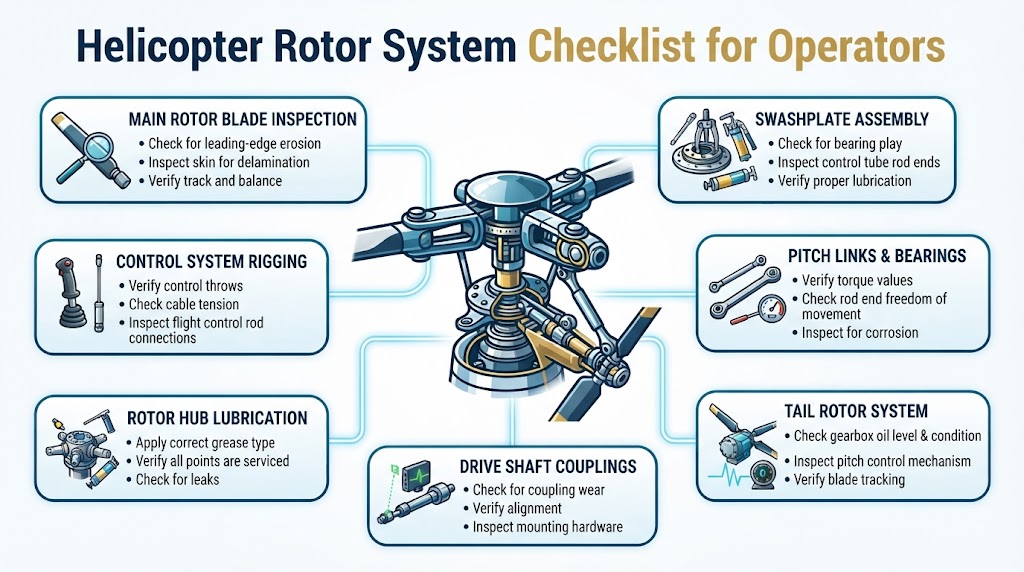
Main Rotor Blade Checklist
Main rotor blades deserve close attention during appropriate inspections because they are exposed to both environmental and operational stresses.
Operators should be alert for visible abnormalities such as:
- Cracks
- Dents
- Nicks
- Scratches
- Corrosion
- Erosion
- Surface damage
- Foreign object damage
- Unusual discoloration
- Damage around blade tips
- Evidence of impact
Composite and metal blades can have different inspection characteristics. A defect that looks superficial may require a different assessment depending on the blade’s construction and the location of the damage.
Operators should not attempt to determine airworthiness simply by judging the size or appearance of a defect.
If blade damage is suspected, the appropriate response should follow the helicopter and rotor-blade manufacturer’s applicable instructions.
Main Rotor Hub Checklist
The main rotor hub is a critical structural component that connects the blades to the helicopter’s rotor system.
During an appropriate visual inspection, operators may look for obvious:
- Cracks
- Corrosion
- Damage
- Abnormal hardware condition
- Fluid leakage where applicable
- Signs of impact
- Unusual component appearance
Some hub conditions cannot be reliably identified through a basic visual inspection.
Operators should therefore avoid treating a visually normal hub as proof that all internal or structural components are serviceable.
Detailed hub inspection, measurement, disassembly, or repair should be performed according to approved maintenance procedures by appropriately qualified personnel.
Blade Grip and Pitch-Control Components
Blade grips and associated pitch-control components are important because they allow blade pitch to change according to the helicopter’s control system.
Potential warning signs may include:
- Visible damage
- Corrosion
- Unusual wear
- Abnormal movement
- Damaged hardware
- Fluid leakage where applicable
- Changes in normal control behavior
Operators should pay particular attention to changes from the helicopter’s normal operating characteristics.
However, unusual movement or control response does not necessarily identify a particular failed component. Multiple systems may contribute to a similar symptom.
Pitch-control components should not be adjusted or repaired based on general online guidance.
Swashplate Inspection Considerations
The swashplate plays an important role in transferring pilot control inputs to the rotor system.
Depending on helicopter design, it may include stationary and rotating portions that work together to control blade pitch.
Operators may look for obvious signs of:
- Damage
- Corrosion
- Fluid leakage where applicable
- Unusual residue
- Abnormal visible movement
- Component deterioration
Detailed inspection of swashplate components involves aircraft-specific procedures and qualified maintenance personnel.
If the operator notices an unusual control response, abnormal noise, or other unexpected rotor-system behavior, the observation should be reported rather than attempting to determine the exact source.
Pitch Links and Related Control Components
Pitch links and related control components can be critical to rotor operation.
Potential concerns may include:
- Corrosion
- Damage
- Abnormal hardware appearance
- Wear
- Unusual movement
- Evidence of impact
- Signs of improper maintenance
Because these components can affect rotor control, operators should not treat visible abnormalities as merely cosmetic.
Any questionable condition should be handled according to the helicopter’s approved maintenance procedures.
Main Rotor Shaft and Bearing Considerations
The main rotor shaft transfers rotational power into the rotor system, while bearings in applicable assemblies support rotating or moving components.
Potential warning signs may include:
- New vibration
- Abnormal mechanical noise
- Visible leakage where applicable
- Corrosion
- Unusual operating behavior
A bearing or shaft problem cannot normally be confirmed through a simple pilot-level inspection.
For that reason, operators should focus on recognizing changes in aircraft behavior and visible abnormalities rather than attempting to disassemble or diagnose components.
Tail Rotor Checklist
The tail rotor is another critical area that deserves careful attention.
For helicopters using a conventional tail rotor, operators may inspect the visible condition of:
- Tail rotor blades
- Tail rotor hub
- Pitch-control components
- Visible hardware
- Blade surfaces
- Attachment areas
- Relevant guards or surrounding components where installed
Look for obvious:
- Cracks
- Dents
- Nicks
- Corrosion
- Foreign object damage
- Missing or abnormal hardware
- Fluid leakage where applicable
- Unusual surface damage
Because the tail rotor contributes to directional control, abnormalities should be treated seriously and reported through the appropriate maintenance process.
Tail Rotor Pitch-Control System
The tail rotor pitch-control system allows the pilot to influence tail rotor thrust and therefore directional control on applicable helicopters.
Potential warning signs can include:
- Abnormal pedal response
- Unexpected yaw behavior
- Unusual vibration
- Visible damage
- Corrosion
- Fluid leakage where applicable
- Unusual control-system behavior
A change in pedal response or yaw behavior does not automatically mean the tail rotor is defective. Other systems can contribute to similar symptoms.
Nevertheless, unexplained changes in directional control should receive appropriate attention.
Rotor System Lubrication Considerations
Some rotor components use lubrication systems or grease points, while others may use different arrangements depending on their design.
Operators should be familiar with the normal appearance of their helicopter and remain alert for:
- New fluid leakage
- Grease accumulation
- Unusual residue
- Contamination
- Evidence of a deteriorated seal
- Unexpected changes around lubrication areas
Lubrication requirements are highly aircraft-specific.
Operators should not assume that one helicopter’s lubricant, servicing method, or interval applies to another helicopter.
The aircraft and component manufacturer’s documentation should always determine the applicable requirements.
Rotor System Vibration
Vibration is one of the most important operational warning signs associated with rotorcraft.
A new or increasing vibration can have many possible causes, including:
- Rotor-blade condition
- Rotor imbalance
- Tracking issues
- Hub problems
- Bearing concerns
- Drive-system problems
- Engine-related conditions
- Tail rotor issues
- Mounting or structural concerns
Because several systems can produce similar symptoms, pilots should avoid assuming that vibration automatically identifies a particular failed component.
Operators should pay attention to changes in:
- Intensity
- Frequency
- Location
- Operating conditions under which vibration occurs
- Whether the vibration is increasing over time
Accurate pilot reports can help maintenance personnel investigate the condition more efficiently.
Rotor Tracking and Balance Considerations
Rotor tracking refers generally to how rotor blades follow their intended paths relative to one another during rotation.
Rotor balance involves maintaining appropriate distribution of mass and aerodynamic characteristics within the rotor system.
Problems with tracking or balance can contribute to:
- Vibration
- Increased component stress
- Reduced passenger comfort
- Abnormal aircraft behavior
- Additional wear
Tracking and balancing are specialized maintenance activities.
Operators should not attempt to make adjustments based on general instructions found online. Appropriate procedures, equipment, and aircraft-specific technical information are required.
Foreign Object and Impact Damage
Rotor systems can encounter foreign objects during ground operations and flight.
Possible sources include:
- Gravel
- Stones
- Loose runway debris
- Ground equipment
- Vegetation
- Birds
- Other airborne or ground objects
A foreign object strike may produce an obvious mark, but some consequences may not be immediately visible.
Operators should report suspected impacts according to applicable procedures.
A helicopter continuing to operate normally after an impact does not automatically prove that the rotor system has remained unaffected.
Corrosion and Environmental Exposure
Rotor components can be exposed to environmental conditions that contribute to deterioration.
Potential factors include:
- Moisture
- Humidity
- Salt
- Dust
- Chemicals
- Temperature changes
- Outdoor storage
- Coastal operating environments
Operators should be especially attentive to aircraft that regularly operate in demanding environments.
Visible corrosion should not automatically be classified as cosmetic. Its importance depends on the component, location, material, and severity.
Corrosion assessment and treatment should follow approved maintenance procedures.
Preflight Rotor System Checklist for Operators
The helicopter manufacturer’s approved checklist should always be the primary reference.
The following is a general awareness checklist rather than a replacement for aircraft-specific procedures:
- Review the approved aircraft inspection checklist
- Visually inspect main rotor blades
- Look for obvious cracks, dents, or other damage
- Check for visible corrosion
- Look for foreign object damage
- Inspect visible rotor hub areas
- Check visible pitch-control components
- Inspect the swashplate area where visible
- Look for unusual leakage where applicable
- Inspect tail rotor blades
- Check the visible tail rotor hub area
- Look for abnormal hardware condition
- Review previously reported discrepancies
- Consider any unusual vibration or noise reported during earlier operation
- Confirm applicable maintenance status
This checklist is intended to support awareness. It does not establish airworthiness by itself.
Postflight Rotor System Monitoring
Operators should also pay attention to rotor-system observations after flights.
Important information may include:
- New vibration
- Unusual mechanical noise
- Abnormal control feel
- Unexpected yaw behavior
- Fluid leakage
- Visible damage
- Suspected foreign object contact
- Hard landing
- Rotor strike
- Other abnormal events
Pilot reports should be as specific as possible.
For example, instead of simply reporting “vibration,” an operator can document when the vibration occurred, whether it changed with airspeed or power setting, and whether it was felt through the controls, airframe, or cabin.
Specific observations can help maintenance personnel investigate the issue.
When Should an Operator Ground or Restrict an Aircraft?
Operators should never establish universal grounding rules based solely on a generic checklist.
The correct decision depends on:
- Helicopter model
- Nature of the discrepancy
- Applicable operating procedures
- Maintenance program
- Manufacturer requirements
- Applicable regulations
- Qualified maintenance assessment
- Operational circumstances
Concerns that generally warrant prompt maintenance attention can include:
- Suspected cracks
- Significant blade damage
- New unexplained vibration
- Suspected rotor strike
- Significant leakage
- Major corrosion
- Abnormal control response
- Tail rotor abnormalities
- Unusual mechanical noise
- Foreign object damage
The aircraft’s approved procedures and applicable maintenance requirements should determine the appropriate action.
Maintenance Documentation and Rotor-System Records
Accurate records are an important part of rotorcraft operation.
Operators should maintain appropriate documentation relating to:
- Inspections
- Repairs
- Component replacements
- Overhauls
- Service information
- Applicable airworthiness directives
- Component life tracking
- Pilot-reported discrepancies
- Maintenance sign-offs
- Special inspections
Good records allow maintenance personnel to understand the helicopter’s history and identify recurring issues.
They can also support fleet planning and help operators determine when upcoming maintenance activities may affect aircraft availability.
Manufacturer Documentation and Regulatory Compliance
Rotor systems differ considerably between helicopter models.
For that reason, operators should rely on applicable documentation such as:
- Aircraft maintenance manuals
- Rotor-system maintenance documentation
- Component maintenance information where applicable
- Instructions for Continued Airworthiness
- Manufacturer service information
- Service bulletins
- Airworthiness directives
- Approved maintenance programs
- Applicable aviation regulations
Generic checklists are useful for awareness but should never override aircraft-specific instructions.
The same visible symptom can have different implications on different helicopter designs.
Rotor System Inspection Frequency
There is no single inspection schedule that applies to every helicopter rotor system.
Inspection requirements can depend on:
- Helicopter model
- Rotor-system design
- Manufacturer requirements
- Operating category
- Maintenance program
- Flight hours
- Calendar time
- Operating environment
- Component life limits
- Special inspections
- Applicable regulations
Operators should therefore avoid using a generic number of flight hours or calendar months as a universal rotor inspection interval.
The appropriate inspection schedule should come from the aircraft’s approved maintenance documentation and applicable requirements.
Common Rotor System Problems Operators Should Not Ignore
Some observations deserve particular attention.
Damaged Rotor Blades
Visible cracks, significant dents, foreign object damage, or other abnormal blade conditions should be evaluated appropriately.
Excessive or New Vibration
A new vibration can indicate a developing problem or an issue elsewhere in the helicopter.
Corrosion
Corrosion should be evaluated according to the component and applicable maintenance guidance.
Fluid Leakage
Unexplained leakage around rotor-system components may indicate a maintenance concern.
Unusual Noise
A new mechanical sound can provide valuable information about changing aircraft condition.
Abnormal Control Response
Unexpected changes in cyclic, collective, or directional control behavior should not be dismissed.
Tail Rotor Abnormalities
Changes in yaw behavior, pedal response, or tail rotor vibration deserve attention.
Suspected Rotor Strike
A suspected strike should be handled according to the appropriate inspection requirements even if visible damage appears limited.
Common Operator Mistakes
Treating a General Checklist as the Official Inspection Procedure
A generic checklist cannot replace the aircraft manufacturer’s approved checklist.
Ignoring Small Visible Damage
Small damage should be reported rather than dismissed without appropriate evaluation.
Continuing With Unexplained Vibration
Vibration that is new or increasing deserves appropriate investigation.
Failing to Report Abnormal Sounds
Pilots are often in the best position to notice changes in normal aircraft sound.
Performing Unauthorized Maintenance
Rotor systems contain critical components that require appropriate qualifications and approved procedures.
Missing Documentation
Unrecorded discrepancies can make maintenance history difficult to track.
Ignoring Recurring Problems
Repeated vibration, leakage, or other discrepancies should be communicated clearly to maintenance personnel.
Assuming Normal Flight Means Everything Is Serviceable
A helicopter can continue operating while a developing mechanical issue is present. Normal handling does not replace inspection and maintenance requirements.
Relying on Generic Internet Advice
Online information can provide general education, but aircraft-specific technical documentation must take priority.
Helicopter Rotor System Operator Checklist
| Area | What Operators Should Look For | When to Escalate |
|---|---|---|
| Main rotor blades | Visible damage, cracks, corrosion, unusual surface condition | Any suspected significant damage |
| Rotor hub | Visible abnormalities, damage, or leakage | Suspected structural or mechanical concern |
| Blade grips | Visible damage or abnormal condition | Any questionable condition |
| Pitch links | Damage, corrosion, abnormal hardware | Any abnormal appearance |
| Swashplate | Visible damage or leakage where applicable | Unusual condition or control behavior |
| Main rotor shaft | Leakage or abnormal operation | Unusual vibration or other concern |
| Tail rotor | Blade and hub condition | Damage or abnormal vibration |
| Control system | Normal control response | Any unexplained control issue |
| Lubrication areas | Leakage or contamination | New or unexplained leakage |
| Vibration | Changes from normal operation | Maintenance evaluation |
| Records | Open discrepancies and inspection status | Any unresolved maintenance concern |
This table is a general operator reference and does not establish maintenance requirements or determine aircraft serviceability.
How JETANDROTOR.COM Can Support Helicopter Operators
JETANDROTOR.COM can serve as an aviation-focused resource for helicopter operators, pilots, aircraft owners, and aviation professionals researching rotorcraft, aircraft components, maintenance considerations, and operational topics.
Understanding rotor-system components and recognizing common warning signs can help operators communicate more effectively with maintenance professionals and make better-informed operational decisions.
For actual inspections, repairs, component replacement, and airworthiness decisions, operators should rely on qualified aviation maintenance personnel and applicable manufacturer documentation.
Final Thoughts
A helicopter rotor system contains numerous interconnected components that must work together reliably during every flight. Operators can support safe operations by paying attention to visible blade and hub conditions, unusual vibration, abnormal noise, fluid leakage, corrosion, control changes, and suspected impact damage. A structured checklist can improve consistency, but it should always complement the helicopter manufacturer’s approved inspection procedures. Operators should never use a general checklist to replace qualified maintenance judgment or aircraft-specific requirements. When an abnormality is identified, accurate reporting and timely maintenance evaluation are essential. Good inspection habits, documentation, and maintenance coordination can contribute to reliable helicopter operations.
Frequently Asked Questions
1. What should operators check on a helicopter rotor system?
Operators should follow the helicopter’s approved checklist and look for appropriate visible signs of damage, corrosion, leakage, foreign object impact, abnormal hardware condition, and other changes in normal operation.
2. How often should a helicopter rotor system be inspected?
Inspection frequency varies by helicopter model, manufacturer requirements, maintenance program, operating environment, applicable regulations, and other factors. Operators should follow the requirements applicable to their specific aircraft.
3. What are common signs of helicopter rotor problems?
Potential warning signs include unusual vibration, abnormal noise, visible blade damage, corrosion, leakage, unexpected control behavior, and changes in normal aircraft performance.
4. What can cause helicopter rotor vibration?
Possible causes include blade condition, imbalance, tracking concerns, hub or bearing issues, drive-system problems, engine-related conditions, and tail rotor problems. Maintenance evaluation is needed to determine the actual cause.
5. What should a pilot do if a rotor blade appears damaged?
The pilot should follow the aircraft’s applicable procedures and report the condition for appropriate maintenance evaluation. Pilots should not assume that minor-looking damage is automatically safe.
6. Why is the tail rotor inspection important?
On helicopters using conventional tail rotors, the tail rotor contributes to directional control and counteracts main rotor torque. Abnormalities can therefore affect important aspects of helicopter operation.
7. Can operators perform rotor system maintenance themselves?
Only activities permitted by applicable regulations and within the operator’s qualifications and authorization should be performed. Detailed rotor-system maintenance should be handled according to approved procedures by appropriately qualified personnel.
8. What documents should operators review for rotor system maintenance?
Relevant documentation can include aircraft maintenance manuals, rotor-system documentation, Instructions for Continued Airworthiness, manufacturer service information, applicable airworthiness directives, approved maintenance programs, and regulations.
9. What should be done after suspected rotor or blade impact?
Operators should follow the applicable aircraft and component manufacturer’s procedures and obtain the required maintenance evaluation. The absence of obvious damage does not necessarily establish that the rotor system is unaffected.
10. Why is an aircraft-specific rotor inspection checklist important?
Helicopter rotor systems vary significantly between models. An aircraft-specific checklist reflects the components, inspection requirements, and procedures applicable to that particular helicopter.

