
Introduction
Aviation depends on many forms of engineering. Some aircraft use powerful jet engines. Others depend on rotating blades to generate lift. Each design solves a different flight challenge.
Jet propulsion helps aircraft travel efficiently at high speeds. Rotorcraft support missions that need vertical takeoff, hovering, or access to confined areas. Both fields combine aerodynamics, mechanical engineering, materials science, electronics, and safety design.
This guide explains the main ideas behind jet propulsion and rotorcraft engineering. It covers engine types, important aircraft systems, performance factors, maintenance concepts, and future developments. It also explains how these technologies support modern aviation.
1. What Is Jet Propulsion?
Jet propulsion is a method of moving an aircraft by producing thrust. A jet engine takes in air, compresses it, adds energy, and releases the resulting gases. This process creates a forward force.
The principle relates to Newton’s third law of motion. When an engine accelerates air or exhaust gases in one direction, it produces a reaction force in the opposite direction.
Jet engines are common in commercial aviation and many other aircraft. Their design depends on the aircraft’s speed, size, mission, and operating needs.
Main stages of a gas turbine engine
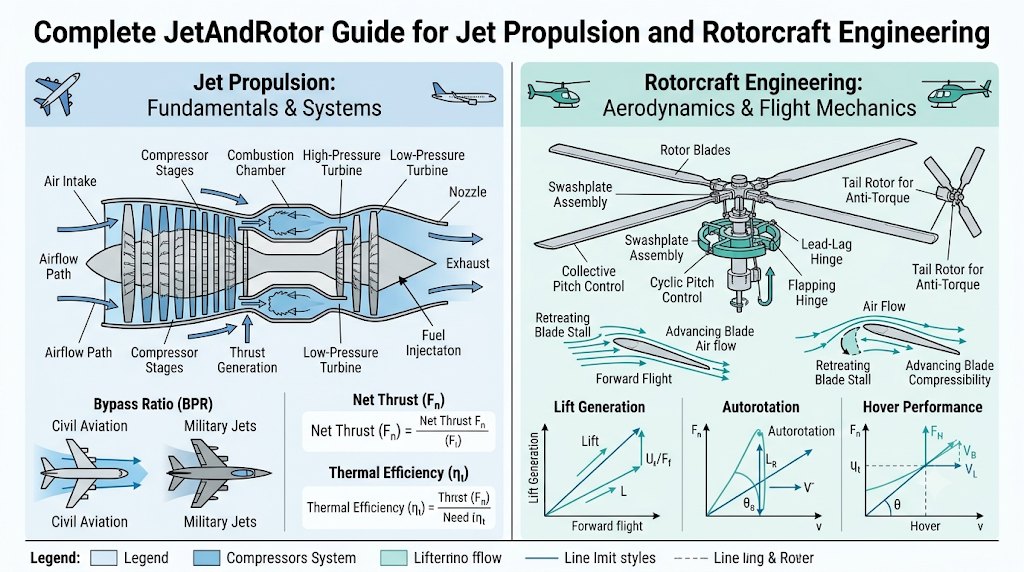
Most gas turbine engines share four main stages:
- Air intake: The engine receives air from the surrounding atmosphere.
- Compression: A compressor raises the air pressure.
- Combustion: Fuel burns with compressed air and adds energy to the gas flow.
- Expansion and exhaust: Hot gases pass through turbine stages and leave the engine, producing useful power and, depending on the design, thrust.
The turbine also drives important engine components. These include the compressor and, in some designs, a fan or output shaft.
NASA’s educational material explains these basic gas turbine principles in its Gas Turbine Propulsion guide.
2. Major Types of Jet and Gas Turbine Engines
Different aircraft need different forms of propulsion. Engineers select an engine based on performance, efficiency, weight, noise, and mission requirements.
Turbojet engines
A turbojet sends most of its airflow through the engine core. It compresses the air, adds fuel energy, and produces a high-speed exhaust stream.
Turbojets played an important role in early jet aviation. Their design is suited to certain high-speed applications. However, other engine types often provide better efficiency for modern commercial transport.
Turbofan engines
Turbofan engines use a large fan at the front. The fan moves air through the engine core and around it through a bypass path.
This bypass airflow produces a large share of the engine’s thrust in many modern designs. High-bypass turbofans are widely used on commercial passenger aircraft.
Their design supports efficient subsonic flight. Engineers also consider noise, fuel use, weight, and emissions when developing turbofan systems.
Turboprop engines
A turboprop uses a gas turbine to drive a propeller through a shaft and reduction gearbox. The propeller produces most of the aircraft’s thrust.
Turboprops are common in regional transport and other aircraft designed for suitable lower-speed routes. They can offer useful efficiency for missions where a large jet engine may not be the best choice.
Turboshaft engines
A turboshaft engine produces power through an output shaft. It is commonly used to power helicopter rotor systems.
Unlike a typical turbojet, its main purpose is not to produce forward thrust from exhaust gases. Instead, it delivers mechanical power to a transmission and rotor system.
This distinction is important when comparing fixed-wing aircraft engines with helicopter powerplants.
Ramjet and scramjet concepts
Ramjets and scramjets are air-breathing propulsion concepts associated with very high-speed flight research.
A ramjet uses the aircraft’s forward motion to compress incoming air. A scramjet is designed for combustion with airflow moving at supersonic speeds through the engine.
These concepts operate in specialized flight regimes. They are not general replacements for the engines used on ordinary passenger aircraft.
3. Important Components of a Jet Engine
A gas turbine engine contains several connected systems. Each component has a defined engineering purpose.
Intake
The intake guides outside air into the engine. Its design must support suitable airflow across the aircraft’s operating range.
Compressor
The compressor raises air pressure before combustion. It contains rotating and stationary aerodynamic components.
Combustion chamber
The combustion chamber adds energy to the compressed airflow through controlled fuel combustion. Engineers study temperature, pressure, emissions, and stable operation.
Turbine
The turbine extracts energy from the hot gas flow. It drives the compressor and may also provide power to a fan or output shaft.
Exhaust system
The exhaust system manages the flow leaving the engine. Its design contributes to engine performance and noise characteristics.
Control and monitoring systems
Modern engines use sensors and electronic controls to monitor important operating conditions. These systems support performance management and maintenance planning.
Engine design requires careful coordination between all these components. A change in one area can affect the performance of the wider system.
4. What Is Rotorcraft Engineering?
Rotorcraft engineering focuses on aircraft that use rotating blades to generate lift. Helicopters are the best-known example, but the category includes other aircraft designs.
The Federal Aviation Administration describes rotorcraft as aircraft that generate lift through rotating blades. Its technical discipline also covers rotorcraft aerodynamics, structures, flight mechanics, and safety.
Unlike conventional fixed-wing aircraft, helicopters can hover and take off or land vertically when their design and operating conditions allow it. These capabilities make them useful for missions that require access to limited spaces.
How a helicopter rotor creates lift
A helicopter’s main rotor has blades that act like rotating wings. As they move through the air, they create aerodynamic forces.
The rotor system supports lift and helps control the aircraft’s movement. The transmission connects engine power to the rotor system.
A helicopter’s design must account for changing aerodynamic loads, vibration, structural strength, and control response. These factors make rotorcraft engineering a complex field.
5. Main Types of Rotorcraft
Rotorcraft include several configurations. Each has different design features and engineering trade-offs.
Conventional helicopters
A common helicopter layout uses one main rotor and a smaller tail rotor. The main rotor provides lift and contributes to directional movement. The tail rotor helps manage the turning effect associated with the main rotor.
Some helicopters use other anti-torque arrangements. The choice depends on the aircraft’s design and intended role.
Coaxial rotorcraft
Coaxial designs use two main rotors arranged on the same axis. The rotors turn in opposite directions.
This arrangement can balance certain rotational effects without a conventional tail rotor. However, it creates its own design and engineering challenges.
Tandem rotorcraft
Tandem rotorcraft use two large rotors placed at different points along the aircraft. This layout can support useful lifting capacity and load distribution.
The design requires careful coordination between the rotor systems and the aircraft structure.
Gyroplanes and autogyros
A gyroplane uses an unpowered rotor for lift during normal flight. A separate propulsion system provides forward movement.
This makes a gyroplane different from a conventional helicopter. The rotor and propulsion systems serve distinct roles.
Tiltrotor aircraft
Tiltrotor aircraft combine features of helicopters and fixed-wing aircraft. Their rotors can change orientation as the aircraft transitions between flight modes.
This design aims to combine vertical-flight capability with efficient forward flight. It also creates complex mechanical, aerodynamic, and control challenges.
6. Important Rotorcraft Systems
A rotorcraft depends on several systems working together. Their design must support strength, reliability, and predictable performance.
- Rotor system: Produces lift and contributes to aircraft control.
- Engine: Supplies mechanical power.
- Transmission: Transfers power to the rotor system.
- Airframe: Supports the aircraft’s structure and installed systems.
- Flight controls: Allow the aircraft to respond to pilot inputs.
- Avionics: Provide navigation, communication, and aircraft information.
- Electrical system: Supplies power to suitable aircraft equipment.
- Monitoring systems: Help track important system conditions.
Engineers evaluate these systems as part of the complete aircraft. A component cannot be judged only by its individual performance. Its effect on the wider aircraft also matters.
7. Jet Propulsion and Rotorcraft: Key Differences
Jet-powered fixed-wing aircraft and rotorcraft solve different transportation problems.
| Engineering area | Jet-powered fixed-wing aircraft | Rotorcraft |
|---|---|---|
| Main lift source | Wings | Rotating rotor blades |
| Main propulsion role | Produces forward thrust | Often supplies power to the rotor |
| Typical capability | Efficient forward flight | Vertical flight and hovering in suitable designs |
| Key engineering focus | Engine performance and wing aerodynamics | Rotor aerodynamics and dynamic loads |
| Common powerplant | Turbofan or other suitable engine | Often a turboshaft or piston engine |
| Design challenge | Balancing speed, range, and efficiency | Balancing lift, control, vibration, and weight |
The comparison shows why engineers cannot use one design approach for every aircraft. Each aircraft must match its propulsion and lifting systems to its mission.
8. Aerodynamics and Aircraft Performance
Aerodynamics studies how air moves around objects. It helps engineers understand lift, drag, airflow, and stability.
Four forces are central to many basic explanations of flight:
- Lift: The aerodynamic force that supports an aircraft against gravity.
- Weight: The force caused by gravity.
- Thrust: The forward force produced by a propulsion system.
- Drag: The resistance created by movement through air.
The balance between these forces affects aircraft performance. Engineers study how changes in speed, altitude, air density, and aircraft configuration influence the result.
Performance considerations for jet aircraft
Jet aircraft design often considers:
- Fuel efficiency and engine performance.
- Aircraft weight and payload.
- Cruise speed and operating altitude.
- Aerodynamic drag.
- Noise and environmental impact.
- Engine reliability and maintenance needs.
Performance considerations for rotorcraft
Rotorcraft engineering adds other important factors:
- Rotor aerodynamic efficiency.
- Vibration and noise.
- Structural loads on rotor blades.
- Power requirements during different flight conditions.
- Transmission design and reliability.
- Aircraft weight and useful load.
These factors influence design choices. Engineers must evaluate them together rather than treating each one separately.
9. Materials and Structural Engineering
Aircraft structures must balance strength, weight, durability, and cost. Materials also need to meet strict engineering and certification requirements.
Common aerospace material groups include:
- Aluminium alloys: Used in many aircraft structures because of their useful strength-to-weight properties.
- Titanium alloys: Selected for certain applications that need high strength and heat resistance.
- Advanced composites: Used in suitable structures to reduce weight and support specific performance goals.
- Specialist alloys: Used in demanding engine environments where temperature and mechanical loads are important.
Rotorcraft structures face repeated dynamic loads. Rotor blades and related components require careful engineering because they experience changing forces during operation.
Material selection also affects inspection needs, repair planning, service life, and manufacturing cost.
10. Maintenance, Reliability, and Safety
Aircraft safety depends on sound design, approved maintenance, trained professionals, and careful oversight.
Jet engines and rotorcraft systems contain many connected components. Their condition must be monitored throughout their service life.
Maintenance planning may include:
- Scheduled inspections.
- Component condition monitoring.
- Review of maintenance records.
- Approved repair and replacement processes.
- Technical documentation and traceability.
- Compliance with applicable aviation requirements.
Modern maintenance programs may use sensor data and digital analysis to help identify developing issues. These tools can support planning, but they do not replace approved maintenance procedures or qualified personnel.
The FAA provides educational and regulatory resources for aircraft and rotorcraft safety. Its Rotorcraft technical discipline page explains the wider engineering and certification areas involved.
11. Applications of Jet and Rotorcraft Technology
Jet propulsion and rotorcraft serve different needs across aviation.
Commercial transportation
Jet-powered aircraft support passenger and cargo transportation over regional and long-distance routes. Engine selection depends on aircraft size, route needs, operating cost, and performance.
Emergency medical services
Helicopters can reach some locations that are difficult to access by road or conventional aircraft. They support certain emergency medical transport missions.
Search and rescue
Rotorcraft can support search and rescue teams. Their ability to access selected areas makes them useful in some response situations.
Offshore transportation
Helicopters transport people and supplies to offshore facilities. Aircraft selection depends on mission needs, range, weather limits, and safety requirements.
Utility and infrastructure work
Specialized rotorcraft may support inspection and other utility tasks. Such work requires suitable aircraft, trained teams, and approved procedures.
Research and technology development
Aerospace research explores improvements in propulsion, materials, rotor systems, efficiency, and aircraft noise. Research findings can influence future aircraft designs.
12. Current Engineering Challenges
Jet propulsion and rotorcraft engineering continue to face major technical challenges.
Fuel efficiency
Engineers aim to reduce fuel use while meeting performance and safety requirements. Better materials, aerodynamic improvements, and improved engine designs can support this goal.
Noise reduction
Aircraft noise affects communities and airport environments. Engineers study engines, propellers, rotor blades, and aircraft structures to understand and reduce noise.
Emissions
Aviation research explores ways to reduce environmental impact. Work includes engine efficiency, alternative fuels, electric systems, and other technology pathways.
Weight management
Lower aircraft weight can improve useful load and efficiency. However, weight reduction must never compromise required structural strength or safety.
Reliability
Aircraft systems must perform consistently under demanding conditions. Design reviews, testing, inspection, and maintenance planning all support reliability.
System integration
Modern aircraft combine mechanical, electrical, digital, and control systems. Engineers must make sure these systems work together and meet certification requirements.
13. Future Trends in Jet Propulsion and Rotorcraft
Aerospace research continues to explore new ways to improve aircraft performance and sustainability.
Sustainable aviation fuels
Sustainable aviation fuels are being studied as one possible way to reduce aviation’s lifecycle emissions. Their use depends on fuel standards, supply, aircraft compatibility, and wider infrastructure.
Hybrid-electric propulsion
Hybrid-electric systems combine different sources of power. Researchers are studying how these systems may support selected aircraft types and missions.
Electric vertical takeoff and landing aircraft
Electric vertical takeoff and landing aircraft, often called eVTOL aircraft, use electric propulsion concepts for vertical flight. Designs vary widely, and they face challenges involving batteries, range, noise, certification, and infrastructure.
Advanced materials
New materials may help reduce weight and improve durability. Engineers must still evaluate manufacturing quality, inspection methods, repair needs, and long-term performance.
Digital engineering
Digital models and simulation tools help engineers study aircraft systems before physical testing. They can support design analysis, system integration, and maintenance planning.
Improved monitoring
Sensors and data analysis can help track aircraft condition. These tools may support maintenance decisions when used within approved technical programs.
Future progress will depend on testing, certification, practical performance, and safety evidence. A promising concept must prove that it can meet real aviation requirements.
14. Skills for Students Interested in Aerospace Engineering
Students interested in jet propulsion or rotorcraft engineering can build a strong foundation through several subjects.
Useful areas of study include:
- Mathematics and applied physics.
- Aerodynamics and fluid mechanics.
- Mechanical and aerospace engineering.
- Thermodynamics and heat transfer.
- Materials science.
- Computer-aided design.
- Electronics and control systems.
- Programming and simulation.
- Technical communication and teamwork.
Aerospace engineering is a broad field. Students can explore propulsion, structures, avionics, materials, testing, or safety engineering.
Learning should begin with reliable educational resources and supervised academic projects. Aircraft maintenance and engineering work must follow applicable qualifications, regulations, and approved procedures.
15. How JETANDROTOR.COM Can Support Aviation Learning
JETANDROTOR.COM can serve as an educational resource for readers interested in jet propulsion and rotorcraft engineering.
Useful content areas include:
- Beginner guides to gas turbine engines.
- Explanations of turbofan, turboprop, and turboshaft systems.
- Introductions to helicopter and rotorcraft designs.
- Comparisons of fixed-wing and rotary-wing aircraft.
- Basic explanations of aerodynamics.
- Articles about aerospace materials and structures.
- Overviews of aircraft maintenance and reliability.
- Educational discussions of future propulsion concepts.
- Career and study guides for aspiring aerospace engineers.
The site should present technical topics in clear language. It should distinguish established technology from experimental research. It should also direct readers toward trusted aviation authorities and educational institutions.
Frequently Asked Questions
1. What is jet propulsion?
Jet propulsion produces thrust by accelerating air or exhaust gases. The resulting reaction force moves an aircraft forward.
2. What is the difference between a turbojet and a turbofan?
A turbojet sends most of its airflow through the engine core. A turbofan uses a front fan and moves additional air around the core. Many modern passenger aircraft use turbofans.
3. What is a turboshaft engine?
A turboshaft is a gas turbine engine that delivers mechanical power through an output shaft. It commonly powers helicopter rotor systems.
4. What is rotorcraft engineering?
Rotorcraft engineering focuses on aircraft that use rotating blades to generate lift. It includes rotor aerodynamics, structures, propulsion, controls, and safety.
5. Are all rotorcraft helicopters?
No. Helicopters are one type of rotorcraft. Gyroplanes and tiltrotors are other examples.
6. How is a gyroplane different from a helicopter?
A helicopter normally uses an engine-driven rotor for lift. A gyroplane uses an unpowered rotor for lift and a separate propulsion system for forward movement.
7. Why do helicopters use rotor systems?
Rotor systems generate the aerodynamic forces needed for lift. They also support aircraft movement and control.
8. What is the difference between thrust and lift?
Thrust is a force produced by a propulsion system. Lift is an aerodynamic force that supports an aircraft against gravity. Their roles are different, even though both affect flight.
9. What materials are used in aircraft engineering?
Aircraft may use aluminium alloys, titanium alloys, advanced composites, and specialist alloys. Engineers select materials according to the application and required performance.
10. What subjects help students enter aerospace engineering?
Mathematics, physics, mechanical engineering, aerodynamics, thermodynamics, materials science, and programming provide a useful foundation.
11. What are eVTOL aircraft?
eVTOL means electric vertical takeoff and landing. These aircraft use electric propulsion concepts to support vertical flight. Their designs and capabilities vary.
12. Why is aircraft maintenance important?
Maintenance helps preserve aircraft condition and system reliability. It follows approved technical data, inspection requirements, and applicable aviation regulations.
Conclusion
Jet propulsion and rotorcraft engineering are important parts of modern aerospace technology. Jet engines provide thrust for many fixed-wing aircraft. Rotor systems generate lift for helicopters and other rotorcraft. Both fields require careful work in aerodynamics, structures, materials, propulsion, and safety.
New research is exploring cleaner propulsion, better materials, digital engineering, and improved aircraft efficiency. These developments may shape future aviation. A clear understanding of the basic engineering principles helps students and aviation readers follow this progress.

