
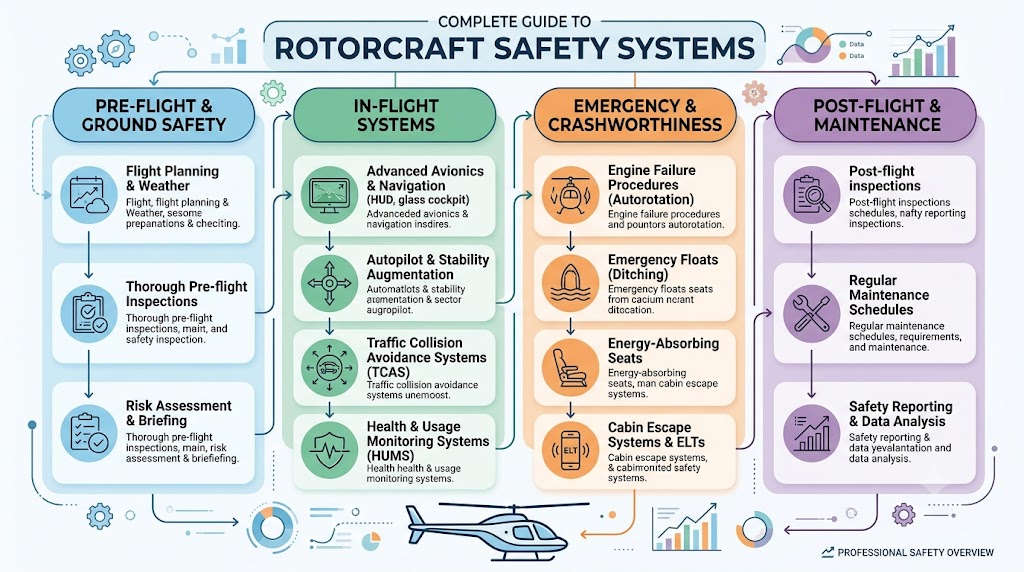
Rotorcraft safety is not provided by a single piece of equipment. It comes from a network of systems that work together to prevent failures, detect developing problems, give crews time to respond, protect occupants when an accident cannot be avoided, and support recovery afterward.
A modern rotorcraft may incorporate flight-control protections, engine and transmission monitoring, rotor vibration monitoring, fire detection and suppression, crashworthy seating, energy-absorbing structures, emergency exits, flotation equipment, emergency locator transmitters, terrain-awareness functions, weather and navigation systems, and increasingly sophisticated health-monitoring technologies.
The most important principle is that these systems should be considered as layers of protection. A warning system does not replace sound maintenance. A crashworthy seat does not prevent an accident. A terrain-awareness system does not eliminate the need for terrain clearance. Each layer addresses a different part of the risk chain.
Executive Summary
Rotorcraft safety systems can be grouped into several interconnected areas:
- Primary flight and control systems — provide the basic means of controlling the aircraft.
- Powerplant and rotor-drive protection — detect or mitigate engine, gearbox, rotor, and drive-system problems.
- Flight-control augmentation — improves stability, workload management, and controllability where installed.
- Warning and alerting systems — provide information about abnormal conditions.
- Avionics and situational-awareness systems — help crews understand terrain, traffic, weather, navigation, and aircraft status.
- Fire protection systems — detect and contain fire or hazardous over-temperature conditions.
- Crashworthiness systems — reduce injury severity during survivable accidents.
- Emergency equipment — supports occupants after an accident or forced landing.
- Health and usage monitoring — helps maintenance teams identify developing mechanical problems.
- Maintenance and inspection controls — ensure safety systems remain functional throughout the aircraft lifecycle.
The effectiveness of the overall safety architecture depends on the interaction between these layers rather than on any single technology.
1. What Are Rotorcraft Safety Systems?
Rotorcraft safety systems are the aircraft systems, equipment, structures, monitoring functions, and design features intended to:
- Prevent hazardous conditions.
- Detect abnormal conditions.
- Warn the flight crew.
- Maintain or recover controllability.
- Limit the consequences of failures.
- Protect occupants during an accident.
- Help locate and assist survivors.
- Provide maintenance personnel with evidence of developing faults.
This distinction matters because safety systems operate at different points in the accident chain.
For example:
Prevention → Detection → Warning → Control → Mitigation → Survival → Recovery
A transmission-monitoring system may operate primarily in the detection stage. A fire-extinguishing system is primarily a mitigation system. A crashworthy seat operates mainly during the survival stage.
A mature rotorcraft safety design therefore avoids depending on one layer to compensate for weaknesses in another.
2. The Rotorcraft Safety System Architecture
A useful way to understand rotorcraft safety is to divide it into six broad layers.
| Safety Layer | Primary Purpose | Typical Examples |
|---|---|---|
| Prevention | Reduce probability of hazardous conditions | Robust component design, redundancy, inspections |
| Detection | Identify abnormal conditions early | Sensors, chip detectors, vibration monitoring |
| Alerting | Inform the crew or maintenance team | Cautions, warnings, annunciators |
| Control | Preserve aircraft controllability | Flight controls, stability augmentation |
| Mitigation | Reduce consequences of failure | Fire suppression, flotation, emergency systems |
| Survival & Recovery | Protect and locate occupants | Crashworthy seats, ELT, emergency equipment |
The layers should complement one another.
For example, a rotor-drive safety strategy may combine:
component design + lubrication monitoring + chip detection + vibration monitoring + crew indications + inspection + maintenance action
rather than relying on a single sensor.
EASA has specifically addressed rotor-drive chip detection and vibration-health-monitoring technologies within its rotorcraft certification framework.
3. Primary Flight-Control Systems
The primary flight-control system is the foundation of rotorcraft safety because it provides the pilot with control over the aircraft’s attitude, direction, and rotorcraft flight path.
Depending on the aircraft configuration, the system may involve:
- Cyclic controls
- Collective controls
- Pedal controls
- Main-rotor control mechanisms
- Tail-rotor control systems
- Hydraulic or powered flight-control components
- Mechanical linkages
- Servo actuators
- Control mixers
- Associated sensors and indications
Why Flight-Control Reliability Matters
Rotorcraft flight controls can contain numerous mechanical, hydraulic, electrical, or electronic elements. Failure of a critical component can therefore have consequences that are very different from a failure in a non-critical cabin system.
Safety engineering focuses on:
- Redundancy where required
- Appropriate component strength
- Fail-safe characteristics
- Separation of critical systems
- Protection from environmental effects
- Proper inspection
- Correct adjustment
- Detection of abnormal conditions
The exact design depends heavily on rotorcraft type and certification category.
4. Hydraulic Flight-Control Systems
Many rotorcraft use hydraulic assistance to reduce the physical forces required to operate flight controls.
A hydraulic system may include:
- Pumps
- Reservoirs
- Filters
- Pressure regulators
- Actuators
- Valves
- Hydraulic lines
- Pressure indications
- Backup or emergency provisions where applicable
Hydraulic assistance can improve controllability and reduce pilot workload, but it also introduces another system whose condition must be managed.
Important safety considerations include:
- Fluid contamination
- Leakage
- Pressure loss
- Component degradation
- Hose or line damage
- Seal deterioration
- Pump failure
- Incorrect maintenance
- Indication-system faults
A sophisticated safety architecture considers not merely whether a hydraulic component can fail, but what happens to aircraft controllability after that failure.
5. Stability Augmentation and Automatic Flight-Control Systems
Some rotorcraft use stability augmentation systems or more comprehensive automatic flight-control systems.
These systems may help with:
- Aircraft stability
- Attitude control
- Heading control
- Vertical or lateral control
- Workload reduction
- Coupled flight functions
- Autopilot functions
The exact capabilities vary considerably between aircraft.
Safety Value
Automatic or augmented control can reduce pilot workload during demanding operations and can help maintain desired aircraft behavior.
However, automation introduces its own safety considerations.
The crew must understand:
- What the system controls
- What it does not control
- When it disengages
- What failure indications mean
- Which modes are active
- What happens after sensor or power failures
- How system status is communicated
A recurring lesson in aviation automation is that mode awareness is part of system safety.
6. Main-Rotor Safety
The main rotor is one of the most safety-critical systems on a rotorcraft.
Safety considerations include:
- Blade structural integrity
- Rotor-head condition
- Blade attachment
- Pitch-control mechanisms
- Rotor-drive components
- Vibration
- Balance
- Fatigue
- Corrosion
- Foreign-object damage
- Maintenance history
Rotor systems experience substantial cyclic and dynamic loads. Consequently, inspection and condition monitoring are central to rotorcraft airworthiness.
Safety monitoring can involve:
- Scheduled inspections
- Component life limits
- Vibration monitoring
- Rotor tracking and balancing
- Structural inspections
- Non-destructive inspection methods
- Health-monitoring technologies
The precise inspection requirements are aircraft-specific and must be taken from the approved maintenance data for that aircraft.
7. Tail-Rotor and Anti-Torque Safety
For conventional helicopters, the tail-rotor system performs a critical anti-torque function and contributes to directional control.
Its safety architecture can include:
- Tail rotor blades
- Gearbox
- Drive shaft
- Intermediate gearboxes
- Pitch-control mechanism
- Bearings
- Structural supports
- Control linkages
Potential hazards include:
- Drive-system damage
- Gearbox problems
- Control-linkage degradation
- Blade damage
- Bearing deterioration
- Vibration
- Foreign-object damage
Some rotorcraft use alternative anti-torque architectures, such as fenestron or NOTAR-type designs, so the specific safety system depends on aircraft configuration.
8. Engine Safety Systems
Rotorcraft propulsion systems require multiple layers of protection because engine problems can directly affect available power.
Important systems may include:
- Engine monitoring
- Oil-pressure monitoring
- Oil-temperature monitoring
- Turbine temperature monitoring
- Torque measurement
- Rotor-speed monitoring
- Fuel-pressure monitoring
- Fuel-flow measurement
- Overspeed protection
- Engine control systems
- Fire detection
- Fire suppression
The objective is not simply to display numbers.
A useful monitoring architecture should help answer:
Is the engine operating normally?
Is a parameter approaching a limit?
Is the trend changing?
Does the crew need to respond?
Does maintenance need to investigate?
9. Rotor-Speed Monitoring
Rotor speed is a fundamental parameter in rotorcraft operations.
Monitoring systems can provide information about:
- Main-rotor speed
- Engine speed
- Power relationships
- Overspeed conditions
- Underspeed conditions
Modern cockpit displays may integrate this information into broader engine and aircraft monitoring systems.
The important safety principle is that abnormal rotor-speed conditions should be detected and communicated in a way appropriate to the aircraft’s design and operating procedures.
10. Transmission and Gearbox Protection
Transmission and gearbox systems are particularly important because they transfer power between the engine and rotor systems.
A safety architecture may include:
- Oil-pressure monitoring
- Oil-temperature monitoring
- Chip detection
- Vibration monitoring
- Gearbox temperature sensing
- Torque monitoring
- Lubrication-system monitoring
- Scheduled inspections
- Component life tracking
Why Chip Detection Matters
Mechanical degradation can generate metallic particles.
Chip-detection systems are designed to help identify certain forms of developing internal mechanical deterioration.
EASA has specifically established certification provisions addressing the effectiveness of rotorcraft chip-detection systems for detecting developing degradation or failure in rotor-drive components.
This illustrates an important principle:
Safety monitoring is most valuable when it provides useful warning before a component reaches a catastrophic condition.
11. Vibration Health Monitoring
Rotorcraft naturally generate vibration, but abnormal vibration can provide valuable information about developing mechanical problems.
Health-monitoring systems can potentially support detection of:
- Rotor imbalance
- Component degradation
- Gearbox abnormalities
- Bearing problems
- Drive-system issues
- Structural problems
Large-rotorcraft certification work has specifically addressed improved vibration health monitoring for critical rotor and rotor-drive components.
HUMS
A Health and Usage Monitoring System (HUMS) can combine information about aircraft usage and mechanical condition.
Depending on the aircraft and installation, HUMS may support:
- Vibration monitoring
- Component trend monitoring
- Usage tracking
- Exceedance recording
- Maintenance decision support
- Condition-based maintenance
HUMS should not be treated as a replacement for approved maintenance requirements.
It is better understood as an additional source of information that can help maintenance organizations make better-informed decisions.
12. Fire Detection Systems
Fire is a high-consequence hazard in aviation, so rotorcraft may incorporate dedicated fire-detection systems for relevant compartments or zones.
A fire-detection architecture may include:
- Temperature-sensitive elements
- Fire detectors
- Overheat detection
- Warning circuits
- Cockpit annunciation
- Independent power or monitoring arrangements where required
The goal is early recognition of a dangerous thermal condition.
Detection alone, however, does not control the fire.
That is why detection is normally paired with other protective measures.
13. Fire-Extinguishing Systems
Where installed and required, fire-extinguishing systems may provide a means of suppressing or controlling fire in protected areas.
Typical components can include:
- Extinguishing-agent containers
- Distribution lines
- Discharge mechanisms
- Cockpit controls
- Pressure monitoring
- Fire-zone isolation features
The system must be maintained according to approved aircraft documentation.
An extinguisher that has lost pressure, has an expired component, or has a damaged discharge system is not an effective safety layer.
14. Fuel-System Safety
Fuel systems introduce several important hazards:
- Fire
- Leakage
- Contamination
- Fuel starvation
- Fuel-system blockage
- Incorrect fuel quantity indication
- Tank damage
- Vapor hazards
Safety features can include:
- Fuel quantity measurement
- Low-fuel indications
- Fuel shutoff provisions
- Fire-resistant design
- Fuel-system segregation
- Tank protection
- Proper venting
- Fuel filtration
For accident survivability, fuel-system design can also be important because reducing post-impact fuel leakage can reduce the consequences of a crash.
15. Electrical-System Protection
Electrical systems support an increasing number of rotorcraft safety functions.
They may power:
- Flight instruments
- Engine monitoring
- Communications
- Navigation
- Lighting
- Flight-control augmentation
- Warning systems
- Emergency equipment
- Mission equipment
Important protections include:
- Circuit protection
- Electrical load management
- Redundant power sources where appropriate
- Battery systems
- Generator or alternator monitoring
- Wiring protection
- Electrical bonding and grounding
- Separation of critical circuits
As aircraft become more digitally integrated, electrical-system reliability becomes increasingly important to overall safety.
16. Warning, Caution, and Advisory Systems
A cockpit safety system should not merely collect information. It must communicate useful information to the crew.
Rotorcraft may use:
- Warning lights
- Caution indications
- Advisory messages
- Audio alerts
- Engine displays
- Integrated vehicle-health displays
- Master warning or caution systems
A good alerting system should distinguish between conditions according to their urgency.
Poor alert design can create:
- Alarm fatigue
- Confusion
- Incorrect prioritization
- Delayed response
- Excessive workload
The quality of an alerting system therefore depends on both technology and human factors.
17. Terrain and Obstacle Awareness
Terrain-related accidents are an important safety concern for rotorcraft because helicopters frequently operate:
- At relatively low altitude
- Near terrain
- Around obstacles
- In confined areas
- In changing visibility conditions
Depending on aircraft configuration and operational approval, safety technology may include:
- Terrain awareness
- Terrain databases
- Obstacle information
- Altitude awareness
- Synthetic-vision functions
- Enhanced visual displays
These systems are most effective when treated as situational-awareness aids, not as substitutes for flight planning, lookout, navigation discipline, or operating limitations.
18. Navigation and Situational Awareness
Navigation systems can contribute significantly to rotorcraft safety.
Possible systems include:
- GNSS-based navigation
- Inertial systems
- Radio navigation
- Moving maps
- Digital flight displays
- Electronic charts
- Integrated navigation systems
The safety benefit comes from reducing uncertainty about:
- Position
- Track
- Terrain
- Airspace
- Navigation references
- Intended route
However, digital systems can introduce database, software, sensor, power, and human-interface risks.
19. Weather Detection and Awareness
Weather can rapidly change rotorcraft operating conditions.
Relevant systems may include:
- Weather radar
- Storm information
- Outside-air-temperature indications
- Wind information
- Visibility-related equipment
- Integrated weather displays
Rotorcraft operators should distinguish between:
weather information
and
weather capability.
Having a weather display does not mean that the aircraft can safely operate in every weather condition shown on it.
20. Night-Vision and Enhanced Vision Technologies
Rotorcraft used in demanding environments may employ technologies designed to improve environmental awareness.
Examples can include:
- Night-vision-compatible cockpit systems
- Night-vision imaging systems
- Enhanced vision
- Synthetic vision
- Improved external lighting
These systems can provide additional information, but they have limitations.
Performance can be affected by:
- Weather
- Darkness
- Sensor limitations
- Obstructions
- Lighting conditions
- Equipment configuration
- Crew training
A safety system is valuable only when users understand its operating envelope.
21. Emergency Locator Transmitters
An Emergency Locator Transmitter (ELT) can assist search-and-rescue organizations in locating an aircraft after an emergency.
ELTs are part of the broader post-accident safety architecture.
Their value depends on factors such as:
- Correct installation
- Power availability
- Antenna condition
- Activation behavior
- Inspection status
- Signal environment
An ELT should therefore be treated as an emergency-support system rather than an accident-prevention system.
22. Crashworthy Design
Preventing accidents is only one part of aviation safety.
A second question is:
If an accident occurs, how effectively does the aircraft protect its occupants?
Crashworthiness focuses on reducing injury severity during survivable accidents.
Relevant features may include:
- Energy-absorbing seats
- Restraint systems
- Structural load paths
- Crash-resistant fuel-system features
- Seat attachment strength
- Occupant protection zones
- Emergency exits
- Interior design considerations
Crashworthiness is a design discipline, not simply an equipment category.
23. Energy-Absorbing Seats
Seats can play an important role in reducing occupant injury during high-energy events.
Energy-absorbing designs are intended to manage crash loads rather than transmitting all of the impact energy directly to the occupant.
Important factors include:
- Seat structure
- Attachment points
- Restraint systems
- Energy absorption
- Occupant positioning
- Seat maintenance
A damaged or improperly maintained seat can undermine a safety feature that is otherwise effective by design.
24. Restraint Systems
Seat belts and restraint systems are among the most direct occupant-protection mechanisms.
Their effectiveness depends on:
- Correct installation
- Proper adjustment
- Structural integrity
- Hardware condition
- Webbing condition
- Correct use
Restraint systems should be inspected according to applicable maintenance instructions and replaced or repaired when required.
25. Emergency Exits and Egress
Survival after an accident may depend on how quickly occupants can leave the aircraft.
Safety design therefore considers:
- Exit availability
- Exit accessibility
- Door operation
- Emergency markings
- Cabin layout
- Obstruction control
- Lighting
- Occupant familiarity
For operators, emergency-egress training is particularly important because an exit system is only useful if occupants can identify and use the available escape paths under stressful conditions.
26. Emergency Flotation Systems
Rotorcraft operating over or near water may be equipped with flotation systems depending on aircraft configuration and operational requirements.
These systems may include:
- Inflatable flotation devices
- Inflation systems
- External flotation assemblies
- Pressure or deployment components
Flotation systems have their own maintenance requirements and limitations.
They should never be considered a guarantee of survival. Their purpose is to provide an additional layer of protection in an appropriate emergency scenario.
27. Emergency Lighting
Emergency lighting can help occupants identify:
- Exits
- Cabin pathways
- Emergency equipment
- Escape routes
This becomes particularly important when normal electrical power or cabin visibility is compromised.
Emergency lighting may therefore be part of a larger system that combines:
power redundancy + lighting + exit marking + occupant training
28. Communications Systems
Reliable communication is a safety system because it enables the crew to exchange information with:
- Air traffic services
- Operations personnel
- Other aircraft
- Emergency responders
- Ground organizations
Depending on the aircraft and mission, communications may involve:
- VHF radios
- Satellite communications
- Intercom systems
- Emergency frequencies
- Data communications
Communication redundancy can become especially important for rotorcraft operating in remote environments.
29. Collision Avoidance and Traffic Awareness
Traffic-awareness technologies can help crews identify nearby aircraft and improve situational awareness.
Depending on the installation, this may involve:
- Traffic information
- Collision-avoidance functions
- Transponder systems
- Integrated traffic displays
The operational value depends on aircraft equipment, surrounding traffic, surveillance coverage, and system limitations.
Traffic-awareness technology should complement, rather than replace, appropriate visual and procedural traffic management.
30. Rotorcraft Cybersecurity
Modern rotorcraft increasingly depend on:
- Digital avionics
- Networked systems
- Software
- Databases
- Electronic maintenance systems
- Connected equipment
This creates cybersecurity considerations that did not exist to the same extent in purely mechanical architectures.
Potential concerns include:
- Unauthorized access
- Malicious software
- Compromised databases
- Supply-chain risks
- Insecure maintenance interfaces
- Software integrity
- Data manipulation
EASA’s rotorcraft certification framework includes cybersecurity-related provisions for rotorcraft systems.
Cybersecurity should therefore be integrated into the aircraft lifecycle rather than treated as a separate IT problem.
31. Redundancy and Fail-Safe Design
One of the central ideas in aviation safety engineering is that critical functions should not necessarily depend on a single point of failure.
Possible strategies include:
- Redundant sensors
- Independent power sources
- Multiple control paths
- Segregated wiring
- Backup instruments
- Independent monitoring
- Fault detection
- Graceful degradation
However, redundancy has a cost.
Additional systems can introduce:
- More weight
- More components
- More maintenance
- More failure modes
- Greater integration complexity
Therefore, redundancy should be applied according to the safety significance of the function.
32. Safety Assessment of Rotorcraft Systems
Rotorcraft certification does not simply ask whether an individual component works.
It also considers what happens when systems fail.
A safety assessment may consider:
- System function.
- Potential failures.
- Failure effects.
- Probability or likelihood considerations.
- Crew awareness.
- Aircraft-level consequences.
- Redundancy.
- Independence.
- Mitigation.
- Verification.
EASA has updated its rotorcraft safety-assessment provisions to address equipment, systems, and installations and to align the framework with broader safety-assessment practices.
This is why a safety system should always be evaluated in the context of the aircraft as a whole.
33. Maintenance Is a Safety System
It is tempting to think of safety systems as hardware.
In practice, maintenance is itself a critical safety layer.
A safety architecture can fail operationally because of:
- Missed inspections
- Incorrect parts
- Improper installation
- Incorrect torque
- Incomplete documentation
- Deferred defects
- Inadequate troubleshooting
- Poor configuration control
- Incorrect software/database updates
- Failure to follow approved maintenance data
The aircraft’s safety equipment is only as dependable as the processes that maintain it.
34. Condition-Based Maintenance and Trend Monitoring
Traditional maintenance often relies heavily on scheduled inspections and component intervals.
Condition monitoring adds another dimension by looking for evidence of changing equipment condition.
Trend monitoring can help identify:
- Gradual vibration changes
- Temperature trends
- Oil-pressure changes
- Performance deterioration
- Repeated exceedances
- Recurring faults
The key is interpretation.
A single abnormal reading may not tell the complete story. A trend across multiple flights or operating cycles may be more meaningful.
35. Safety Data and Maintenance Records
Good records help connect aircraft behavior with maintenance history.
Useful records may include:
- Component changes
- Inspection results
- Defect reports
- Fault messages
- Exceedances
- Vibration trends
- Engine trends
- Corrective actions
- Recurring defects
Strong recordkeeping helps maintenance organizations distinguish:
isolated events
from
developing patterns.
36. Human Factors in Rotorcraft Safety
Technology does not eliminate human error.
Rotorcraft safety must account for:
- Workload
- Fatigue
- Distraction
- Communication
- Automation management
- Training
- Situational awareness
- Decision-making
- Maintenance human factors
A warning system that is technically accurate but difficult to interpret under workload may not provide the intended safety benefit.
Similarly, a maintenance procedure that is unnecessarily confusing can increase the probability of human error.
37. Common Rotorcraft Safety Failure Modes
Several broad categories deserve particular attention.
Single-Point Dependency
A critical function depends on one component without adequate mitigation.
Poor Fault Indication
A developing problem exists but is not communicated clearly.
Maintenance-Induced Error
A system becomes unsafe because of incorrect maintenance.
Sensor Misinterpretation
The system receives inaccurate information and produces misleading output.
Alarm Overload
Too many alerts make it difficult to identify the most important condition.
Configuration Error
Installed equipment does not match approved configuration or required settings.
Deferred Defect Accumulation
Multiple minor defects interact and create a larger operational problem.
Inadequate Training
Personnel have equipment but do not understand its limitations.
False Confidence
Operators assume that safety technology eliminates the underlying hazard.
38. Safety Systems by Operational Objective
| Objective | Relevant Safety Systems |
|---|---|
| Prevent mechanical failure | Inspection, component-life control, lubrication monitoring |
| Detect mechanical degradation | HUMS, chip detection, vibration monitoring |
| Protect propulsion | Engine monitoring, fire detection, overspeed protection |
| Maintain controllability | Flight controls, hydraulic assistance, stability augmentation |
| Improve awareness | Navigation, terrain awareness, traffic awareness |
| Detect abnormal conditions | Warning and caution systems |
| Protect occupants | Crashworthy seats, restraints, structural protection |
| Support water operations | Flotation and emergency equipment |
| Support rescue | ELT and communications |
| Protect digital systems | Cybersecurity controls and configuration management |
| Maintain airworthiness | Approved maintenance procedures and records |
39. How to Evaluate a Rotorcraft Safety System
When assessing a safety system, ask the following questions.
1. What hazard does it address?
A system should have a clearly understood safety purpose.
2. What happens if the system fails?
The failure case is often more important than normal operation.
3. Does it provide detection or prevention?
These are different functions.
4. How does the crew receive the information?
Consider display, audio, priority, clarity, and workload.
5. Is there redundancy?
If the function is safety-critical, determine whether a single failure can eliminate it.
6. What are its limitations?
Every system has an operating envelope.
7. How is it maintained?
Determine inspection intervals, testing, component life, and configuration requirements.
8. How is effectiveness verified?
A safety system should have a defined method of proving that it remains functional.
40. Safety System Lifecycle
A strong safety program considers the complete lifecycle.
Planning
Identify hazards and operational requirements.
Design
Select appropriate safety architecture and redundancy.
Certification
Demonstrate compliance with applicable airworthiness requirements.
Installation
Ensure approved configuration and correct integration.
Testing
Verify normal operation and relevant failure behavior.
Operation
Use the system within its approved limitations.
Monitoring
Track faults, trends, and system performance.
Maintenance
Perform required inspections and corrective actions.
Modification
Control changes to hardware, software, wiring, and configuration.
Retirement
Remove components when life limits, condition, or configuration requirements demand it.
41. Regulatory Perspective
The regulatory framework matters because rotorcraft safety systems are not designed in isolation from airworthiness requirements.
In the United States, the FAA identifies Part 27 and Part 29 as the primary rotorcraft airworthiness standards for normal-category and transport-category rotorcraft respectively. The FAA also publishes associated advisory material and policies concerning rotorcraft certification and safety-enhancing equipment.
In the European system, EASA maintains CS-27 and CS-29 for small and large rotorcraft. EASA’s current Easy Access Rules for Large Rotorcraft consolidate the applicable CS-29 requirements, acceptable means of compliance, and guidance material.
The exact requirements applicable to an aircraft depend on factors such as:
- Aircraft category
- Type design
- Certification basis
- Installed equipment
- Intended operation
- State of registry
- Operating rules
- Approved modifications
Therefore, a general article should never be treated as a substitute for the aircraft’s approved documentation or applicable regulatory requirements.
42. Practical Rotorcraft Safety Checklist
Aircraft Systems
- Flight-control systems are maintained according to approved data.
- Hydraulic systems are inspected as required.
- Engine indications are functioning correctly.
- Rotor-speed indications are operational.
- Transmission monitoring systems are functional.
- Relevant chip-detection systems are serviceable.
- Vibration-monitoring equipment is functioning where installed.
- Fire-detection systems are serviceable.
- Fire-extinguishing systems meet required inspection conditions.
- Electrical systems are correctly configured.
- Warning and caution systems operate correctly.
Avionics
- Navigation equipment is serviceable.
- Relevant terrain-awareness equipment is operational.
- Traffic-awareness equipment is functional where installed.
- Communication systems are serviceable.
- Required databases are current according to applicable procedures.
- Software configuration is controlled.
Occupant Protection
- Seats are correctly installed.
- Restraint systems are serviceable.
- Emergency exits are accessible.
- Emergency lighting is functional where installed.
- Required emergency equipment is available.
- Flotation equipment is inspected where applicable.
Emergency Support
- ELT is properly maintained.
- Emergency communications equipment is serviceable.
- Emergency equipment is correctly stowed.
- Crew members understand relevant emergency equipment.
Maintenance
- Required inspections are current.
- Component life limits are tracked.
- Defects are properly recorded.
- Correct parts and approved data are used.
- Modifications are properly controlled.
- Recurring defects are investigated rather than repeatedly deferred.
43. Common Mistakes to Avoid
Treating Safety Equipment as a Substitute for Maintenance
Monitoring technology cannot compensate for poor maintenance practices.
Ignoring System Limitations
A sophisticated system can still provide incomplete or misleading information outside its intended operating envelope.
Focusing Only on Prevention
Survivability matters too. Crashworthiness and emergency equipment are important parts of the safety architecture.
Overlooking Human Factors
A technically capable system can still be ineffective if users misunderstand its indications.
Adding Technology Without Integration
Installing another display or sensor does not automatically improve safety. The system must fit into the overall aircraft architecture and crew workflow.
Ignoring Configuration Management
Safety-critical digital and electronic systems require disciplined control of hardware, software, databases, and interfaces.
Assuming Every Rotorcraft Uses the Same Architecture
Helicopters and other rotorcraft differ substantially in design, certification basis, mission, and equipment.
44. How Safety Systems Work Together
Consider a hypothetical rotor-drive problem.
A mature safety architecture might involve:
Component design
↓
Lubrication system
↓
Chip detection
↓
Vibration monitoring
↓
Cockpit indication
↓
Crew response
↓
Maintenance inspection
↓
Corrective action
The important insight is that safety does not depend on one sensor.
Each layer contributes a different form of protection.
If one layer misses the problem, another may detect it.
That is the essence of a layered safety architecture.
45. What Makes a Rotorcraft Safety System Effective?
A technically sophisticated safety system is not automatically an effective one.
The most useful systems generally have several characteristics:
Early Detection
They provide meaningful warning before the hazard becomes catastrophic where feasible.
Clear Indication
The information can be understood under operational workload.
Appropriate Redundancy
Critical functions are protected against relevant failures.
Maintainability
The system can be inspected, tested, repaired, and configured correctly.
Traceability
Faults and maintenance actions can be recorded and analyzed.
Known Limitations
Operators understand where the system may not provide reliable information.
Integration
The system works coherently with other aircraft systems and operating procedures.
46. Future Direction of Rotorcraft Safety
Rotorcraft safety is increasingly moving toward greater use of:
- Continuous condition monitoring
- Vibration-based health assessment
- Digital maintenance records
- Integrated aircraft-health data
- Advanced cockpit displays
- Improved terrain awareness
- More sophisticated automation
- Enhanced occupant protection
- More structured safety assessment
- Cybersecurity engineering
The direction is not simply toward adding more technology.
The larger trend is toward better information, earlier detection, improved fault isolation, and more systematic risk management.
EASA’s continuing updates to CS-27 and CS-29 demonstrate how certification frameworks evolve as new safety technologies and operational experience become available.
47. Final Takeaways
Rotorcraft safety systems should be viewed as an interconnected safety architecture rather than a collection of unrelated devices.
The strongest approach combines reliable aircraft design, effective monitoring, clear crew information, appropriate redundancy, disciplined maintenance, occupant protection, emergency equipment, and human-factors engineering.
Systems such as HUMS, vibration monitoring, chip detection, fire protection, flight-control augmentation, terrain awareness, crashworthy seating, and emergency-location equipment each address different parts of the risk chain.
No individual system eliminates rotorcraft risk.
The practical objective is to build enough independent layers that a single failure, error, or abnormal condition does not automatically become an accident.
Ultimately, rotorcraft safety depends on the combination of sound engineering, appropriate certification, disciplined maintenance, trained personnel, effective monitoring, and informed operational decision-making.

