
Aviation engineering projects often involve complex technical requirements, detailed documentation, regulatory considerations, and coordination between multiple stakeholders. Whether an organization needs aircraft modification support, structural analysis, systems engineering, certification assistance, or fleet technical services, the engineering consultant can play an important role in the project.
However, choosing a consultant should involve more than comparing quotations. A consultant may have extensive aviation experience but limited experience with a particular aircraft type or project category. Another may have strong technical capabilities but lack the resources or communication process needed for a larger assignment.
A structured evaluation helps organizations compare relevant experience, technical capabilities, project scope, documentation, communication, timelines, and costs before making a selection.
What Does an Aviation Engineering Consultant Do?
Aviation engineering consultants provide specialized technical services to aircraft owners, operators, manufacturers, maintenance organizations, and other aviation businesses.
Depending on their expertise and authorization, their work may involve:
- Aircraft engineering
- Structural analysis
- Aircraft modifications
- Avionics and systems engineering
- Aircraft performance analysis
- Maintenance engineering
- Certification support
- Technical documentation
- Fleet engineering support
- Engineering project management
The scope varies between consultants. A company experienced in one engineering discipline may not have the expertise or authorization required for another.
That distinction makes project-specific evaluation important.
Why Consultant Selection Matters
Engineering decisions can influence aircraft projects, schedules, documentation, maintenance planning, and certification activities.
Choosing an unsuitable consultant can create problems such as:
- Delayed engineering work
- Unclear project responsibilities
- Incomplete documentation
- Additional project costs
- Communication gaps
- Rework
- Certification-related delays
- Difficulty coordinating with other organizations
The objective should not simply be to find a consultant who can perform engineering work. The objective is to find a consultant whose capabilities match the project’s actual requirements.
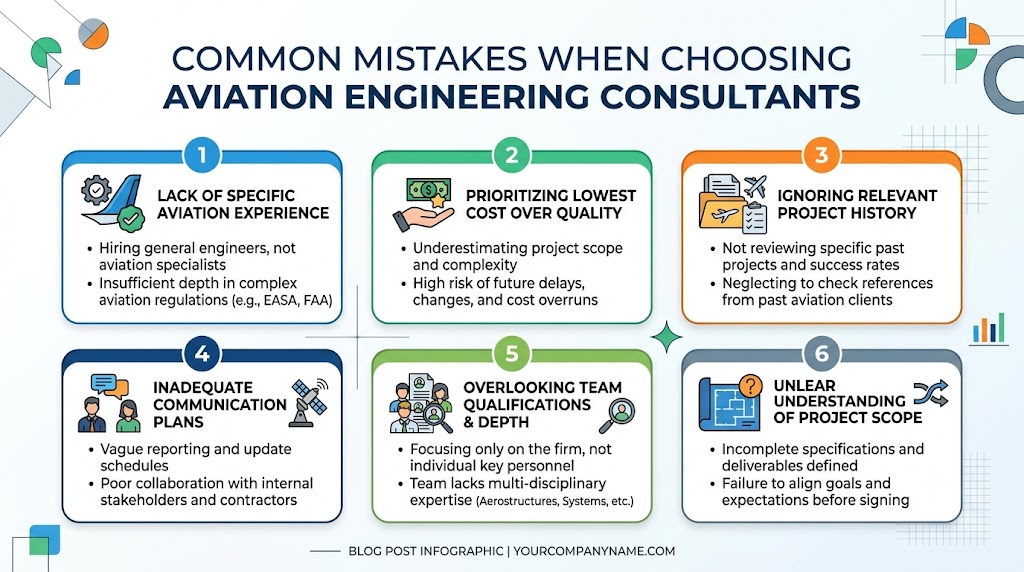
Common Mistakes When Choosing Aviation Engineering Consultants
1. Choosing a Consultant Based Only on Price
Cost is an important consideration, but the lowest quotation does not automatically represent the most suitable option.
A low initial quotation may not include every activity required to complete the project. Additional engineering reviews, documentation, meetings, revisions, testing support, or certification-related activities may affect the overall cost.
When comparing proposals, examine:
- Scope of work
- Deliverables
- Engineering assumptions
- Required inputs
- Review cycles
- Project milestones
- Additional services
- Payment structure
A meaningful comparison should consider the total project scope, not just the headline price.
2. Failing to Verify Relevant Aviation Experience
General engineering experience does not automatically translate into relevant aviation expertise.
A consultant may have experience in engineering but limited exposure to aircraft-specific requirements.
Before selecting a consultant, consider whether their experience matches:
- Aircraft engineering
- Aviation systems
- Structural work
- Certification activities
- Maintenance engineering
- Aircraft modifications
- The specific technical discipline involved
Relevant experience should match the actual project rather than simply the broader aviation industry.
3. Ignoring Aircraft-Type Experience
Aircraft vary significantly in their structures, systems, configurations, documentation, and engineering requirements.
A consultant with experience on one aircraft family may not automatically have equivalent experience with another.
Ask whether the consultant has relevant experience with:
- The aircraft type
- Similar aircraft configurations
- Comparable modifications
- Similar engineering problems
- Applicable technical documentation
Aircraft-type experience does not replace project-specific evaluation, but it can provide useful context when assessing capability.
4. Failing to Check Qualifications and Applicable Credentials
Aviation engineering work can involve specialized qualifications, approvals, authorizations, or organizational capabilities.
These requirements vary depending on:
- Jurisdiction
- Aircraft type
- Project scope
- Engineering activity
- Certification requirements
- Organization
- Applicable aviation rules
Do not assume that a consultant’s general aviation experience means they hold every qualification or approval required for your project.
Ask for relevant evidence and verify it through appropriate sources.
5. Not Defining the Project Scope Clearly
An unclear scope can create problems before engineering work even begins.
For example, a project described simply as:
“Aircraft modification engineering”
may not explain the actual work required.
A better project scope should identify relevant elements such as:
- Engineering objective
- Aircraft involved
- Existing configuration
- Proposed change
- Required analysis
- Expected deliverables
- Review requirements
- Certification involvement
- Project milestones
The more clearly the client defines the requirement, the easier it becomes to evaluate proposals.
6. Failing to Define Deliverables
Two consultants may quote similar prices while planning to provide very different deliverables.
Depending on the project, deliverables could include items such as:
- Engineering reports
- Drawings
- Analysis documentation
- Technical assessments
- Compliance documentation
- Modification records
- Certification-support material
The exact deliverables depend on the project.
Before signing an agreement, make sure both parties understand what documents and outputs the consultant will provide.
7. Overlooking Communication Practices
Technical expertise alone does not guarantee smooth project communication.
Engineering projects may involve aircraft owners, operators, maintenance teams, regulators, suppliers, manufacturers, and other technical organizations.
Poor communication can lead to:
- Delayed responses
- Misunderstood requirements
- Repeated work
- Missed milestones
- Conflicting technical information
Ask prospective consultants about:
- Primary points of contact
- Reporting frequency
- Technical review meetings
- Document management
- Escalation procedures
- Expected response times
8. Not Checking Previous Project Experience
Previous work can provide useful evidence of how a consultant approaches engineering assignments.
Where information can be shared appropriately, ask about experience with projects involving:
- Similar aircraft
- Similar engineering disciplines
- Comparable modifications
- Similar certification environments
- Similar project complexity
Confidentiality may prevent consultants from sharing detailed client information. That does not prevent a buyer from asking for an appropriate description of relevant experience.
9. Ignoring Regulatory and Certification Considerations
Some aviation engineering projects involve certification or regulatory requirements.
The applicable process can vary depending on the jurisdiction, aircraft, modification, and type of engineering activity.
A common mistake is to select a consultant based on technical capability without considering whether the consultant understands the relevant certification environment.
Ask:
- What regulatory framework applies?
- What certification activities are expected?
- What documentation will be required?
- Who is responsible for submissions?
- Which activities fall within the consultant’s authority?
- Which activities require involvement from another approved organization?
The answers should be specific to the project.
10. Choosing a Consultant Without Evaluating Technical Resources
A consultant’s capabilities depend not only on individual expertise but also on the technical resources available to complete the work.
Depending on the project, relevant resources may include:
- Engineering personnel
- Analysis capabilities
- CAD resources
- Technical documentation systems
- Project management resources
- Quality processes
- Specialist engineering expertise
A small assignment may require limited resources, while a complex modification or certification project may require broader capabilities.
11. Ignoring Project Timelines and Dependencies
Aviation engineering projects rarely operate in isolation.
Engineering work may depend on:
- Aircraft availability
- Technical data
- Measurements
- Maintenance activities
- Supplier information
- Testing
- Regulatory reviews
- Customer approvals
Ask prospective consultants to identify major milestones and dependencies.
A realistic schedule should recognize activities outside the consultant’s direct control.
12. Failing to Define Responsibilities
Unclear responsibilities can cause significant project confusion.
For example, the client, engineering consultant, maintenance organization, aircraft manufacturer, and other stakeholders may each have different responsibilities.
Before work begins, establish:
- Who supplies aircraft data
- Who provides technical records
- Who approves project decisions
- Who prepares engineering documents
- Who coordinates testing
- Who handles regulatory communication
- Who maintains final records
Clear responsibility assignments reduce unnecessary duplication and confusion.
How to Evaluate Aviation Engineering Expertise
A structured evaluation can make consultant selection easier.
Consider five major areas.
Technical Expertise
Does the consultant understand the engineering discipline required for the project?
Aviation Experience
Does the organization have relevant aviation engineering experience?
Aircraft Experience
Has the consultant worked with the aircraft type or comparable configurations?
Regulatory Understanding
Does the consultant understand the applicable regulatory and certification environment?
Project Delivery
Can the consultant manage documentation, communication, milestones, reviews, and technical coordination?
No single factor should replace a complete evaluation.
Checking Aircraft-Type and Project Experience
When reviewing a consultant’s background, look beyond broad statements such as:
“We have extensive aviation experience.”
Ask more specific questions.
For example:
- Which aircraft types have you supported?
- What types of engineering projects have you completed?
- Have you handled similar modifications?
- Which technical disciplines did those projects involve?
- What types of engineering documentation did you produce?
- Have you worked with organizations involved in similar certification processes?
Specific answers provide more useful information than general marketing statements.
Understanding Qualifications, Approvals, and Credentials
Not every aviation engineering project requires the same qualifications or approvals.
The appropriate requirements depend on the nature of the work.
When evaluating a consultant, identify:
- The engineering task.
- The applicable jurisdiction.
- The relevant aircraft.
- The expected certification pathway.
- The type of technical documentation required.
- Any approvals or authorizations that apply.
Then verify that the consultant’s qualifications and capabilities align with those requirements.
Defining Project Scope and Deliverables
A strong project statement should describe what the consultant needs to accomplish.
A useful scope can include:
| Project Element | What to Define |
|---|---|
| Objective | What the project needs to achieve |
| Aircraft | Aircraft type and relevant identification |
| Configuration | Existing configuration and proposed change |
| Engineering | Required technical disciplines |
| Analysis | Required engineering assessments |
| Documentation | Expected reports, drawings, or records |
| Certification | Applicable certification support |
| Schedule | Major milestones |
| Client Inputs | Information the client must provide |
| Responsibilities | Who handles each activity |
This structure gives both parties a clearer understanding of the assignment.
Questions to Ask Before Hiring an Aviation Engineering Consultant
Before selecting a consultant, consider asking:
Experience
- What relevant aviation engineering projects have you completed?
- Have you worked on similar aircraft?
- Have you handled comparable technical challenges?
Technical Capability
- Which engineering disciplines can your team support?
- What technical resources are available?
- Do you use internal specialists or external resources?
Documentation
- What deliverables will you provide?
- How will technical revisions be managed?
- How will project records be maintained?
Regulatory Support
- What certification or regulatory support can you provide?
- Which activities fall within your scope?
- Which activities require another organization?
Project Management
- Who will manage the project?
- How will progress be reported?
- How will technical changes be handled?
Commercial Terms
- What does the quotation include?
- What assumptions affect the price?
- How are additional engineering activities handled?
Aviation Engineering Consultant Evaluation Checklist
Use the following checklist when comparing potential consultants:
| Evaluation Area | Questions to Consider |
|---|---|
| Aviation Experience | Does the consultant have relevant aviation experience? |
| Aircraft Experience | Have they worked with similar aircraft? |
| Technical Expertise | Do their engineering capabilities match the project? |
| Qualifications | Are relevant qualifications or approvals verified? |
| Project Scope | Is the proposed scope clearly defined? |
| Deliverables | Are expected outputs documented? |
| Regulatory Knowledge | Does their experience match the applicable environment? |
| Resources | Do they have sufficient technical resources? |
| Communication | Is there a clear communication process? |
| Schedule | Are milestones realistic and documented? |
| References | Can relevant experience be verified appropriately? |
| Cost | Does the quotation reflect the complete scope? |
| Responsibilities | Are stakeholder responsibilities clearly defined? |
How to Compare Multiple Consultants
Comparing consultants can become difficult when every proposal uses different terminology.
Start by creating a common evaluation framework.
Compare:
- Relevant technical experience
- Aircraft-type experience
- Project methodology
- Deliverables
- Regulatory knowledge
- Available resources
- Communication process
- Schedule
- Commercial terms
- References
Do not compare quotations until you understand what each quotation actually covers.
A consultant offering a lower price may have a narrower scope, while a higher quotation may include additional engineering activities. The difference needs to be understood before making a commercial decision.
Red Flags When Choosing an Aviation Engineering Consultant
Certain situations deserve additional questions.
Vague Technical Claims
Broad statements about expertise without project-specific evidence may require clarification.
Unclear Scope
If nobody can clearly explain what the consultant will deliver, project expectations may become difficult to manage.
Unexplained Costs
Unexpected additional charges can create budget problems when the original proposal lacks clear assumptions.
Limited Communication
A consultant who cannot explain how progress and technical questions will be managed may create coordination challenges.
Unverified Qualifications
Do not rely solely on statements about approvals, credentials, or authorizations. Verify relevant information appropriately.
No Clear Responsibility Structure
If project responsibilities remain unclear, different stakeholders may assume someone else is handling an important activity.
Cost vs. Capability: What Should Organizations Consider?
Cost remains an important part of consultant selection, but it works best as one element within a broader evaluation.
Consider the relationship between:
Scope + Expertise + Deliverables + Schedule + Documentation + Cost
A proposal becomes easier to evaluate when these elements are clearly defined.
Instead of comparing only hourly rates or total quotations, examine what the consultant plans to deliver for the quoted amount.
Aviation Engineering Consultant Selection Mistakes and Better Practices
| Mistake | Potential Consequence | Better Practice |
|---|---|---|
| Selecting only by price | Scope or capability gaps | Compare complete proposals |
| Ignoring aircraft experience | Additional learning or project risk | Verify relevant aircraft experience |
| Unclear scope | Disputes over responsibilities | Document project requirements |
| No defined deliverables | Incomplete expectations | Specify required outputs |
| Ignoring regulatory needs | Certification-related complications | Discuss applicable requirements |
| Poor communication | Delays and misunderstandings | Establish reporting processes |
| No reference checks | Limited visibility into experience | Verify relevant project background |
| Unclear timelines | Scheduling problems | Define milestones and dependencies |
| Unverified credentials | Qualification concerns | Independently verify relevant claims |
| Undefined responsibilities | Duplication or gaps | Create a responsibility structure |
Building a Reliable Consultant Selection Process
Organizations can improve consultant selection by using a repeatable process.
1. Define the Requirement
Describe the aircraft, engineering problem, desired outcome, and expected scope.
2. Identify Required Expertise
Determine which engineering disciplines and technical capabilities the project requires.
3. Create Selection Criteria
Establish criteria covering experience, technical capability, documentation, regulatory knowledge, communication, schedule, and cost.
4. Request Comparable Proposals
Give each consultant enough information to prepare proposals that address the same basic requirements.
5. Verify Key Information
Check relevant qualifications, experience, references, and project capabilities.
6. Clarify Scope
Resolve differences in assumptions before selecting a consultant.
7. Document Responsibilities
Make stakeholder roles clear before engineering work begins.
8. Establish Communication
Agree on reporting, technical reviews, document exchange, and escalation procedures.
Frequently Asked Questions
Q1. What should I look for in an aviation engineering consultant?
Look for relevant aviation experience, appropriate technical expertise, aircraft-type knowledge, applicable qualifications or approvals, strong documentation practices, clear communication, and project capabilities that match your requirements.
Q2. Should I choose an aviation engineering consultant based on price?
Price should be considered alongside scope, technical expertise, deliverables, schedule, documentation, and relevant experience. A quotation cannot be evaluated properly without understanding what it includes.
Q3. Does every aviation engineering consultant have the same capabilities?
No. Consultants can specialize in different engineering disciplines, aircraft types, project categories, and regulatory environments.
Q4. Why does aircraft-type experience matter?
Different aircraft have different structures, systems, configurations, and technical documentation. Relevant aircraft experience can help demonstrate familiarity with the project’s technical environment.
Q5. What questions should I ask before hiring a consultant?
Ask about relevant projects, aircraft experience, technical capabilities, deliverables, regulatory experience, project management, documentation, timelines, and commercial assumptions.
Q6. Why should project responsibilities be documented?
Clear responsibilities help prevent duplicated work, missed activities, misunderstandings, and delays among the client, consultant, maintenance organization, and other stakeholders.
Q7. How can I compare two aviation engineering proposals?
Compare their scope, technical approach, deliverables, relevant experience, resources, regulatory support, schedule, assumptions, and total commercial terms rather than comparing only the final price.
Q8. Are aviation engineering consultants responsible for certification approval?
Not necessarily. Responsibilities and authorities vary by project, organization, jurisdiction, and applicable regulatory framework. The consultant’s actual role should be clearly established.
Q9. Should I check references before selecting a consultant?
Relevant references or project experience can provide useful information about the consultant’s capabilities, although confidentiality may limit the amount of detail available.
Q10. What is the biggest mistake when hiring an aviation engineering consultant?
One common problem is selecting a consultant without first defining the actual project requirements. A clear scope makes it much easier to determine which technical capabilities and qualifications are needed.
Conclusion
Choosing an aviation engineering consultant requires more than comparing prices or general industry claims.
Organizations should evaluate relevant technical expertise, aircraft experience, qualifications, documentation, communication, and project management capabilities.
A clearly defined scope also helps consultants provide more useful and comparable proposals.
Clients should verify important credentials and understand applicable regulatory responsibilities before work begins.
Clear deliverables, timelines, and stakeholder responsibilities can reduce misunderstandings throughout the project.
A structured selection process gives aviation organizations a stronger foundation for managing complex engineering assignments.

