
Introduction
Enterprise software delivery has become increasingly complex as organizations adopt cloud computing, microservices, DevOps, artificial intelligence, distributed engineering teams, and continuous delivery practices. Businesses are expected to release software rapidly while maintaining security, quality, compliance, and operational reliability. Achieving these objectives requires more than modern development tools or automated deployment pipelines. It requires a disciplined approach that combines governance, automation, engineering standards, and continuous improvement into a unified delivery strategy.
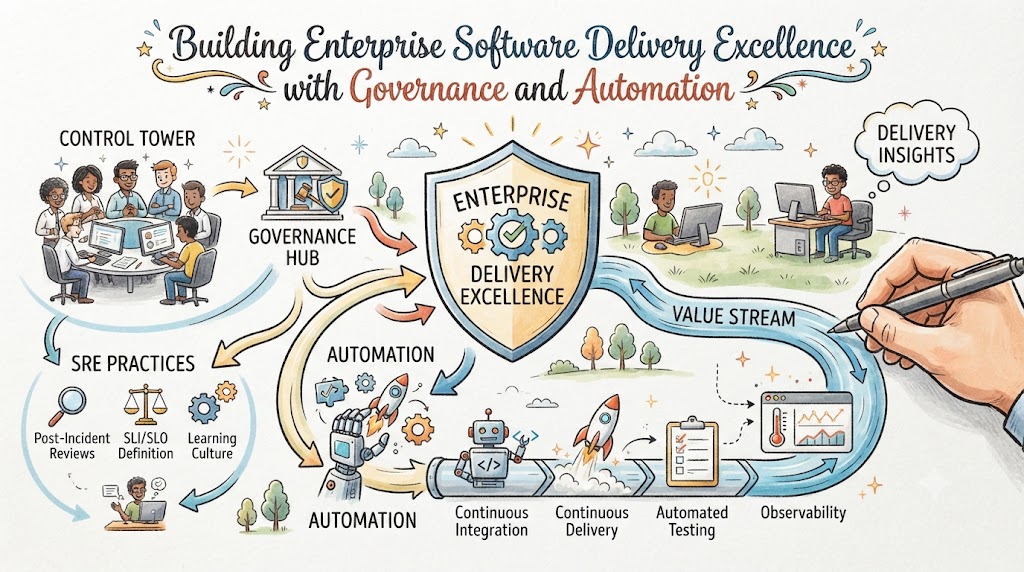
Software delivery excellence is achieved when development, quality assurance, security, operations, platform engineering, and business stakeholders work together through standardized processes supported by intelligent automation. Governance provides the structure needed to maintain consistency and accountability, while automation reduces manual effort, improves reliability, and accelerates delivery. Together, these capabilities enable enterprises to build scalable engineering organizations capable of delivering high-quality digital products with confidence.
What Is Enterprise Software Delivery Excellence?
Enterprise Software Delivery Excellence is the ability to consistently deliver secure, reliable, scalable, and high-quality software while meeting business objectives, customer expectations, and regulatory requirements. It extends beyond software deployment by covering every stage of the software development lifecycle, including planning, architecture, development, testing, security, deployment, operations, monitoring, and continuous improvement.
Excellence is not measured solely by deployment speed. It is reflected in predictable delivery, operational resilience, customer satisfaction, engineering productivity, governance maturity, and continuous optimization. Organizations that achieve delivery excellence build engineering systems that support innovation without compromising quality or operational stability.
Why Governance Is Critical for Enterprise Engineering
As engineering organizations grow, development teams often adopt different tools, workflows, coding standards, deployment practices, and operational processes. Without governance, these differences create inconsistencies that reduce efficiency, increase operational risks, and make enterprise-scale software delivery difficult to manage.
Governance establishes organization-wide engineering standards, policies, responsibilities, approval processes, security controls, compliance requirements, and operational expectations. Rather than limiting innovation, effective governance creates a structured framework that enables engineering teams to work independently while maintaining consistency across the enterprise. This balance improves collaboration, strengthens accountability, and supports sustainable software delivery.
Common Challenges in Enterprise Software Delivery
Large engineering organizations frequently encounter delivery challenges that affect both technical performance and business outcomes.
Common challenges include:
- Inconsistent engineering standards
- Manual deployment activities
- Fragmented toolchains
- Weak governance
- Security integrated too late
- Technical debt accumulation
- Limited operational visibility
- Compliance complexity
- Slow release cycles
- Cross-team communication gaps
- Infrastructure inconsistencies
- Operational risks
These challenges often increase software delivery costs while reducing engineering productivity and customer confidence.
Core Principles of Software Delivery Excellence
Building enterprise delivery excellence requires organizations to establish foundational engineering principles that guide decision-making across every delivery stage.
Core principles include:
- Standardized engineering practices
- Continuous automation
- Security by design
- Quality-first development
- Operational transparency
- Continuous measurement
- Cross-functional collaboration
- Risk-based governance
- Customer-focused delivery
- Continuous improvement
- Business alignment
These principles help organizations create predictable, scalable, and resilient software delivery systems.
Building Strong Governance Across the Delivery Lifecycle
Governance should support every phase of software delivery rather than focusing only on release approvals.
The governance framework typically covers:
| Delivery Stage | Governance Focus |
|---|---|
| Planning | Business alignment and prioritization |
| Design | Architecture standards |
| Development | Coding standards and collaboration |
| Testing | Quality validation |
| Security | Secure engineering practices |
| Deployment | Release governance |
| Operations | Reliability and monitoring |
| Improvement | Continuous optimization |
Applying governance consistently across the lifecycle improves software quality while reducing delivery risks.
The Role of Automation in Modern Software Delivery
Automation is one of the primary drivers of engineering productivity and operational consistency. It reduces repetitive manual activities while improving software reliability.
Automation opportunities include:
- Continuous Integration
- Continuous Delivery
- Automated testing
- Infrastructure provisioning
- Configuration management
- Security scanning
- Compliance validation
- Deployment automation
- Monitoring automation
- Incident response automation
Organizations with mature automation practices release software more frequently while maintaining higher levels of quality and operational confidence.
Integrating DevSecOps into Enterprise Delivery
Security must be integrated directly into software delivery rather than introduced as a final approval step before production deployment.
Governance should include:
- Secure coding standards
- Vulnerability management
- Static security analysis
- Dependency scanning
- Infrastructure security
- Identity management
- Secrets management
- Compliance automation
- Continuous monitoring
- Security governance
Embedding security into engineering workflows reduces vulnerabilities while enabling faster and more secure software releases.
Strengthening Platform Engineering
Platform engineering provides standardized development environments, reusable infrastructure, developer self-service capabilities, and operational consistency across engineering teams.
Assessment areas include:
- Internal developer platforms
- Infrastructure as Code
- Environment standardization
- Self-service provisioning
- Platform automation
- Configuration management
- Developer enablement
- Cloud governance
- Scalability
- Operational resilience
A strong platform engineering strategy enables developers to focus on delivering business value instead of managing infrastructure complexity.
Measuring Software Delivery Performance
Continuous measurement enables engineering organizations to understand delivery performance and identify opportunities for improvement.
Important engineering metrics include:
- Deployment frequency
- Lead time for changes
- Change failure rate
- Mean Time to Recovery
- Build success rates
- Test automation coverage
- Security findings
- Incident frequency
- Customer satisfaction
- Engineering productivity
These metrics help leadership make data-driven decisions that continuously improve software delivery capabilities.
Building a Culture of Engineering Excellence
Technology alone cannot create enterprise delivery excellence. Successful organizations also develop engineering cultures that encourage collaboration, accountability, innovation, and continuous learning.
Engineering leaders should promote knowledge sharing, regular retrospectives, cross-functional collaboration, technical mentoring, automation-first thinking, operational ownership, engineering transparency, and continuous feedback. These cultural practices improve both technical performance and employee engagement while supporting long-term organizational success.
Governance Roles and Responsibilities
Clearly defined responsibilities ensure governance remains consistent across engineering and business functions.
| Role | Primary Responsibility |
|---|---|
| Executive Leadership | Strategic technology direction |
| CTO | Enterprise engineering governance |
| Engineering Managers | Delivery oversight |
| Software Architects | Technical standards |
| DevOps Teams | Automation governance |
| Platform Engineering | Developer platform management |
| Security Teams | Security governance |
| QA Teams | Quality assurance |
| Operations Teams | Service reliability |
| Product Managers | Business alignment |
Clear accountability strengthens governance while improving engineering collaboration.
Benefits of Governance and Automation
Organizations that combine governance with automation achieve measurable improvements across engineering and business operations.
Major benefits include:
- Faster software delivery
- Higher software quality
- Improved deployment reliability
- Better security posture
- Stronger compliance
- Increased automation
- Reduced operational risks
- Better engineering visibility
- Improved collaboration
- Enhanced customer satisfaction
- Greater scalability
- Sustainable engineering growth
These benefits position organizations for long-term digital transformation and competitive advantage.
Best Practices for Building Enterprise Software Delivery Excellence
Organizations should continuously refine engineering practices as technology and business requirements evolve.
Recommended best practices include:
- Standardize engineering processes across teams.
- Automate repetitive delivery activities.
- Integrate security into every delivery stage.
- Measure engineering performance continuously.
- Establish lightweight but effective governance.
- Invest in platform engineering capabilities.
- Improve operational observability.
- Encourage cross-functional collaboration.
- Continuously reduce technical debt.
- Treat software delivery as an evolving organizational capability.
Following these practices enables organizations to build resilient engineering systems that support continuous innovation.
Frequently Asked Questions About Enterprise Software Delivery Excellence
1. What is Enterprise Software Delivery Excellence?
Enterprise Software Delivery Excellence is the ability to consistently deliver secure, reliable, scalable, and high-quality software through standardized engineering practices, governance, automation, collaboration, and continuous improvement across the entire software development lifecycle.
2. Why is governance important for software delivery?
Governance establishes consistent engineering standards, security controls, compliance requirements, operational processes, and accountability across teams. It helps organizations improve delivery predictability while reducing operational risks and maintaining software quality.
3. How does automation improve software delivery?
Automation reduces manual effort, improves deployment consistency, accelerates release cycles, enhances software quality, strengthens security validation, and allows engineering teams to focus on innovation instead of repetitive operational tasks.
4. Which engineering teams should participate in governance?
Effective governance typically involves executive leadership, engineering management, software architects, DevOps teams, platform engineering, quality assurance, security, operations, infrastructure teams, and product management to ensure organization-wide alignment.
5. How can organizations continuously improve software delivery?
Organizations should monitor engineering metrics, expand automation, strengthen governance, invest in platform engineering, improve developer experience, integrate security throughout delivery, encourage collaboration, and regularly review engineering processes to identify improvement opportunities.
Final Thoughts
Enterprise software delivery excellence is achieved through the combination of disciplined governance, intelligent automation, standardized engineering practices, and a culture of continuous improvement. Organizations that rely solely on development tools or deployment automation often struggle to achieve consistent software quality, operational resilience, and business alignment. Governance provides the structure that ensures engineering teams work toward common objectives, while automation enables speed, reliability, and scalability across the delivery lifecycle.
By continuously improving governance frameworks, expanding automation, strengthening platform engineering, integrating security into every delivery stage, measuring engineering performance, and fostering collaboration across development, operations, quality assurance, and business teams, organizations can build software delivery capabilities that support sustainable innovation, exceptional customer experiences, and long-term digital success.

