
Introduction
Jet aircraft operate across a wide range of speeds, altitudes, and weather conditions. These conditions can change how air flows around the aircraft. They can also affect lift, drag, stability, and control.
Aerodynamics is the study of how air moves around objects and creates forces. Pilots use this knowledge to understand aircraft behavior during takeoff, climb, cruise, descent, approach, and landing.
However, several aerodynamic problems can affect jet operations. These include aerodynamic stalls, compressibility effects, buffet, wake turbulence, wind shear, and icing. Each problem has different causes and possible consequences.
Understanding these risks helps aviation professionals make informed decisions. It also supports better training, operational planning, and safety management.
Understanding Jet Aircraft Aerodynamics
Four main forces act on an aircraft during flight:
- Lift: The aerodynamic force that supports the aircraft against gravity.
- Weight: The force of gravity acting on the aircraft.
- Thrust: The forward force produced by the engines.
- Drag: The aerodynamic force that resists movement through the air.
During steady, level flight, lift balances weight, while thrust balances drag. Changes in speed, altitude, configuration, or flight path can affect this balance.
Three other concepts are important.
Angle of attack describes the angle between a wing’s reference line and the oncoming airflow. It affects the amount of lift the wing produces.
Mach number compares an aircraft’s speed with the local speed of sound. It helps pilots and engineers understand high-speed airflow effects.
Aircraft configuration refers to the position of components such as flaps, slats, and landing gear. Configuration changes can affect lift and drag.
The Federal Aviation Administration (FAA) explains these principles in its Pilot’s Handbook of Aeronautical Knowledge. They provide a foundation for understanding many aerodynamic risks.
Common Aerodynamic Problems in Jet Operations
1. Aerodynamic Stall
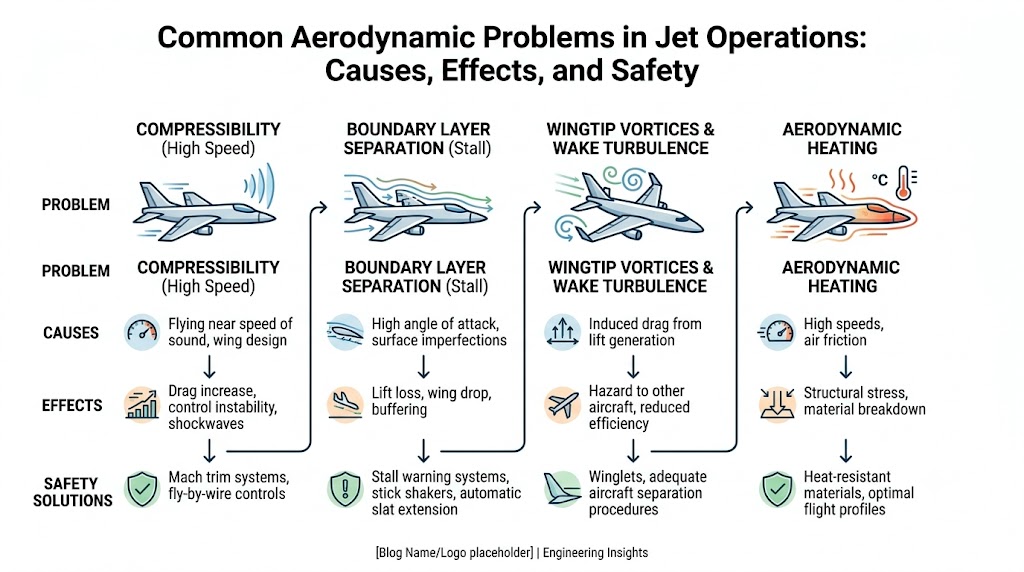
An aerodynamic stall occurs when a wing exceeds its critical angle of attack. The airflow separates from the wing, reducing the lift it can produce.
A stall is not simply a result of flying too slowly. A wing can stall at different airspeeds, depending on its angle of attack and flight conditions.
Several factors can increase stall risk:
- Excessive angle of attack.
- Increased load factor during a maneuver.
- Changes in aircraft configuration.
- Ice or contamination on the wing.
- Incorrect speed or energy management.
Possible signs vary by aircraft. They may include stall warnings, buffet, or changes in control response.
Jet aircraft may have stall-warning systems and other protections. However, their features differ by design and aircraft type. Pilots must understand the relevant limitations and procedures for their aircraft.
The FAA’s Airplane Flying Handbook explains the relationship between critical angle of attack and stall.
2. High-Speed Compressibility Effects
Compressibility becomes important when airflow over parts of an aircraft approaches the speed of sound. This can happen even when the aircraft itself is flying below the speed of sound.
At these speeds, local airflow may accelerate beyond Mach 1. Shock waves can form where the airflow changes rapidly.
These effects can cause several problems:
- A sharp increase in drag.
- Changes in aircraft stability.
- Reduced effectiveness of some control surfaces.
- Airflow separation and buffet.
- Changes in pitch behavior.
The exact effects depend on wing design, aircraft speed, altitude, and configuration.
Jet aircraft have defined operating limits to help prevent hazardous high-speed conditions. Crews must monitor the relevant speed and Mach limits and follow approved procedures.
3. Mach Tuck and Pitch Changes
Mach tuck is a nose-down pitching tendency that can occur in some aircraft under certain high-speed conditions.
As airflow changes around a wing, shock waves may develop and move. This can change the distribution of aerodynamic forces and shift the wing’s center of pressure. The resulting changes may create a nose-down pitching tendency.
Possible effects include:
- Changes in pitch trim.
- Increased difficulty maintaining the intended flight path.
- Changes in aircraft handling.
- Reduced safety margins if operating limits are exceeded.
Aircraft designs differ significantly. Many modern transport aircraft include design features that reduce or manage these effects.
Pilots must understand their aircraft’s approved speed limits and high-altitude operating guidance. General aerodynamic explanations cannot replace aircraft-specific training.
4. Buffet and Airflow Separation
Buffet is a vibration or shaking caused by unsteady airflow acting on the aircraft.
It can occur in different flight conditions. For example, airflow separation near a wing stall can cause low-speed buffet. Shock waves and related airflow separation can cause high-speed buffet.
| Feature | Low-speed buffet | High-speed buffet |
|---|---|---|
| Common cause | Airflow separation as the wing approaches a stall | Shock waves and airflow separation at high Mach numbers |
| Related conditions | High angle of attack or limited stall margin | Compressibility effects and high-speed operating conditions |
| Possible effect | Vibration and reduced lift capability | Vibration, changing control response, and reduced operating margins |
| Key consideration | Stall awareness and approved procedures | Mach awareness and aircraft operating limits |
Buffet is not identical to a stall, although it can be associated with one. Its meaning depends on the aircraft and flight conditions.
Unusual vibration or unexpected handling changes require careful attention. Pilots should interpret these cues alongside aircraft instruments, warning systems, and approved procedures.
5. Dutch Roll and Directional Instability
Dutch roll is a combined rolling and yawing motion. The aircraft moves from side to side while its nose swings left and right.
This motion relates to the interaction between an aircraft’s lateral and directional stability. Swept-wing aircraft can be particularly associated with Dutch roll characteristics.
If the motion becomes poorly controlled, it can affect comfort, handling, and the aircraft’s flight path.
Many jet aircraft use a yaw damper to help reduce Dutch roll. This system makes automatic rudder inputs to damp unwanted yawing motion.
However, the system’s capabilities and limitations depend on aircraft design. Pilots and maintenance teams must understand the relevant system indications and procedures.
Proper training, system maintenance, and awareness of unusual aircraft motion help support safe operations.
6. Wake Turbulence
Wake turbulence is disturbed air created by an aircraft as it generates lift. It includes two counter-rotating vortices that trail behind the aircraft.
These vortices can affect another aircraft flying through them. A wake encounter may cause sudden rolling or other unwanted aircraft motion.
Wake turbulence is especially important during takeoff, approach, and landing. Aircraft often operate close together during these phases.
Its strength and persistence depend on factors such as the generating aircraft’s weight, configuration, and flight conditions. Wind and atmospheric conditions can also affect vortex movement.
General risk-management principles include:
- Follow applicable wake turbulence separation requirements.
- Remain aware of the flight path of preceding aircraft.
- Consider relevant air traffic control advisories.
- Use approved procedures for the aircraft and operation.
- Avoid assuming that a short time interval always means the wake has disappeared.
The FAA provides additional information in its Aircraft Wake Turbulence guidance.
7. Wind Shear and Microbursts
Wind shear is a change in wind speed or direction over a short distance. It can occur at different altitudes and may affect aircraft during any phase of flight.
A microburst is a concentrated downdraft that spreads outward near the ground. It can create strong and rapidly changing wind conditions.
These conditions are particularly concerning during takeoff and landing because the aircraft has less altitude available to manage unexpected changes.
Wind shear can cause changes in airspeed, lift, and flight path. The effects depend on the wind pattern, aircraft energy state, and flight conditions.
General risk-management measures include:
- Review available weather information before departure.
- Pay attention to airport wind-shear alerts and aircraft warnings.
- Follow applicable operating limitations.
- Use approved aircraft-specific procedures.
- Coordinate clearly with other flight crew members.
Wind shear response is aircraft-specific and must follow approved training and operating guidance. The FAA discusses wind shear and other flight hazards in its Pilot’s Handbook of Aeronautical Knowledge.
8. Icing and Aerodynamic Performance
Ice can form on aircraft surfaces when moisture and temperature conditions allow it. Ice or frost on a wing can change its shape and surface texture.
Even a relatively small amount of contamination may affect aerodynamic performance. The impact depends on the type, location, and amount of contamination, along with the aircraft design.
Possible effects include:
- Reduced lift.
- Increased drag.
- Changes in stall behavior.
- Increased aircraft weight.
- Changes in handling or control response.
Ice can also affect sensors and other aircraft systems. This makes icing both an aerodynamic concern and a wider operational hazard.
Aircraft may use different ice-protection systems, such as heating or de-icing equipment. These systems have specific operating limits and requirements.
Crews must follow approved icing procedures and applicable aircraft limitations. They should never assume that an installed protection system makes every icing condition safe.
9. High Angle of Attack and Energy Management
Aircraft performance depends on more than airspeed alone. Angle of attack, aircraft weight, load factor, and configuration also matter.
During a maneuver, the wing may need to produce more lift. This can increase the angle of attack required to maintain the flight path. Under some conditions, the aircraft may approach its critical angle of attack sooner than expected.
Energy management means maintaining an appropriate balance between speed, altitude, and aircraft performance.
Poor energy management may lead to unwanted speed changes, unstable approaches, or reduced margins from aerodynamic limits.
Pilots receive aircraft-specific training to understand these relationships. They must also use approved operating speeds, configuration guidance, and procedures.
10. Drag and Configuration Problems
Drag is the aerodynamic force that resists an aircraft’s movement through the air. Jet aircraft experience different forms of drag, including parasite drag and induced drag.
Aircraft configuration can change total drag significantly.
For example, extending landing gear or high-lift devices usually increases drag. Speed brakes also increase drag when deployed according to approved procedures.
Configuration problems may arise when a component is not in the required position or when the aircraft is not configured as expected for a flight phase.
Possible consequences include:
- Lower-than-expected performance.
- Increased fuel consumption.
- Changes in climb or descent capability.
- Difficulty maintaining the intended speed or flight path.
Correct configuration management depends on approved checklists, clear crew coordination, and awareness of aircraft indications.
Maintenance teams also play an important role. They inspect relevant components and investigate faults according to approved maintenance instructions.
11. Ground Effect and Runway Performance
Ground effect occurs when an aircraft flies close to the ground and the ground changes the airflow around its wings.
In this region, induced drag can decrease. This can change how the aircraft responds during takeoff and landing.
Ground effect may influence the aircraft’s ability to accelerate, climb, or settle toward the runway. Its impact depends on aircraft design, speed, height above the surface, and other conditions.
However, ground effect does not guarantee a safe takeoff or landing. It cannot replace correct speed management, runway planning, or approved procedures.
Pilots must follow aircraft-specific guidance when evaluating runway performance and handling near the ground.
When Are Aerodynamic Problems More Likely?
Aerodynamic risks can increase or change under different operating conditions. The exact effect depends on the aircraft and its current state.
| Operating condition | Potential aerodynamic concern | General safety consideration |
|---|---|---|
| High altitude | Reduced air density and smaller margins between some operating limits | Monitor aircraft-specific speed and Mach guidance |
| High aircraft weight | Greater lift demand and possible performance penalties | Follow weight, balance, and performance limits |
| Rapid maneuvering | Increased load factor and angle of attack | Remain within approved operating limits |
| Turbulence | Unexpected changes in aircraft motion and loading | Follow turbulence guidance and operating procedures |
| Icing | Changes in lift, drag, and stall behavior | Apply approved icing procedures |
| High-speed flight | Compressibility effects, buffet, and control changes | Respect speed and Mach limits |
| Takeoff and landing | Limited altitude and changing aircraft configuration | Use approved procedures and monitor warnings |
| Wake encounters | Sudden rolling or other unwanted motion | Apply wake turbulence avoidance guidance |
These are general principles, not a prediction that a specific problem will occur. Aircraft manuals provide the information needed for each aircraft type.
Warning Signs and Operational Awareness
Pilots use several sources of information to understand aircraft behavior. These include flight instruments, warning systems, weather reports, and changes in handling.
Potential warning cues include:
- Unexpected buffet or vibration.
- Unusual pitch, roll, or yaw movement.
- Unexpected airspeed or Mach changes.
- Stall or wind-shear warnings.
- Abnormal flight-path behavior.
- Aircraft configuration or system alerts.
No single cue applies to every aircraft. Some warnings may have several possible causes, and some aerodynamic changes may occur without an obvious warning.
Flight crews must interpret the information in context. They should follow approved aircraft procedures and use the training provided for their specific aircraft.
How Aviation Professionals Manage Aerodynamic Risks
Aerodynamic safety depends on several connected practices.
Aircraft-specific training
Pilots need training that matches the aircraft they operate. This includes understanding its handling characteristics, operating limits, warnings, and protection systems.
Weather assessment
Weather information helps crews identify potential turbulence, icing, wind shear, and other hazards. Conditions may change during a flight, so crews must continue monitoring relevant information.
Speed and configuration management
Correct speed selection and aircraft configuration support predictable performance. Crews use approved checklists, procedures, and aircraft indications to manage these factors.
System awareness and maintenance
Aircraft systems can help crews identify or manage certain aerodynamic risks. However, these systems have limitations. Proper inspection and maintenance help ensure they function as designed.
Crew communication
Clear communication helps the flight crew share information about aircraft behavior, weather, and operational concerns. Good coordination also supports consistent use of approved procedures.
Following approved procedures
General aerodynamic knowledge helps explain why a problem occurs. It does not replace the aircraft flight manual, operating checklists, or qualified instruction.
The FAA provides a useful starting point through its official aviation handbooks and manuals.
The Role of Aircraft Design and Technology
Aircraft manufacturers use engineering methods to manage aerodynamic risks. The exact features depend on the aircraft’s purpose and design.
Common examples include:
- High-lift devices: Flaps and slats help increase lift during specific phases of flight.
- Stall-warning systems: These alert crews to conditions associated with a stall.
- Flight-control systems: These help manage the aircraft’s response to pilot inputs.
- Yaw dampers: These reduce unwanted yawing motions on aircraft equipped with them.
- Ice-protection systems: These help prevent or remove ice from selected surfaces.
- Speed and Mach alerts: These help crews monitor relevant operating limits.
These features do not remove every aerodynamic risk. Their operation, limitations, and required crew responses differ by aircraft type.
Safe operations still depend on training, maintenance, accurate information, and compliance with approved procedures.
Practical Aerodynamic Awareness Checklist
The following checklist is an educational awareness aid. It is not an official preflight checklist or a substitute for aircraft operating procedures.
- Confirm the aircraft type and applicable operating limitations.
- Review current and forecast weather conditions.
- Consider possible turbulence, wind shear, and icing.
- Understand the aircraft’s relevant speed and Mach limits.
- Monitor aircraft configuration and system indications.
- Remain aware of changes in handling, buffet, or warnings.
- Follow applicable wake turbulence guidance.
- Use approved procedures for abnormal or hazardous conditions.
- Maintain clear communication within the flight crew.
- Refer to aircraft-specific manuals and qualified training when needed.
Frequently Asked Questions
1. What are the most common aerodynamic problems in jet operations?
Common concerns include stalls, compressibility effects, buffet, Dutch roll, wake turbulence, wind shear, icing, and configuration-related performance changes. Their likelihood and effects depend on the aircraft and operating conditions.
2. What causes a stall in a jet aircraft?
A stall occurs when the wing exceeds its critical angle of attack. It is not caused by low airspeed alone. Weight, load factor, configuration, and airflow conditions can affect the available margin.
3. How do compressibility effects influence jet performance?
At high speeds, local airflow may reach or exceed the speed of sound. Shock waves can form, increasing drag and changing stability or control response. Aircraft-specific limits help manage these effects.
4. What is the difference between buffet and stall?
Buffet is vibration caused by unsteady airflow. A stall occurs when the wing exceeds its critical angle of attack. Buffet may occur near a stall, but it can also result from high-speed compressibility effects.
5. Why is wake turbulence dangerous for following aircraft?
Wake vortices can create sudden rolling or other unwanted aircraft motion. Their strength and movement depend on the generating aircraft and atmospheric conditions. Following aircraft must observe applicable avoidance guidance.
6. How can wind shear affect a jet during approach?
Wind shear can cause rapid changes in wind speed or direction. These changes may affect airspeed, lift, and flight path, which is especially important near the ground. Crews must follow approved warnings and procedures.
7. How does icing change aircraft aerodynamics?
Ice can change wing shape and surface smoothness. This may reduce lift, increase drag, and change stall behavior. The effect depends on the aircraft and the type and extent of contamination.
8. Why is aircraft-specific aerodynamic training important?
Different aircraft have different wing designs, flight-control systems, warnings, and operating limits. Aircraft-specific training helps pilots understand these differences and apply the correct approved procedures.
Conclusion
Common aerodynamic problems in jet operations can affect lift, drag, stability, and aircraft control. Stalls, compressibility effects, wake turbulence, wind shear, and icing each create different challenges. Their effects depend on aircraft design, flight conditions, and operating procedures. Training, weather awareness, maintenance, and correct configuration management help aviation professionals manage these risks. Most importantly, pilots must follow approved aircraft-specific guidance rather than relying on general aerodynamic principles alone.

