
Introduction
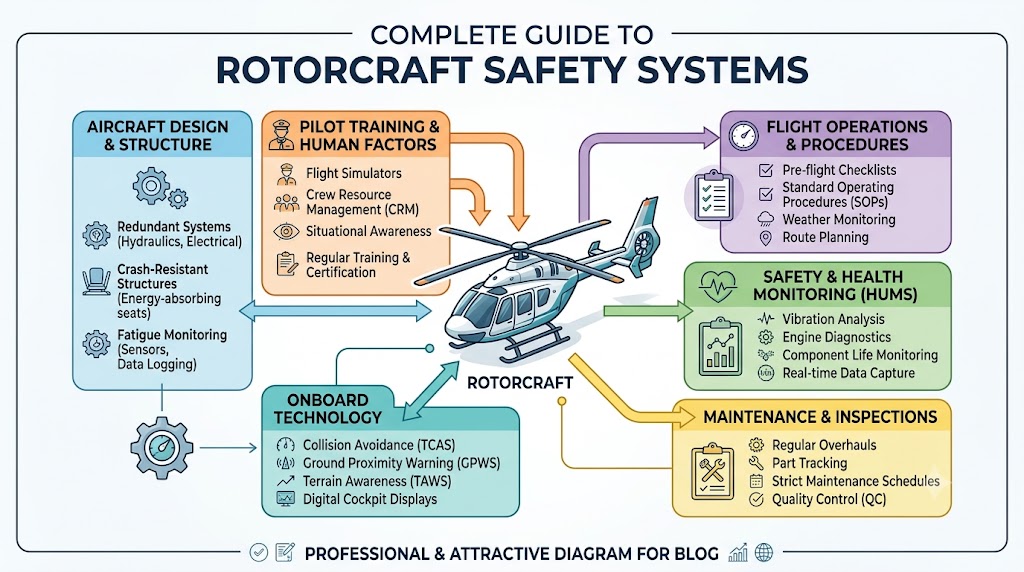
Rotorcraft safety is not provided by one device, one checklist, or one pilot action. It is the result of several layers working together: sound aircraft design, reliable propulsion and flight-control systems, appropriate operating procedures, pilot training, occupant protection, emergency equipment, maintenance, and effective decision-making.
A useful way to understand rotorcraft safety is to divide it into three stages:
- Prevent the accident
- Control the aircraft when something goes wrong
- Improve survivability when an accident cannot be avoided
Modern rotorcraft safety engineering increasingly follows this layered approach. The FAA’s rotorcraft safety guidance, for example, includes both operational safety concepts and equipment intended to improve occupant survivability.
1. What Are Rotorcraft Safety Systems?
Rotorcraft safety systems are the aircraft systems, equipment, design features, procedures, and technologies intended to:
- prevent accidents
- detect abnormal conditions
- maintain aircraft control
- assist recovery from emergencies
- protect occupants during impact
- reduce post-crash hazards
- support evacuation and rescue
They include both active safety systems and passive safety systems.
Active Safety Systems
Active systems help prevent or manage an emergency while the aircraft is operating.
Examples include:
- engine monitoring
- rotor RPM warning systems
- transmission monitoring
- flight-control systems
- stability augmentation
- caution and warning systems
- navigation equipment
- terrain-awareness technologies
- weather information
- emergency procedures
Passive Safety Systems
Passive systems primarily reduce injury or improve survivability after an accident.
Examples include:
- crash-resistant seats
- energy-absorbing structures
- crash-resistant fuel systems
- occupant restraints
- emergency exits
- emergency lighting
- flotation systems
- life rafts
- emergency locator equipment
The distinction matters because preventing an accident and surviving one require different engineering strategies.
2. The Rotorcraft Safety Chain
A mature safety program can be viewed as a chain:
Aircraft design → Maintenance → Preflight → Pilot decision-making → Flight control → Emergency response → Occupant protection → Evacuation → Rescue
A failure in one layer does not necessarily produce an accident if the other layers work correctly.
For example, an engine problem may be managed successfully through:
- early detection
- appropriate pilot response
- sufficient altitude and airspeed
- autorotation capability
- selection of a suitable landing area
- crashworthy seating and structure
This is why rotorcraft safety should never be reduced to a list of individual pieces of equipment.
3. Main Categories of Rotorcraft Safety Systems
| Safety Category | Primary Purpose | Typical Examples |
|---|---|---|
| Propulsion protection | Prevent or detect powerplant problems | Engine monitoring, warning systems |
| Rotor protection | Maintain safe rotor energy | RPM monitoring, governors |
| Flight-control systems | Maintain controllability | Hydraulic assistance, stability augmentation |
| Warning systems | Alert crew to abnormal conditions | Audio/visual alerts |
| Navigation systems | Reduce navigation-related risk | GNSS, moving maps |
| Terrain awareness | Increase terrain avoidance awareness | TAWS/HTAWS |
| Collision avoidance | Reduce traffic conflict risk | Traffic alerting systems |
| Fire protection | Detect and control fire | Fire detection, extinguishing systems |
| Crashworthiness | Reduce occupant injury | Energy-absorbing seats and structures |
| Fuel protection | Reduce post-crash fire risk | Crash-resistant fuel systems |
| Emergency flotation | Support controlled water evacuation | Inflatable floats |
| Emergency communications | Support rescue | ELT and other locator equipment |
| Restraint systems | Keep occupants protected | Harnesses and seat belts |
| Emergency egress | Allow rapid evacuation | Exits, handles, lighting |
| Survival equipment | Support occupants after evacuation | Rafts and survival equipment |
The exact equipment varies substantially according to aircraft type, certification basis, mission, configuration, and operating environment.
4. Engine and Powerplant Safety Systems
The engine is one of the most safety-critical systems in a rotorcraft because loss of engine power immediately changes the aircraft’s energy-management problem.
Safety begins before an emergency with:
- fuel management
- engine condition monitoring
- temperature monitoring
- pressure monitoring
- vibration monitoring
- scheduled inspections
- contamination control
- proper starting procedures
- correct operating limits
Depending on the aircraft, pilots may monitor parameters such as:
- torque
- turbine temperature
- engine RPM
- gas-generator speed
- oil pressure
- oil temperature
- fuel pressure
- fuel quantity
- transmission parameters
Why Monitoring Matters
A warning system can provide valuable time between an abnormal condition and an actual failure.
However, a warning system is not a substitute for understanding aircraft limitations.
A warning may indicate that a parameter has crossed a threshold, but the pilot still has to determine:
- whether the indication is genuine
- whether the situation is worsening
- whether immediate action is required
- whether the aircraft remains controllable
- whether an emergency landing should be initiated
5. Rotor RPM Protection
Rotor RPM is fundamental to helicopter control.
The main rotor must maintain an appropriate rotational speed to produce the required aerodynamic performance.
A substantial decrease in rotor RPM can reduce available lift and energy for an autorotation. FAA training material emphasizes the importance of maintaining rotor RPM during power-loss emergencies.
Some helicopters incorporate:
- RPM governors
- overspeed protection
- visual RPM indications
- audio RPM warnings
- engine/rotor coupling systems
These systems help reduce pilot workload, but they do not eliminate the need for correct collective and throttle management.
Practical Principle
The safety system should be considered a layer of protection, not permission to disregard operating limitations.
6. Autorotation: The Fundamental Rotorcraft Emergency Capability
Autorotation is one of the most important concepts in helicopter emergency operations.
During autorotation, the main rotor is driven by aerodynamic forces rather than engine power. The FAA describes it as a descending maneuver in which upward airflow through the rotor provides the energy needed to keep the rotor turning.
In a power-loss situation, the pilot’s priorities include:
- Maintain aircraft control.
- Preserve appropriate rotor RPM.
- Establish the aircraft’s recommended autorotation speed.
- Select an appropriate landing area.
- Manage the descent and energy state.
- Complete the landing according to the aircraft’s procedures.
The precise technique varies by helicopter.
Why Autorotation Is Not a Guaranteed “Safety System”
Autorotation provides an emergency capability, but its success depends on:
- altitude
- airspeed
- rotor RPM
- aircraft weight
- wind
- terrain
- pilot reaction time
- aircraft configuration
- landing area
- mechanical condition
The helicopter’s height-velocity diagram illustrates combinations of altitude and airspeed where a successful power-off landing may be difficult or unlikely. FAA accident investigations repeatedly emphasize the importance of understanding these limitations.
7. Height-Velocity Safety
The height-velocity (H-V) diagram is one of the most important rotorcraft safety references.
It identifies portions of the flight envelope where an engine failure may leave insufficient energy, altitude, or reaction time for a successful autorotation.
Risk can increase during conditions such as:
- very low altitude
- low airspeed
- certain high-altitude/low-speed combinations
- takeoff and landing transitions
- confined-area operations
The exact H-V diagram differs by aircraft.
Operational Lesson
Pilots should not treat the H-V diagram as a generic helicopter rule. The appropriate diagram and limitations are aircraft-specific.
A helicopter that has adequate performance in one flight condition may not have the same margin in another.
8. Transmission and Drivetrain Monitoring
The drivetrain transfers power from the engine to the rotor system.
Critical components can include:
- main transmission
- intermediate gearbox
- tail rotor gearbox
- driveshafts
- freewheeling unit
- clutches or coupling mechanisms
Safety monitoring may involve:
- oil pressure
- oil temperature
- chip detection
- vibration monitoring
- torque measurement
- gearbox inspection
Chip Detection
Magnetic chip detectors can provide an early indication of abnormal component wear by detecting metallic debris in lubrication systems.
But chip detection has limitations.
A clean detector does not prove that every drivetrain component is healthy. Likewise, a detected chip does not automatically establish the precise cause of a problem.
The correct response depends on:
- aircraft documentation
- maintenance procedures
- quantity and type of debris
- associated indications
- inspection findings
- engineering requirements
9. Flight-Control Safety Systems
Helicopters depend on highly responsive flight controls.
Major control functions generally include:
- collective
- cyclic
- pedals
Depending on the helicopter, flight-control systems may incorporate:
- hydraulic assistance
- redundant hydraulic circuits
- servo actuators
- stability augmentation
- automatic flight-control systems
- trim systems
Hydraulic assistance can significantly reduce pilot control forces.
However, hydraulic failure does not necessarily mean the same thing on every helicopter.
Some designs provide:
- manual reversion
- dual hydraulic systems
- emergency hydraulic modes
- limited-duration backup capability
The aircraft flight manual or rotorcraft flight manual remains the controlling source for aircraft-specific procedures.
10. Stability Augmentation and Automatic Flight Control
Modern rotorcraft may use stability augmentation or automatic flight-control functions to reduce workload and improve handling characteristics.
These systems can help with:
- attitude stabilization
- heading control
- altitude management
- flight-path control
- workload reduction
But automation introduces another category of risk: automation dependency.
Pilots must understand:
- what the system controls
- what it does not control
- engagement requirements
- disengagement conditions
- failure indications
- reversion modes
- appropriate pilot response
A sophisticated automated system can improve safety only when its operating envelope and failure behavior are understood.
11. Fire Detection and Fire Protection
Rotorcraft fire protection can involve several layers.
Detection
Systems may monitor:
- engine compartments
- auxiliary power units
- transmission areas
- other designated fire zones
Warning
The crew may receive:
- visual warnings
- audio warnings
- system messages
Suppression
Depending on aircraft design, fire-extinguishing systems may be available for designated compartments.
Prevention
Fire safety also depends on:
- fuel-system integrity
- electrical-system protection
- proper maintenance
- leak detection
- hot-surface management
- wiring condition
- component separation
Fire protection is therefore both an equipment issue and a maintenance issue.
12. Crash-Resistant Fuel Systems
Fuel-system design is especially important because a survivable impact can become much more dangerous if fuel leaks and ignites.
Crash-resistant fuel-system concepts are intended to reduce:
- fuel tank rupture
- fuel leakage
- ignition potential
- post-crash fire
The FAA specifically identifies crash-resistant fuel systems as an important rotorcraft occupant-safety feature.
FAA accident lessons also show why this matters: investigators have identified post-impact fire as a significant hazard when fuel-system crash resistance is inadequate.
Maintenance Matters
A crash-resistant design still depends on:
- correct installation
- proper inspection
- component condition
- approved configuration
- compliance with applicable maintenance requirements
Safety characteristics can be compromised by unauthorized modifications or improper maintenance.
13. Crash-Resistant Seats and Structures
A rotorcraft can be designed to manage crash energy rather than simply resisting deformation.
Safety features may include:
- energy-absorbing seats
- stroking seat designs
- crashworthy structures
- controlled deformation zones
- improved restraint geometry
- strengthened occupant compartments
The objective is not necessarily to prevent every part of the aircraft from deforming.
Instead, controlled deformation can help manage the energy transmitted to occupants.
The FAA identifies crash-resistant seats and structures alongside crash-resistant fuel systems as important rotorcraft occupant-protection technologies.
14. Occupant Restraint Systems
Seat belts and harnesses are basic but critical safety systems.
A restraint system should:
- keep the occupant positioned correctly
- reduce movement during impact
- work with the seat structure
- permit emergency release
- remain compatible with the operational configuration
The Important Trade-Off
A restraint that keeps a person securely attached during impact must also allow rapid release during evacuation.
An FAA investigation of an AS350B2 accident illustrates this interaction: passenger restraint arrangements contributed to difficulties with emergency egress after a water landing.
This demonstrates an important principle:
A safety system should be evaluated across the complete emergency sequence, not just for the first hazard.
15. Emergency Flotation Systems
Emergency flotation systems are designed for helicopters that may need to ditch in water.
Depending on aircraft design, systems may include:
- inflatable floats
- inflation bottles
- activation controls
- immersion switches
- pressure systems
- flotation storage compartments
The purpose is generally to provide enough buoyancy and stability to support evacuation.
A Critical Limitation
Flotation systems are not necessarily designed to absorb a severe water impact.
The FAA’s investigation of an S-92A accident noted that the flotation system was intended to support a controlled water landing rather than absorb the forces of a severe impact.
That distinction is crucial.
Flotation is not equivalent to impact protection.
16. Flotation System Reliability
Flotation systems introduce their own engineering requirements.
Important considerations include:
- deployment reliability
- symmetrical inflation
- bottle pressure
- activation mechanism condition
- hose routing
- leak integrity
- inspection intervals
- environmental exposure
- correct rigging
An FAA investigation into an AS350B2 ditching found that incomplete and asymmetric flotation deployment contributed to the helicopter becoming inverted.
This is a valuable maintenance lesson:
Certification of a safety system does not remove the need for correct installation, inspection, testing, and maintenance.
17. Emergency Locator Transmitters
Emergency locator equipment helps search-and-rescue organizations locate an aircraft after an accident or emergency.
Depending on the equipment and aircraft configuration, activation may occur:
- automatically
- manually
- through emergency procedures
Locator equipment should be considered part of a broader emergency-response system rather than a guarantee of immediate rescue.
Its effectiveness depends on factors such as:
- signal transmission
- antenna condition
- battery condition
- installation
- terrain
- water
- aircraft damage
- search-and-rescue response
18. Navigation and Situational-Awareness Systems
Modern navigation equipment can reduce several categories of risk.
Examples include:
- GNSS navigation
- moving maps
- terrain databases
- electronic flight displays
- digital navigation systems
- weather information
- traffic awareness
The key benefit is improved situational awareness.
However, electronic information must not be treated as infallible.
Potential problems include:
- outdated databases
- incorrect settings
- sensor errors
- loss of electrical power
- GPS degradation
- display failures
- pilot interpretation errors
Good cockpit design therefore combines technology with procedural cross-checking.
19. Terrain Awareness and Warning
Terrain-related accidents can occur when pilots lose adequate awareness of:
- terrain elevation
- obstacles
- flight path
- visibility
- navigation position
Terrain-awareness systems can provide additional warning capability.
Their value is greatest when combined with:
- appropriate flight planning
- weather assessment
- altitude discipline
- visual lookout
- correct database management
- pilot understanding of system limitations
A warning system should provide an additional safety layer, not replace basic terrain clearance principles.
20. Traffic Awareness and Collision Avoidance
Rotorcraft frequently operate in environments where other aircraft may be present.
Traffic-awareness technologies can improve the pilot’s ability to detect nearby aircraft.
Depending on the aircraft and system, functions may include:
- traffic display
- proximity alerts
- traffic information
- collision-avoidance guidance
The safety benefit depends on:
- equipment compatibility
- aircraft equipage
- signal availability
- correct installation
- pilot response
- operating environment
Visual lookout and communication procedures remain important.
21. Electrical System Protection
Electrical failures can affect:
- flight instruments
- communications
- navigation
- lighting
- engine systems
- warning systems
- automatic flight-control functions
Safety architecture may therefore include:
- circuit protection
- redundant electrical sources
- batteries
- essential buses
- emergency power
- load-shedding procedures
A well-designed electrical system separates essential and non-essential loads so that a failure does not unnecessarily remove every important capability at once.
22. Emergency Lighting and Egress
After an accident, the ability to leave the aircraft quickly can become more important than many flight systems.
Emergency egress considerations include:
- clearly identifiable exits
- accessible handles
- emergency lighting
- unobstructed escape paths
- restraint release
- passenger briefing
- underwater escape considerations where applicable
Passengers need to understand their specific exit and restraint arrangement before departure.
This becomes especially important when:
- doors are removed
- external equipment is installed
- special harnesses are used
- passengers are carrying equipment
- the helicopter operates over water
23. Emergency Equipment and Survival Systems
Depending on the mission and operating environment, rotorcraft may carry:
- life rafts
- personal flotation equipment
- immersion protection
- survival kits
- emergency lighting
- locator equipment
- first-aid equipment
- fire extinguishers
The appropriate equipment depends on the operation.
A helicopter performing offshore operations has different survival requirements from one performing local inland operations.
The important principle is mission-specific safety engineering.
24. Human Factors Are Part of the Safety System
Many rotorcraft accidents involve interactions between:
- aircraft systems
- procedures
- workload
- environment
- maintenance
- pilot decision-making
- organizational practices
Human factors include:
- fatigue
- workload
- distraction
- expectation bias
- poor communication
- checklist misuse
- automation dependence
- inadequate training
- time pressure
Safety systems should therefore be designed around realistic human behavior.
A technically excellent system can still fail if:
- the warning is difficult to interpret
- controls are poorly positioned
- procedures are ambiguous
- maintenance access is difficult
- emergency actions are excessively complex
25. Maintenance as a Safety System
Maintenance is not merely support work. It is one of the primary layers of rotorcraft safety.
A mature maintenance program addresses:
Scheduled Maintenance
- inspections
- component replacement
- lubrication
- system checks
- life-limited components
Unscheduled Maintenance
- abnormal indications
- vibration
- leaks
- warning messages
- unusual noises
- component discrepancies
Configuration Control
- approved parts
- approved modifications
- correct equipment configuration
- service bulletins and applicable directives
Documentation
- accurate maintenance records
- defect tracking
- component history
- inspection results
- configuration changes
26. Safety Systems Can Create New Failure Modes
This is an important engineering lesson.
Adding a safety system does not automatically reduce total risk.
A new system can introduce:
- additional failure modes
- wiring complexity
- maintenance requirements
- false alarms
- pilot workload
- weight
- aerodynamic effects
- installation constraints
- inspection burden
Therefore, the correct question is not:
“Does this equipment improve safety?”
The better question is:
“Under which conditions does this equipment improve safety, and what new failure modes does it introduce?”
27. Safety System Failure Modes
| Failure Mode | Potential Consequence | Typical Mitigation |
|---|---|---|
| False warning | Unnecessary workload | System validation and procedures |
| Missed warning | Delayed response | Redundancy and monitoring |
| Sensor failure | Incorrect information | Cross-checks and fault monitoring |
| Power failure | Loss of equipment | Backup power |
| Poor installation | System malfunction | Approved installation and inspection |
| Incorrect maintenance | Reduced reliability | Procedures and quality control |
| Pilot misunderstanding | Incorrect response | Training |
| Obstructed exit | Delayed evacuation | Configuration checks |
| Restraint malfunction | Injury or delayed egress | Inspection and functional checks |
| Flotation asymmetry | Instability after ditching | Correct maintenance and deployment checks |
| Database error | Incorrect situational awareness | Database management |
| Automation failure | Control/workload problems | Training and reversion procedures |
28. Safety System Integration
The strongest rotorcraft safety architecture is integrated.
Consider an engine failure.
A safe outcome may depend on:
Engine monitoring → pilot recognition → warning → rotor RPM management → autorotation → landing-site selection → crashworthy structure → restraint system → evacuation → locator equipment
No individual component guarantees survival.
The overall system succeeds because multiple layers interact.
This is why aviation safety engineering often focuses on defense in depth.
29. Safety by Mission Type
Different rotorcraft operations require different safety priorities.
| Operation | Important Safety Considerations |
|---|---|
| Passenger transport | Restraints, crashworthiness, egress |
| Offshore operations | Flotation, life rafts, survival equipment |
| Search and rescue | Crew coordination, hoist systems, emergency equipment |
| Aerial observation | Low-altitude risk, H-V awareness, obstacle clearance |
| External-load operations | Load management, control margins, human factors |
| Utility operations | Terrain, weather, workload, equipment configuration |
| Emergency medical operations | Night operations, landing-site hazards, crew coordination |
| Training | Emergency procedures, instructor oversight, aircraft limitations |
The “best” safety configuration cannot be separated from the mission.
30. Operational Safety: Prevention Before Protection
Safety equipment should not become an excuse for accepting unnecessary exposure.
A sound operational hierarchy is:
- Avoid unnecessary hazards.
- Reduce exposure through planning.
- Maintain adequate aircraft performance margins.
- Use appropriate safety equipment.
- Prepare for emergencies.
- Train for realistic failures.
- Ensure recovery and rescue capability.
This hierarchy is particularly important during:
- low-level operations
- confined-area operations
- mountain flying
- offshore operations
- night operations
- poor-weather conditions
- external-load operations
31. Training for Safety-System Use
Training should cover more than the location of switches.
Pilots and crew should understand:
- system purpose
- activation criteria
- limitations
- failure indications
- emergency procedures
- alternate procedures
- abnormal indications
- post-emergency actions
For example, flotation training should not simply teach:
“Pull the flotation handle.”
It should also cover:
- when deployment is appropriate
- system limitations
- aircraft-specific procedures
- passenger preparation
- evacuation
- post-landing considerations
32. Common Rotorcraft Safety Mistakes
1. Treating equipment as a substitute for judgment
Technology provides additional protection; it does not remove operational risk.
2. Ignoring aircraft-specific limitations
Helicopters differ substantially in performance and system design.
3. Treating warning systems as infallible
Sensors and displays can fail or provide misleading information.
4. Neglecting maintenance documentation
A safety system can be ineffective if its inspection and configuration history is unclear.
5. Focusing on impact but ignoring evacuation
Surviving the impact is only one part of accident survivability.
6. Installing equipment without considering integration
Additional equipment can affect weight, balance, electrical loads, aerodynamics, and maintenance.
7. Inadequate emergency training
Knowing where an emergency control is located is not equivalent to being prepared to use it correctly.
8. Ignoring mission-specific hazards
A helicopter’s safety requirements depend heavily on how and where it operates.
33. A Practical Rotorcraft Safety Assessment
A useful assessment can examine five layers.
Layer 1 — Prevention
Ask:
- Are known hazards identified?
- Is the aircraft operated within its limitations?
- Is maintenance current?
- Are weather and terrain appropriate?
Layer 2 — Detection
Ask:
- Are abnormal conditions detected early?
- Are warnings clear?
- Are critical parameters monitored?
Layer 3 — Control
Ask:
- Can the aircraft remain controllable after a major failure?
- Are emergency procedures trained?
- Is there adequate energy and altitude margin?
Layer 4 — Survivability
Ask:
- Are seats crashworthy?
- Is the fuel system crash resistant?
- Are occupants properly restrained?
- Are post-impact fire hazards controlled?
Layer 5 — Rescue
Ask:
- Can occupants escape?
- Is emergency equipment accessible?
- Can rescuers locate the aircraft?
- Is the operation equipped for its environment?
34. Safety System Maintenance Checklist
A maintenance-focused review should consider:
- Emergency systems inspected according to approved requirements
- Warning systems operational
- Batteries within required condition
- Locator equipment tested as required
- Fire-protection systems inspected
- Restraints inspected
- Emergency exits accessible
- Emergency lighting functional
- Flotation equipment correctly configured where installed
- Flotation bottles/pressure checked according to requirements
- Hydraulic systems inspected
- Rotor and drivetrain monitoring systems operational
- Required modifications incorporated
- Approved parts and configurations verified
- Maintenance records complete
- Defects properly documented and resolved
The exact inspection requirements must come from the applicable aircraft maintenance documentation and regulatory framework.
35. Pilot and Crew Safety Checklist
Before flight, crews should be familiar with:
Aircraft
- operating limitations
- H-V diagram
- emergency procedures
- warning systems
- engine indications
- rotor RPM indications
Environment
- weather
- terrain
- obstacles
- landing areas
- water exposure
- emergency landing options
Occupants
- restraints
- exits
- passenger briefing
- special equipment
- emergency procedures
Mission
- expected workload
- external equipment
- fuel requirements
- communications
- alternate plans
36. How to Evaluate a Rotorcraft Safety System
When assessing an existing or proposed system, use the following questions:
1. What hazard does it address?
If the hazard is not clearly defined, the equipment may be solving the wrong problem.
2. How does it reduce risk?
Understand the actual mechanism rather than relying on marketing terminology.
3. What happens when it fails?
Every safety system needs a failure analysis.
4. What happens when it activates incorrectly?
False activation can sometimes create a new hazard.
5. Does it increase pilot workload?
A system that requires complex emergency interpretation may reduce some risks while increasing others.
6. How is it maintained?
Consider inspection access, parts availability, testing, calibration, and documentation.
7. What happens six months or several maintenance cycles later?
Long-term reliability is more important than installation-day performance.
8. Does it work with the rest of the aircraft?
Evaluate system integration rather than treating equipment independently.
37. Safety Design Principles
Several principles consistently improve rotorcraft safety.
Redundancy
Critical functions may benefit from independent backup capability.
Fail-Safe Behavior
A failure should produce the safest practical system state.
Fault Detection
The aircraft should identify important failures early where technically feasible.
Simplicity
Emergency actions should be understandable and manageable.
Separation
A single failure should not unnecessarily disable multiple independent safety functions.
Maintainability
Safety systems must remain serviceable throughout the aircraft lifecycle.
Human-Centered Design
Controls, alerts, displays, and procedures should account for realistic human limitations.
Verification
Safety claims should be supported by appropriate testing and inspection.
38. What “Good” Rotorcraft Safety Looks Like
A well-designed rotorcraft safety program has several characteristics.
It prevents predictable problems
Through:
- planning
- maintenance
- training
- limitations
- monitoring
It detects developing failures
Through:
- sensors
- warnings
- inspections
- pilot observation
It preserves control
Through:
- aircraft design
- redundancy
- emergency procedures
- pilot training
It protects occupants
Through:
- crashworthy structures
- seats
- restraints
- fuel-system protection
It supports evacuation
Through:
- accessible exits
- emergency lighting
- appropriate procedures
It supports rescue
Through:
- locator equipment
- communications
- mission-specific survival equipment
39. Key Lessons From Accident Investigations
Accident investigations provide an important perspective because they reveal how multiple safety layers interact under real conditions.
The FAA’s lessons-learned material shows examples involving:
- engine power loss
- rotor RPM management
- H-V limitations
- crash-resistant fuel systems
- flotation failures
- occupant restraints
- emergency egress
For example, investigations have shown that a successful autorotation does not automatically guarantee a survivable outcome if the subsequent water landing, flotation deployment, restraint system, or evacuation process fails.
Similarly, an aircraft can have technically sophisticated systems while still being exposed to significant risk if it is operated in a portion of the flight envelope where recovery margins are limited.
The broader lesson is straightforward:
Safety must be evaluated as a system, not as a collection of individual components.
40. Decision Framework for Rotorcraft Safety Upgrades
When deciding whether to add or upgrade safety equipment, evaluate:
| Criterion | Key Question |
|---|---|
| Hazard | What specific risk is being reduced? |
| Benefit | How much additional protection does it provide? |
| Reliability | How likely is it to work when needed? |
| Failure | What happens if it fails? |
| Integration | Does it interact with existing systems? |
| Weight | What aircraft performance impact exists? |
| Maintenance | What additional inspection is required? |
| Training | Must pilots or passengers learn new procedures? |
| Cost | What are acquisition and lifecycle costs? |
| Mission | Is it appropriate for the actual operation? |
| Certification | Is the installation appropriately approved? |
| Survivability | Does it improve the outcome after an accident? |
This approach prevents safety upgrades from becoming equipment-shopping exercises.
41. Future Direction of Rotorcraft Safety
Rotorcraft safety is increasingly influenced by:
- better health monitoring
- improved sensors
- advanced flight-control systems
- improved crashworthiness
- better terrain awareness
- enhanced situational awareness
- improved emergency communications
- data-driven maintenance
- more sophisticated simulation
- human-machine interface improvements
The most useful developments will not necessarily be the most technologically complicated.
A system that reliably detects a dangerous condition early, communicates it clearly, and helps the crew respond appropriately can be more valuable than a highly sophisticated system that creates additional workload or maintenance complexity.
42. Final Rotorcraft Safety Checklist
Before considering a rotorcraft safety program mature, verify that it addresses:
Aircraft
- Propulsion reliability
- Rotor-system monitoring
- Transmission condition
- Flight-control integrity
- Electrical redundancy
- Fire protection
- Warning systems
Occupants
- Crashworthy seats
- Restraint systems
- Emergency exits
- Emergency lighting
- Passenger briefing
Emergency Operations
- Autorotation capability
- Emergency procedures
- H-V limitations
- Suitable emergency landing planning
- Water-landing procedures where relevant
Survivability
- Crash-resistant fuel system where applicable
- Energy-absorbing structures
- Appropriate restraints
- Fire-risk reduction
- Emergency egress
Water Operations
- Flotation system where required
- Correct flotation maintenance
- Life rafts where applicable
- Survival equipment
- Appropriate crew/passenger training
Rescue
- Emergency locator capability
- Communications
- Mission-specific survival equipment
- Emergency-response planning
Management
- Maintenance program
- Training program
- Configuration control
- Risk assessment
- Incident/accident learning
- Periodic safety-system review
FAQs
Q1. What are the main rotorcraft safety systems?
They include propulsion and rotor monitoring, flight-control systems, warning systems, crashworthy structures and seats, crash-resistant fuel systems, emergency flotation, restraints, emergency egress equipment, locator systems, and mission-specific survival equipment.
Q2. Why is autorotation important in helicopter safety?
Autorotation allows the rotor system to continue producing aerodynamic lift during an engine power loss by using airflow through the rotor. Its effectiveness depends on the aircraft’s energy state, altitude, airspeed, configuration, environment, and pilot response.
Q3. What is the purpose of a helicopter H-V diagram?
It identifies combinations of height and airspeed where a successful power-off landing may be difficult or unlikely following a power loss.
Q4. Why are crash-resistant fuel systems important?
They are designed to reduce fuel-system damage and leakage during survivable impacts, helping reduce the likelihood of a post-crash fire.
Q5. Do emergency flotation systems guarantee that a helicopter will remain upright?
No. Their effectiveness depends on aircraft design, deployment, maintenance, impact conditions, water conditions, and correct system operation. Investigations have documented situations involving inadequate or asymmetric flotation deployment.
Q6. Why are occupant restraints considered part of a safety system?
Restraints help protect occupants during impact, but they must also allow appropriate emergency release and evacuation. Their design and installation therefore need to be considered together with crashworthiness and egress.
Q7. Can advanced technology eliminate rotorcraft safety risks?
No. Technology can reduce particular risks, improve detection, and support pilot decision-making, but aircraft limitations, weather, maintenance, human factors, and operational decisions remain important.
Q8. Why is maintenance so important for safety equipment?
Safety equipment may only be useful when it is correctly installed, configured, inspected, and maintained. Certification or initial installation does not eliminate lifecycle maintenance requirements.
Q9. Should every helicopter have the same safety equipment?
No. Appropriate equipment depends on aircraft design, certification, mission, operating environment, occupants, and applicable requirements.
Q10. What is the most important principle in rotorcraft safety?
Treat safety as a complete system. Prevention, detection, aircraft control, occupant protection, evacuation, and rescue should reinforce one another rather than being evaluated independently.
Conclusion
Rotorcraft safety is best understood as a layered system rather than a collection of individual devices.
Engine monitoring, rotor protection, flight controls, warning systems, crashworthiness, flotation, restraints, emergency equipment, and training all address different stages of the risk chain.
The strongest safety strategy prevents avoidable emergencies while preserving aircraft control when failures occur.
When an accident cannot be avoided, crash-resistant structures, fuel systems, restraints, flotation, and effective evacuation procedures can influence survivability.
Maintenance and training are equally important because even well-designed safety equipment can fail when it is incorrectly configured, poorly maintained, or misunderstood.
Ultimately, effective rotorcraft safety comes from integrating aircraft design, human performance, operational discipline, maintenance, and emergency preparedness into one coherent safety system.

