
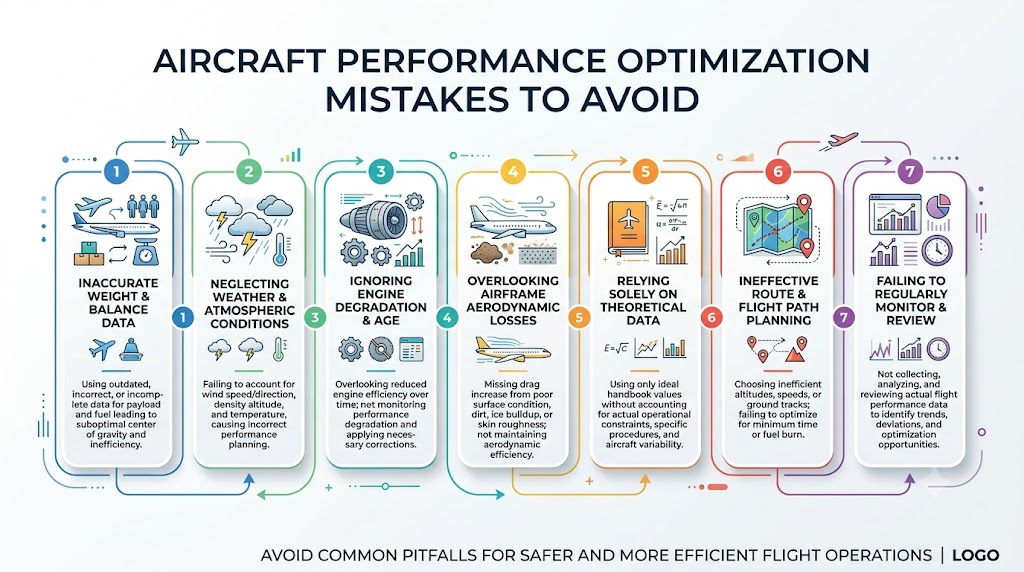
Introduction
Aircraft performance optimization is not simply about getting more speed, reducing fuel burn, or increasing payload. It is the disciplined process of operating an aircraft within its approved limitations while making efficient use of available performance, fuel, weight, altitude, weather, runway, and engine capability.
Many performance problems are not caused by an aircraft being inherently inefficient. They come from poor assumptions, incorrect calculations, weak planning, configuration errors, or failure to account for changing conditions.
A small mistake in weight, temperature, pressure altitude, wind, runway condition, or aircraft configuration can materially affect takeoff distance, climb performance, cruise efficiency, landing performance, and fuel planning.
For aircraft owners, operators, pilots, and maintenance teams, the objective should therefore be straightforward:
Optimize performance without compromising safety margins or operating limitations.
What Aircraft Performance Optimization Really Means
Aircraft performance optimization involves balancing several competing variables rather than maximizing one number.
Typical objectives include:
- Reducing unnecessary fuel consumption
- Improving climb efficiency
- Selecting appropriate cruise settings
- Managing aircraft weight effectively
- Optimizing altitude selection
- Improving runway performance
- Maintaining appropriate safety margins
- Reducing unnecessary operating costs
- Preserving engine and component life
- Improving mission planning
- Maintaining predictable aircraft handling
These objectives are interconnected.
For example, reducing fuel carried may improve aircraft weight and performance, but insufficient fuel reserves create unacceptable operational risk. Flying at a higher altitude may improve cruise efficiency under suitable conditions, but it may also affect climb requirements, weather exposure, oxygen requirements, engine performance, or routing.
The correct question is therefore not:
“How can I make the aircraft perform better?”
It is:
“How can I achieve the required mission safely and efficiently within the aircraft’s approved operating envelope?”
1. Ignoring the Aircraft’s Approved Performance Data
One of the most serious mistakes is relying on memory, general rules, or experience instead of the aircraft’s approved performance information.
Performance varies significantly between aircraft types and even between individual configurations.
Relevant sources may include:
- Aircraft Flight Manual
- Pilot’s Operating Handbook
- Aircraft operating limitations
- Approved performance charts
- Weight-and-balance information
- Manufacturer procedures
- Applicable maintenance documentation
- Approved supplements
- Operating organization’s procedures
Why This Mistake Happens
Experienced pilots sometimes become comfortable with an aircraft and begin relying on familiar numbers.
That familiarity can become dangerous when:
- Payload changes
- Runway conditions change
- Weather changes
- Aircraft configuration changes
- Maintenance has affected performance
- Fuel quantity changes
- Operating altitude changes
- The aircraft is operated near a performance limit
Better Practice
Treat approved performance data as the baseline.
Pilot experience is valuable for interpreting conditions, but it should not replace aircraft-specific performance information.
2. Using Standard Atmosphere Assumptions in Real Conditions
Aircraft performance is strongly affected by atmospheric conditions.
Important variables include:
- Temperature
- Pressure altitude
- Density altitude
- Humidity
- Wind
- Atmospheric pressure
- Runway elevation
A common mistake is using standard-day assumptions when actual conditions are substantially different.
Why It Matters
Hot and high conditions can significantly reduce aircraft performance.
Reduced air density can affect:
- Engine output
- Propeller efficiency
- Wing lift
- Takeoff performance
- Climb rate
- Service ceiling
- Landing performance
Practical Lesson
Do not ask only:
“What is the airport elevation?”
Also consider:
“What is the actual atmospheric condition at the time of operation?”
Performance planning should use the appropriate conditions specified by the aircraft’s approved data.
3. Treating Density Altitude as Just an Aviation Calculation
Density altitude is sometimes treated as a theoretical number rather than an operational concern.
That is a mistake.
High density altitude can create a combination of:
- Longer takeoff distance
- Reduced climb capability
- Higher true airspeed at a given indicated airspeed
- Reduced engine performance
- Reduced propeller efficiency
- Increased workload during critical phases of flight
This becomes particularly important at airports with:
- High elevation
- High temperatures
- Long taxi distances
- Sloping runways
- Terrain restrictions
- Short or contaminated runways
Better Approach
Include density-altitude effects in the operational decision, not merely in the calculation.
A technically correct number is useful only if it leads to an appropriate operational decision.
4. Optimizing Speed Without Considering the Mission
Another common mistake is assuming that the fastest cruise speed is automatically the best cruise speed.
It usually is not.
Increasing speed can affect:
- Fuel flow
- Engine loading
- Range
- Endurance
- Engine temperature
- Noise
- Maintenance considerations
- Arrival planning
For some missions, maximizing speed makes sense.
For others, a slightly slower cruise can provide a better balance between:
time + fuel + range + engine operation.
Better Practice
Define the mission first.
Ask:
- Is the priority minimum trip time?
- Maximum range?
- Maximum endurance?
- Minimum fuel consumption?
- Payload delivery?
- Schedule reliability?
- Engine efficiency?
Then select the appropriate operating strategy.
5. Chasing Minimum Fuel Burn at the Expense of Safety Margin
Fuel efficiency is important, but minimizing fuel burn should never become the sole performance objective.
A flight that consumes slightly less fuel but leaves inadequate flexibility for changing conditions is not optimized.
Fuel planning needs to account for appropriate reserves and operational contingencies.
Potential changes include:
- Headwinds
- Rerouting
- Holding
- Weather avoidance
- Delays
- Airport changes
- Traffic
- Unexpected operational restrictions
The Better Principle
Optimize fuel consumption after establishing an appropriate fuel safety margin, not before.
Fuel efficiency should support sound planning rather than encourage marginal planning.
6. Ignoring Aircraft Weight
Weight is one of the most important variables in aircraft performance.
Additional weight can affect:
- Takeoff distance
- Climb performance
- Cruise efficiency
- Landing distance
- Stall characteristics
- Range
- Payload capability
- Structural loading
Yet weight errors remain surprisingly common.
Possible sources include:
- Incorrect passenger assumptions
- Unverified baggage weights
- Incorrect fuel quantities
- Equipment installed after the original weight calculation
- Configuration changes
- Incorrect empty-weight information
- Poor documentation
Better Practice
Use current aircraft weight-and-balance information and calculate the actual operating condition.
Do not treat maximum gross weight as a target.
Maximum allowable weight is a limitation, not a performance objective.
7. Optimizing Payload Without Considering Center of Gravity
Two aircraft with the same total weight can have different handling characteristics if their center of gravity positions differ.
Center of gravity affects:
- Stability
- Control forces
- Rotation characteristics
- Stall behavior
- Trim requirements
- Fuel efficiency
- Landing characteristics
Trying to maximize payload while ignoring CG can create operational problems even when total weight remains within limits.
Better Practice
Evaluate both:
Total weight
and
Center of gravity position.
A good loading plan should satisfy the applicable weight-and-balance envelope rather than simply maximize payload.
8. Assuming More Fuel Always Means Better Planning
Carrying adequate fuel is essential, but carrying unnecessary fuel also has a performance cost.
Fuel itself adds weight.
Additional weight can increase:
- Takeoff requirements
- Fuel consumption
- Climb time
- Required runway
- Landing considerations
This creates a planning balance.
The Wrong Approach
“Carry as much fuel as possible because more fuel is always safer.”
The Better Approach
Carry fuel according to:
- Planned trip
- Required reserves
- Weather
- Alternate considerations where applicable
- Aircraft limitations
- Mission requirements
- Operational uncertainty
The goal is adequate fuel with appropriate margin, not simply maximum fuel.
9. Failing to Account for Wind Correctly
Wind has a major influence on aircraft performance and trip economics.
A common mistake is treating wind only as a navigation issue.
Wind can affect:
- Groundspeed
- Trip time
- Fuel consumption
- Range
- Runway performance
- Arrival timing
A headwind can make an otherwise efficient cruise strategy less attractive for a particular route.
Similarly, runway wind components should be evaluated using the appropriate aircraft information and operational procedures.
Better Practice
Consider wind at multiple stages:
- Departure runway
- Climb
- Cruise
- Descent
- Arrival runway
Do not assume that a favorable cruise wind compensates automatically for unfavorable runway conditions.
10. Using Generic Performance Numbers Instead of Aircraft-Specific Data
Online calculators, generic aviation tables, remembered figures, or numbers from another aircraft can be useful for education.
They should not automatically be treated as operational performance data.
Performance can differ because of:
- Engine variant
- Propeller configuration
- Aircraft equipment
- Weight
- Airframe condition
- Modification status
- Configuration
- Environmental conditions
Better Practice
Use generic information for understanding concepts.
Use approved aircraft-specific information for operational decisions.
11. Ignoring Runway Surface and Condition
Runway length alone does not determine runway performance.
Relevant factors may include:
- Dry surface
- Wet surface
- Standing water
- Contamination
- Grass
- Gravel
- Snow or ice
- Surface condition
- Slope
- Runway elevation
- Wind
- Temperature
A runway that appears sufficiently long under one set of conditions may offer significantly different performance under another.
Better Practice
Evaluate the actual runway condition against the aircraft’s applicable performance information.
Never assume that a familiar runway always provides the same performance margin.
12. Failing to Consider Runway Slope
Runway slope can affect takeoff and landing performance.
An uphill runway generally presents different takeoff considerations from a downhill runway, while landing performance can also be affected by slope.
The mistake is treating runway length as a standalone metric.
Better Planning
Performance analysis should consider the complete runway environment:
length + slope + surface + wind + temperature + elevation + aircraft weight.
13. Treating Climb Performance as a Fixed Number
Aircraft climb performance changes throughout a flight.
It can be affected by:
- Aircraft weight
- Temperature
- Altitude
- Engine condition
- Configuration
- Airspeed
- Wind
- Terrain
- Atmospheric conditions
A climb rate observed near sea level should not automatically be expected at a significantly higher altitude.
Better Practice
Think of climb performance as a performance curve, not a fixed aircraft characteristic.
This becomes especially important when planning departures around terrain or restricted climb profiles.
14. Optimizing Cruise Altitude Solely for Fuel Economy
Higher altitude can offer performance benefits in some aircraft and operating conditions, but “higher is always better” is an unreliable rule.
Altitude selection can depend on:
- Aircraft performance
- Aircraft weight
- Wind
- Temperature
- Route
- Airspace
- Terrain
- Weather
- Oxygen requirements
- Engine characteristics
- Required climb performance
Better Approach
Choose altitude based on the complete mission.
A theoretically efficient altitude may not be operationally optimal if reaching it requires excessive climb fuel or time.
15. Neglecting Engine Condition
Aircraft performance is not determined solely by aerodynamic design.
Engine condition matters.
Potential contributors to reduced performance include:
- Poor compression
- Fouling
- Incorrect rigging
- Ignition-system problems
- Fuel-system problems
- Induction restrictions
- Cooling issues
- Propeller problems
- Incorrect engine settings
- Maintenance discrepancies
Important Distinction
If an aircraft consistently performs below expected values, changing operating technique may not solve the underlying problem.
The correct response may require maintenance investigation rather than performance optimization.
16. Ignoring Propeller Condition and Configuration
For propeller-driven aircraft, propeller condition can have a meaningful impact on performance.
Relevant factors include:
- Blade condition
- Pitch setting
- Damage
- Balance
- Governing system operation
- Installation configuration
- Maintenance condition
A pilot may attempt to compensate for poor performance through operating technique when the actual problem is mechanical.
Better Practice
If expected performance changes unexpectedly, compare observed performance with historical and approved benchmarks and involve qualified maintenance personnel where appropriate.
17. Treating Aircraft Configuration as Secondary
Aircraft configuration can significantly influence performance.
Depending on the aircraft, relevant configuration elements can include:
- Flap position
- Landing gear
- Cowl flaps
- Propeller setting
- Mixture setting
- Power setting
- Anti-ice equipment
- External equipment
- Doors or access panels
- Required operational equipment
Using the wrong configuration can produce:
- Excessive drag
- Higher fuel consumption
- Reduced climb performance
- Increased temperatures
- Poor cruise efficiency
Better Practice
Use the aircraft’s approved procedures for each phase of flight.
Do not improvise configuration changes merely to chase a performance number.
18. Optimizing Engine Settings Without Understanding the Limits
Engine management requires more than selecting the setting that appears to produce the lowest fuel flow.
Depending on the aircraft and engine, relevant parameters may include:
- RPM
- Manifold pressure
- Fuel flow
- Cylinder temperatures
- Oil temperature
- Oil pressure
- Exhaust temperatures
- Turbine temperatures
- Torque
- Compressor parameters
The correct operating method depends on the specific engine and approved guidance.
Common Mistake
Applying a technique learned on one engine or aircraft to another.
Better Practice
Use the manufacturer’s approved engine operating procedures and understand the relationship between power, mixture, temperature, pressure, and engine limitations.
19. Optimizing Performance by Operating Too Close to the Limits
A recurring mistake is treating aircraft limitations as targets.
Examples include operating close to:
- Maximum takeoff weight
- Maximum landing weight
- Maximum temperature
- Maximum engine limits
- Maximum demonstrated values
- Maximum structural speeds
- Minimum fuel margins
Operating near a limit may be permitted, but it reduces flexibility.
Experienced Operational Principle
A limit defines what must not be exceeded. It does not automatically define a desirable operating point.
A sound performance strategy preserves appropriate margins whenever practical.
20. Failing to Recalculate After Conditions Change
Performance planning is not necessarily a one-time activity completed before departure.
Conditions can change.
Examples:
- Temperature rises
- Wind changes
- Payload changes
- Fuel burn changes aircraft weight
- Runway changes
- Destination conditions deteriorate
- Weather creates a diversion requirement
Better Practice
Reassess performance whenever a significant change affects the original assumptions.
This is particularly important for:
- Takeoff decisions
- High-altitude operations
- Mountain airports
- Short runways
- Hot-weather operations
- Heavy loading
- Marginal weather
21. Ignoring the Difference Between Indicated and True Airspeed
Airspeed terminology matters when analyzing aircraft performance.
Indicated airspeed, calibrated airspeed, equivalent airspeed, and true airspeed serve different purposes.
At higher altitudes, true airspeed can differ substantially from indicated airspeed.
This affects:
- Navigation
- Groundspeed
- Cruise planning
- Range calculations
- Time estimates
- Performance interpretation
Better Practice
Use the correct airspeed reference for the specific performance calculation rather than substituting one airspeed for another.
22. Optimizing for Speed While Ignoring Engine Temperature
Higher power settings can sometimes reduce travel time but may increase thermal loading.
Depending on the aircraft, temperature management may involve:
- Cylinder head temperature
- Oil temperature
- Exhaust gas temperature
- Turbine temperature
- Cooling airflow
Performance optimization should therefore consider both:
short-term performance
and
long-term mechanical health.
A small time saving is not necessarily worthwhile if it produces unnecessary thermal or mechanical stress.
23. Using Poor or Unverified Data
Performance optimization depends on data quality.
Poor data can originate from:
- Incorrect aircraft weight
- Outdated configuration
- Faulty instruments
- Incorrect fuel-flow readings
- Unreliable engine data
- Incorrect atmospheric inputs
- Manual transcription errors
- Spreadsheet mistakes
Better Practice
Establish a reliable performance-data workflow.
For repeated operations, maintain consistent records of:
- Aircraft configuration
- Weight
- Weather
- Power setting
- Fuel consumption
- Cruise speed
- Climb performance
- Takeoff and landing observations where appropriate
Trends are often more valuable than isolated numbers.
24. Failing to Establish a Performance Baseline
Aircraft owners sometimes know that the aircraft “feels slower” or “uses more fuel” but lack objective evidence.
Without a baseline, diagnosing performance degradation becomes difficult.
A useful baseline can include:
| Parameter | Baseline Consideration |
|---|---|
| Cruise speed | At defined power and atmospheric conditions |
| Fuel flow | At defined operating conditions |
| Climb rate | At defined weight and altitude |
| Oil temperature | Normal operating range |
| Engine temperatures | Normal operating range |
| Takeoff performance | Expected distance under defined conditions |
| Landing performance | Expected distance under defined conditions |
The objective is not to create unnecessary paperwork.
The objective is to identify meaningful changes early.
25. Ignoring Gradual Performance Degradation
Performance deterioration can happen gradually.
That makes it easy to miss.
Potential causes include:
- Engine wear
- Airframe contamination
- Propeller degradation
- Drag increases
- Tire or brake issues
- Control-surface rigging problems
- Induction restrictions
- Exhaust problems
- Fuel-system problems
A small degradation may not be obvious on one flight.
Over time, however, it can become operationally significant.
Better Practice
Track trends rather than relying solely on memory.
If performance changes persist, investigate the underlying cause.
26. Treating Aerodynamic Cleanliness as Cosmetic
External condition can influence aerodynamic efficiency.
Potential sources of additional drag include:
- Surface contamination
- Damaged fairings
- Poorly fitted panels
- Improperly secured equipment
- Unapproved modifications
- Damaged seals
- External attachments
Not every cosmetic imperfection creates a meaningful performance penalty, but unexplained drag deserves investigation.
Key Principle
Do not modify or remove aircraft components simply to improve performance unless the change is properly approved and incorporated according to applicable requirements.
27. Ignoring Weight Changes After Modifications
Aircraft configuration changes can alter both weight and balance.
Examples include:
- Avionics upgrades
- Additional equipment
- Interior changes
- Auxiliary systems
- Structural modifications
- New batteries
- Supplemental equipment
A modification can therefore affect:
- Empty weight
- Useful load
- CG
- Fuel planning
- Takeoff performance
- Landing performance
Better Practice
Ensure aircraft records and weight-and-balance information remain consistent with the actual configuration.
28. Confusing Theoretical Optimization With Operational Optimization
A spreadsheet may identify a theoretically ideal operating point.
Real aviation has additional constraints.
Operational optimization may need to account for:
- Weather
- Airspace
- Terrain
- Traffic
- Airport limitations
- Passenger requirements
- Maintenance condition
- Crew workload
- Dispatch reliability
- Regulatory requirements
The mathematically optimal solution may not be the operationally best solution.
The Mature Approach
Optimize within the complete operational system, not inside one equation.
29. Failing to Consider Pilot Workload
An operating technique can be fuel-efficient and technically valid but operationally undesirable if it creates excessive workload.
This matters especially during:
- Departure
- Approach
- Weather avoidance
- High-density traffic
- Mountain operations
- Abnormal situations
Performance optimization should never create unnecessary cockpit complexity.
Better Principle
When two approaches provide similar performance, prefer the one that is:
- Easier to execute
- More repeatable
- Less workload-intensive
- Easier to monitor
- More tolerant of small errors
30. Treating Every Flight as a Separate Optimization Problem
Repeated missions provide an opportunity to learn.
If the same aircraft regularly flies similar routes, operators can identify patterns in:
- Fuel consumption
- Cruise performance
- Climb performance
- Weather effects
- Airport performance
- Loading practices
This allows planning to improve over time.
However, historical data should support—not replace—current performance calculations.
Aircraft Performance Optimization Decision Framework
A useful performance decision process can be organized into six stages.
| Stage | Primary Question |
|---|---|
| 1. Mission | What does the flight actually need to accomplish? |
| 2. Aircraft | Is the aircraft configuration suitable for the mission? |
| 3. Conditions | What are the actual weather, runway, terrain, and routing conditions? |
| 4. Performance | What does the approved performance information indicate? |
| 5. Margin | Are appropriate operational margins available? |
| 6. Validation | Does actual aircraft behavior remain consistent with expectations? |
This framework prevents optimization from becoming a narrow exercise in fuel or speed.
A Practical Aircraft Performance Optimization Workflow
Step 1: Define the Mission
Establish:
- Departure
- Destination
- Route
- Payload
- Required fuel
- Desired arrival time
- Operational constraints
Step 2: Confirm Aircraft Status
Verify:
- Aircraft configuration
- Weight-and-balance status
- Maintenance status
- Required equipment
- Fuel quantity
- Relevant performance limitations
Step 3: Collect Environmental Data
Evaluate:
- Temperature
- Pressure
- Wind
- Density altitude
- Runway condition
- Runway slope
- Terrain
- Weather
Step 4: Calculate Performance
Use the aircraft’s applicable performance information for:
- Takeoff
- Climb
- Cruise
- Descent
- Landing
- Fuel requirements
Step 5: Evaluate Margins
Ask:
- Is takeoff performance acceptable?
- Is climb capability sufficient?
- Is terrain clearance adequately addressed?
- Is landing performance acceptable?
- Is fuel sufficient for the planned operation?
- Are there reasonable alternatives if conditions deteriorate?
Step 6: Select the Operating Strategy
Only after establishing safe and acceptable conditions should you optimize:
- Cruise altitude
- Cruise speed
- Power setting
- Loading
- Fuel strategy
- Routing
Step 7: Monitor Actual Performance
Compare actual results with expected performance.
Look for meaningful deviations.
Step 8: Investigate Persistent Deviations
If performance repeatedly differs from expectations, determine whether the cause is:
- Planning
- Weather
- Aircraft loading
- Pilot technique
- Instrumentation
- Engine condition
- Propeller condition
- Aerodynamic condition
- Configuration
Performance Optimization Metrics Worth Tracking
For aircraft operated regularly, a small number of meaningful metrics can provide useful insight.
Fuel Efficiency
Track fuel consumption against defined operating conditions rather than comparing raw fuel numbers between unrelated flights.
Cruise Performance
Monitor speed at comparable:
- Weight
- Altitude
- Power
- Atmospheric conditions
Climb Performance
Track climb behavior under reasonably comparable conditions.
Takeoff Performance
Where operationally appropriate, monitor expected versus observed performance.
Landing Performance
Use approved procedures and appropriate safety margins rather than treating historical landing distances as guaranteed future performance.
Engine Parameters
Monitor relevant engine indications for trends and unusual changes.
Common Warning Signs of Poor Performance Management
Watch for patterns such as:
- Increasing fuel consumption
- Reduced cruise speed
- Longer-than-expected climb
- Unexpected temperature increases
- Increasing takeoff distance
- Unusual engine indications
- Repeated weight-and-balance corrections
- Large differences between planned and actual fuel use
- Frequent last-minute performance decisions
- Reliance on memory instead of documentation
A single deviation does not automatically indicate a problem.
A persistent trend deserves investigation.
How to Improve Aircraft Performance Without Creating New Risks
Performance improvements should be approached systematically.
Improve Planning Before Modifying the Aircraft
Better loading, routing, altitude selection, and power management may produce useful gains without hardware changes.
Improve Data Quality
Accurate inputs often produce more benefit than increasingly sophisticated calculations based on poor information.
Maintain the Aircraft Properly
Correct maintenance can preserve designed performance.
Reduce Unnecessary Weight
Where appropriate and approved, unnecessary equipment or payload can be evaluated as part of weight management.
Monitor Trends
Early detection of performance degradation can prevent larger problems.
Standardize Repeated Operations
Consistent procedures improve predictability.
Avoid Unapproved Performance Modifications
Any aircraft modification should follow the applicable approval, engineering, maintenance, and regulatory process.
Aircraft Performance Optimization Checklist
Before Flight
- Confirm aircraft configuration
- Confirm current weight-and-balance information
- Determine actual operating weight
- Verify fuel quantity
- Review applicable aircraft limitations
- Obtain relevant weather information
- Evaluate density altitude where applicable
- Evaluate runway condition
- Consider runway slope
- Calculate takeoff performance
- Assess climb performance
- Determine appropriate cruise strategy
- Calculate fuel requirements and appropriate reserves
- Evaluate destination and contingency considerations
During Flight
- Monitor aircraft performance
- Monitor engine parameters
- Maintain appropriate configuration
- Avoid unnecessary deviations from planned operating parameters
- Reassess conditions when they materially change
- Avoid operating beyond applicable limitations
- Maintain appropriate safety margins
After Flight
- Record relevant fuel consumption
- Note significant weather effects
- Record meaningful performance deviations
- Review unexpected engine indications
- Track recurring performance changes
- Report maintenance-related concerns appropriately
A Simple Risk Matrix for Performance Decisions
| Situation | Risk Level | Appropriate Response |
|---|---|---|
| Conditions comfortably within performance margins | Low | Proceed using normal procedures |
| Performance margin is reduced | Moderate | Recalculate and evaluate alternatives |
| Performance data is uncertain | Moderate/High | Obtain reliable information before proceeding |
| Aircraft performance differs materially from expected | High | Investigate and reassess |
| Required performance cannot be demonstrated within limitations | Unacceptable | Do not proceed under those conditions |
| Aircraft condition may affect safe performance | High | Seek qualified maintenance assessment |
The exact operational response depends on the aircraft, mission, applicable procedures, and circumstances.
The Most Important Mistakes to Avoid
If the entire subject has to be reduced to a short list, these are the mistakes that deserve the most attention:
- Ignoring aircraft-specific performance data
- Using standard atmospheric assumptions
- Ignoring actual aircraft weight
- Neglecting center of gravity
- Treating maximum limits as operating targets
- Ignoring runway condition and slope
- Optimizing speed without considering fuel and engine effects
- Reducing fuel margins to improve efficiency
- Ignoring engine or propeller condition
- Failing to investigate persistent performance degradation
- Using unreliable or outdated data
- Making modifications without appropriate approval
- Failing to reassess when conditions change
- Optimizing for theoretical efficiency instead of operational suitability
- Allowing optimization to increase pilot workload unnecessarily
Final Recommendation
Aircraft performance optimization should be treated as a risk-managed operational discipline, not a search for the highest speed or lowest fuel number.
Start with accurate aircraft data, realistic environmental conditions, correct weight and balance, and the applicable operating limitations. Then optimize speed, altitude, power, loading, and fuel strategy within those boundaries.
Most importantly, distinguish between normal performance variation and evidence of aircraft degradation. A persistent decline in performance should be investigated rather than compensated for indefinitely through pilot technique.
The best performance strategy is the one that delivers the required mission with predictable aircraft behavior, adequate margins, efficient resource use, and no compromise to approved operating limits.
FAQs
Q1. What is the biggest aircraft performance optimization mistake?
One of the biggest mistakes is relying on assumptions or remembered figures instead of current, aircraft-specific performance information and actual operating conditions.
Q2. Does reducing aircraft weight always improve performance?
Reducing unnecessary weight generally benefits aircraft performance, but loading decisions must also account for fuel requirements, payload needs, center of gravity, and applicable limitations.
Q3. Is flying at a higher altitude always more fuel efficient?
No. The most efficient altitude depends on aircraft characteristics, weight, weather, wind, engine performance, routing, and other operational constraints.
Q4. Why is density altitude important?
Higher density altitude generally reduces available aircraft performance. It can affect takeoff distance, climb capability, engine output, and other performance characteristics.
Q5. Should pilots always fly at the fastest cruise speed?
No. The best cruise speed depends on the mission. A slower setting may provide a better balance between speed, fuel consumption, range, and engine operation.
Q6. How can an aircraft owner identify performance degradation?
Track comparable performance data over time, including cruise performance, fuel consumption, climb behavior, and relevant engine indications. Persistent deviations should be investigated.
Q7. Can aerodynamic cleaning improve aircraft performance?
Maintaining the aircraft in its proper approved configuration and condition can help preserve designed aerodynamic performance. Any modification or alteration should follow the applicable approval and maintenance requirements.
Q8. Is carrying maximum fuel always the safest choice?
Not necessarily. Adequate fuel reserves are essential, but unnecessary fuel adds weight and can reduce aircraft performance. Fuel planning should balance mission requirements with appropriate reserves and contingencies.
Q9. Why is center of gravity important for performance?
Center of gravity affects aircraft stability, handling, trim, control forces, and other characteristics. Total weight alone does not provide a complete picture of loading suitability.
Q10. What should be done if actual aircraft performance is consistently worse than expected?
First verify the accuracy of the performance inputs and operating conditions. If the difference persists, the aircraft should be evaluated for possible maintenance, configuration, instrumentation, engine, propeller, or aerodynamic issues by appropriately qualified personnel.
Q11. Should generic online performance calculators be used for flight planning?
Generic calculators can help explain performance concepts, but operational decisions should be based on the applicable aircraft-specific and approved performance information.
Q12. What is the best overall approach to aircraft performance optimization?
Use a disciplined cycle of mission definition, accurate aircraft data, environmental assessment, performance calculation, margin evaluation, appropriate operating strategy, and post-flight validation. This produces more reliable results than optimizing a single variable such as speed or fuel burn.
Conclusion
Aircraft performance optimization is about making informed decisions within the aircraft’s approved operating envelope.
The most common failures come from poor data, incorrect assumptions, excessive weight, weak environmental analysis, and treating limits as targets.
Effective optimization combines aircraft condition, loading, weather, runway characteristics, engine performance, and mission requirements.
Regular performance monitoring also helps identify mechanical or configuration problems before they become significant.
The safest strategy is not maximum performance at any cost, but predictable performance with appropriate operational margins.

