
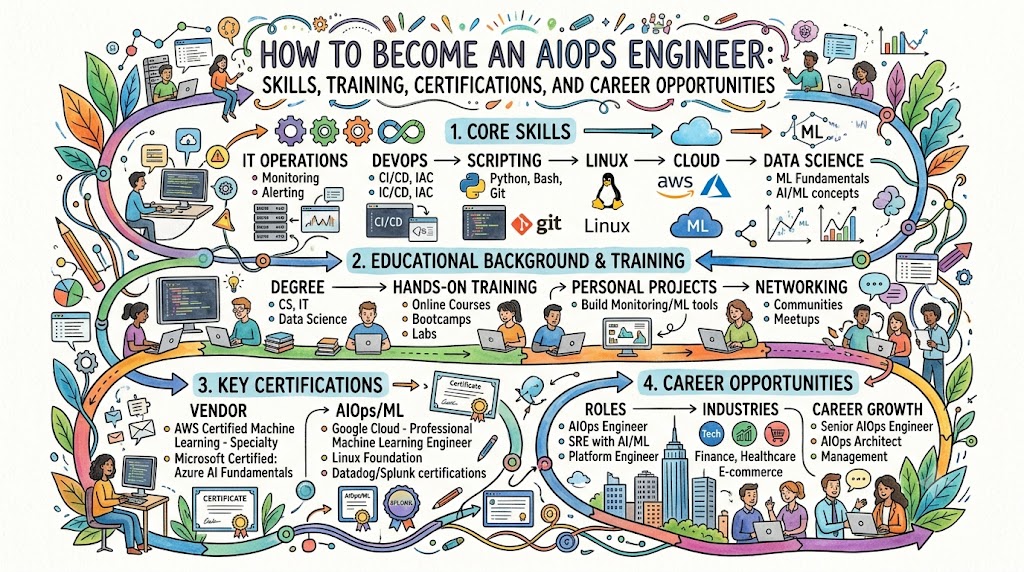
Introduction
As organizations continue to modernize their IT infrastructure, the volume of operational data generated by applications, servers, cloud platforms, containers, and networks is growing at an unprecedented rate. Traditional IT operations teams often struggle to manage this complexity using manual monitoring and troubleshooting methods. This challenge has led to the rapid adoption of Artificial Intelligence for IT Operations, commonly known as AIOps.
AIOps combines artificial intelligence, machine learning, big data analytics, automation, and observability to help organizations detect anomalies, identify root causes, predict incidents, and automate operational tasks. As businesses increasingly rely on digital services, the demand for skilled AIOps Engineers continues to rise.
If you are interested in building a future-proof career at the intersection of AI, automation, cloud computing, DevOps, and IT operations, becoming an AIOps Engineer can be an excellent choice. This guide explains the skills, training, certifications, learning path, and career opportunities available in the AIOps domain.
What Is an AIOps Engineer?
An AIOps Engineer is an IT professional who uses artificial intelligence and machine learning technologies to improve IT operations. They work with monitoring systems, observability platforms, automation tools, cloud environments, and analytics solutions to ensure reliable and efficient IT services.
Instead of manually analyzing thousands of alerts and logs, AIOps Engineers build systems that automatically detect patterns, predict failures, correlate events, and recommend solutions.
Their primary goal is to improve operational efficiency, reduce downtime, accelerate incident resolution, and enhance system reliability.
Why Are AIOps Engineers in High Demand?
Modern enterprises operate highly complex environments that include:
- Multi-cloud infrastructure
- Hybrid cloud platforms
- Kubernetes clusters
- Microservices architectures
- Distributed applications
- Edge computing environments
- AI-powered business applications
Managing these environments manually is becoming increasingly difficult.
Organizations are investing in AIOps because it helps:
- Reduce operational costs
- Improve system availability
- Minimize downtime
- Enhance customer experience
- Automate repetitive operational tasks
- Accelerate incident response
- Improve decision-making through data analytics
As a result, companies are actively seeking professionals with AIOps expertise.
What Does an AIOps Engineer Do?
An AIOps Engineer performs a variety of responsibilities across IT operations, automation, monitoring, and AI-driven analytics.
Monitoring Infrastructure and Applications
AIOps Engineers monitor:
- Servers
- Networks
- Databases
- Applications
- Containers
- Cloud services
They ensure systems remain healthy and available.
Event Correlation
Thousands of alerts can be generated during an outage.
AIOps Engineers use intelligent platforms to:
- Eliminate duplicate alerts
- Group related incidents
- Reduce alert fatigue
- Prioritize critical issues
Root Cause Analysis
Finding the root cause of incidents can take hours or days.
AIOps platforms help engineers:
- Analyze logs
- Correlate events
- Identify dependencies
- Pinpoint failures quickly
Automation
AIOps Engineers design automation workflows for:
- Incident remediation
- Server provisioning
- Resource scaling
- Ticket creation
- Operational processes
Predictive Analytics
Machine learning models help predict:
- Capacity shortages
- Performance degradation
- System failures
- Security anomalies
Observability Management
AIOps Engineers work with:
- Logs
- Metrics
- Traces
- Events
to achieve complete visibility across IT environments.
Essential Skills Required to Become an AIOps Engineer
1. IT Operations Fundamentals
Before learning AIOps, professionals should understand traditional IT operations concepts.
Key topics include:
- System administration
- Network management
- Incident management
- Change management
- Service management
- Infrastructure monitoring
2. Linux Administration
Most enterprise workloads run on Linux-based environments.
Important skills include:
- Command-line operations
- Process management
- Networking
- Shell scripting
- System troubleshooting
3. Cloud Computing
AIOps solutions commonly operate in cloud environments.
Important cloud platforms include:
- Amazon Web Services
- Microsoft Azure
- Google Cloud Platform
Key areas to learn:
- Virtual machines
- Containers
- Storage
- Networking
- Monitoring services
4. DevOps Knowledge
AIOps and DevOps work closely together.
Important DevOps concepts include:
- CI/CD pipelines
- Infrastructure as Code
- Configuration management
- Automation
- Monitoring
5. Observability
Modern AIOps heavily relies on observability.
Learn:
- Logs
- Metrics
- Traces
- Distributed tracing
- Application monitoring
6. Data Analytics
AIOps platforms process massive amounts of operational data.
Important skills include:
- Data analysis
- Pattern recognition
- Statistical analysis
- Data visualization
7. Artificial Intelligence and Machine Learning
Understanding machine learning concepts is beneficial.
Learn:
- Supervised learning
- Unsupervised learning
- Anomaly detection
- Predictive analytics
- Classification algorithms
8. Automation and Scripting
Automation is a core AIOps requirement.
Learn:
- Python
- Bash
- PowerShell
- Automation frameworks
9. Kubernetes and Containers
Modern applications often run on container platforms.
Important technologies include:
- Docker
- Kubernetes
- OpenShift
- Container monitoring
10. Problem-Solving Skills
AIOps Engineers regularly investigate incidents and optimize operations.
Strong analytical thinking is essential.
AIOps Tools Every Engineer Should Learn
Monitoring Tools
- Prometheus
- Nagios
- Zabbix
- Datadog
- SolarWinds
Observability Platforms
- Grafana
- Splunk
- Elastic Stack
- Dynatrace
- New Relic
AIOps Platforms
- IBM Watson AIOps
- Moogsoft
- BigPanda
- PagerDuty AIOps
- BMC Helix AIOps
Automation Tools
- Ansible
- Terraform
- Jenkins
- GitHub Actions
- Rundeck
Container Platforms
- Docker
- Kubernetes
- OpenShift
Recommended Learning Path for Beginners
Step 1: Learn IT Infrastructure Basics
Start with:
- Operating systems
- Networking
- Databases
- Virtualization
Step 2: Learn Linux and Scripting
Focus on:
- Linux administration
- Bash scripting
- Python programming
Step 3: Learn Cloud Technologies
Study:
- AWS
- Azure
- Google Cloud
Understand cloud architecture and services.
Step 4: Learn DevOps Practices
Master:
- Git
- CI/CD
- Automation
- Infrastructure as Code
Step 5: Learn Monitoring and Observability
Practice using:
- Prometheus
- Grafana
- ELK Stack
- Splunk
Step 6: Learn AI and Machine Learning Basics
Understand:
- Data analysis
- Machine learning concepts
- Anomaly detection
Step 7: Study AIOps Platforms
Explore enterprise-grade AIOps solutions and understand their architecture.
Step 8: Earn Certifications
Validate your knowledge through professional certifications.
Best Certifications for Aspiring AIOps Engineers
AIOps Foundation Certification
A beginner-friendly certification covering:
- AIOps fundamentals
- AI concepts
- Machine learning basics
- Event correlation
- Root cause analysis
DevOps Certifications
Popular options include:
- DevOps Foundation
- DevOps Leader
- Certified Kubernetes Administrator
Cloud Certifications
Useful certifications include:
- AWS Certified Cloud Practitioner
- AWS Solutions Architect
- Microsoft Azure Fundamentals
- Google Cloud Digital Leader
Observability Certifications
Focus on:
- Splunk certifications
- Dynatrace certifications
- Elastic certifications
Automation Certifications
Learn:
- Ansible Automation
- Terraform Associate
Hands-On Projects for Building AIOps Experience
Employers value practical experience.
Consider building projects such as:
Intelligent Monitoring Dashboard
Create dashboards using:
- Prometheus
- Grafana
- AlertManager
Log Analytics Platform
Build centralized logging with:
- Elasticsearch
- Logstash
- Kibana
Automated Incident Response System
Use:
- Python
- Ansible
- Monitoring tools
to automatically resolve common incidents.
Cloud Monitoring Solution
Monitor workloads deployed on:
- AWS
- Azure
- Google Cloud
Predictive Failure Detection
Create machine learning models that predict system failures based on historical data.
Career Opportunities in AIOps
AIOps Engineer
Focuses on AI-driven operational automation and monitoring.
Site Reliability Engineer
Uses automation and observability to improve system reliability.
DevOps Engineer
Builds automation pipelines and deployment systems.
Platform Engineer
Creates scalable infrastructure platforms.
Cloud Operations Engineer
Manages cloud infrastructure and operational excellence.
Observability Engineer
Specializes in monitoring, tracing, and operational visibility.
Automation Engineer
Designs workflows that reduce manual operational effort.
IT Operations Analyst
Analyzes operational data and improves service performance.
Industries Hiring AIOps Professionals
AIOps skills are valuable across many industries.
Banking and Financial Services
Banks use AIOps for:
- Fraud detection
- Performance monitoring
- Infrastructure reliability
Healthcare
Healthcare organizations rely on AIOps for:
- System availability
- Patient data access
- Regulatory compliance
Telecommunications
Telecom providers use AIOps to manage large-scale networks.
E-Commerce
Online businesses depend on AIOps for:
- Application performance
- User experience
- Availability
Manufacturing
Manufacturers use AIOps to support:
- Smart factories
- Predictive maintenance
- Industrial automation
Common Challenges for New AIOps Engineers
Learning Multiple Domains
AIOps requires knowledge of:
- IT operations
- Cloud computing
- DevOps
- AI
- Automation
Tool Complexity
Enterprise environments often involve dozens of integrated tools.
Data Quality Issues
Poor-quality operational data can impact AI model accuracy.
Continuous Learning
Technology evolves rapidly, requiring ongoing education.
Tips for Success in an AIOps Career
- Build strong IT fundamentals first.
- Learn Linux and Python thoroughly.
- Gain practical cloud experience.
- Understand observability concepts.
- Practice automation regularly.
- Develop troubleshooting expertise.
- Work on real-world projects.
- Earn recognized certifications.
- Follow industry trends.
- Join professional communities and learning groups.
Future of AIOps Careers
The future of AIOps is closely tied to the growth of:
- Artificial intelligence
- Generative AI
- Autonomous operations
- Cloud-native computing
- Observability platforms
- Intelligent automation
Organizations are moving toward self-healing systems that can detect, diagnose, and resolve issues automatically. Professionals who understand AIOps will play a critical role in designing and managing these intelligent operational environments.
As AI adoption accelerates across industries, the demand for AIOps Engineers is expected to grow significantly, creating excellent career opportunities for IT professionals worldwide.
Conclusion
A career as an AIOps Engineer offers a unique opportunity to combine IT operations, cloud computing, DevOps, observability, automation, and artificial intelligence into a highly valuable and future-focused role. Organizations increasingly depend on AI-driven operations to manage complex digital environments, making AIOps one of the fastest-growing areas in modern IT. By building strong foundations in Linux, cloud computing, monitoring, automation, data analytics, and machine learning, professionals can successfully transition into AIOps roles. Following a structured learning path, gaining hands-on experience with leading AIOps tools, and earning industry-recognized certifications can significantly improve career prospects. Whether you are a beginner entering the technology field or an experienced IT professional looking to advance your career, AIOps provides exciting opportunities to contribute to the future of intelligent IT operations.

