
Introduction
Modern rotorcraft and hybrid aircraft designs often combine rotor systems with jet propulsion to achieve vertical lift, forward thrust, and high-speed flight. Understanding how these systems work together is critical for pilots, aerospace engineers, and aviation enthusiasts. The coordination between jets and rotors directly impacts aircraft lift, stability, maneuverability, efficiency, and overall safety.
From helicopters to tiltrotors and VTOL aircraft, successful integration of these systems enables versatile flight profiles, faster travel, and new mission capabilities. This guide explores the mechanics of jet propulsion, rotor systems, their integration, performance considerations, challenges, and future trends.
Real-World Use Cases
- Tiltrotor Aircraft: Such as the V-22 Osprey, transition from vertical lift to forward flight efficiently.
- VTOL UAVs: Combine ducted fans with small jets for urban air mobility.
- Military Rotorcraft: Auxiliary jets provide high-speed or extended range capabilities.
- Civilian Helicopters: Supplemental propulsion improves cruise speed and reduces rotor load.
- Experimental Hybrid Aircraft: Engineers test energy-efficient rotor/jet combinations.
- Search-and-Rescue Operations: Require precise lift and forward thrust for maneuvering in confined areas.
Evaluation Criteria for Understanding
To fully grasp how these systems interact, consider:
- Rotor type and configuration (main, tail, coaxial, tandem)
- Jet engine type (turbojet, turbofan, turbo-shaft)
- Thrust vectoring and distribution
- Lift-to-weight ratio and torque management
- Aerodynamic efficiency and airflow interaction
- Power transmission between engine and rotor
- Control system integration and pilot interface
- Aircraft stability during transition
- Safety protocols for combined operation
Best for
This guide is best for aviation students, aerospace engineers, rotorcraft pilots, VTOL enthusiasts, and hybrid aircraft designers seeking a clear conceptual understanding of propulsion integration.
Not Ideal for
This guide is not a substitute for aircraft flight manuals, pilot certification training, or certified engineering documentation. It is a technical overview for educational and conceptual purposes.
How Jet Propulsion Works
Jet propulsion produces forward thrust by accelerating air or exhaust gases through a nozzle. The main types include:
- Turbojet: Simple, high-speed engine, less fuel-efficient at low speed.
- Turbofan: High bypass ratio, efficient for cruise, commonly used in tiltrotors.
- Turboprop: Drives a propeller via a turbine, providing efficient thrust at moderate speeds.
- Ramjet: Uses aircraft speed for compression, mainly experimental.
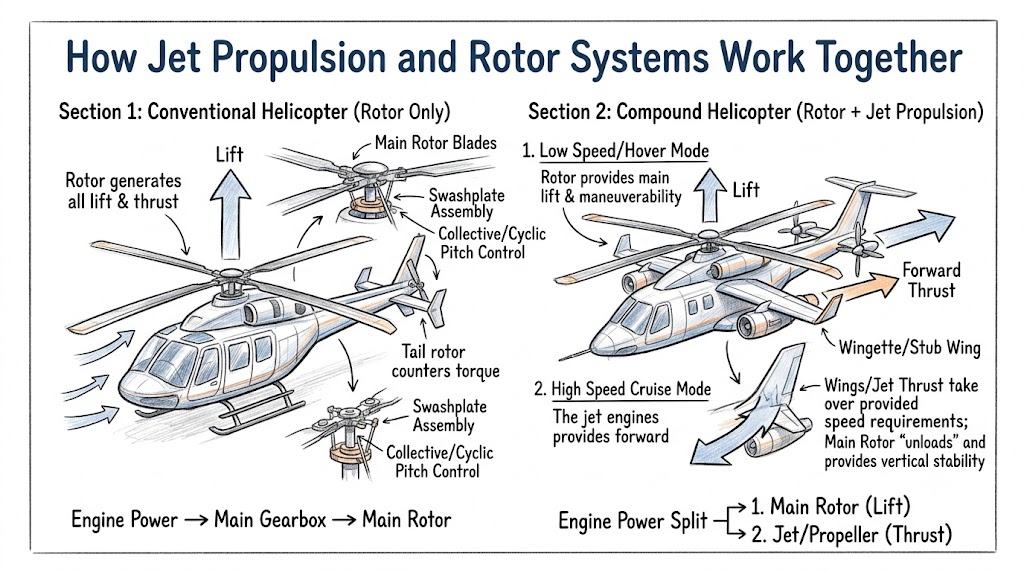
In hybrid rotorcraft, jet engines can provide forward thrust, reduce rotor load, or supplement high-speed flight, while rotors maintain vertical lift and maneuvering.
How Rotor Systems Work
Rotor systems generate lift by spinning airfoils (rotor blades) to push air downward. Key components include:
- Main rotor: Provides vertical lift and forward thrust when tilted.
- Tail rotor: Counteracts torque in single-rotor helicopters.
- Coaxial rotors: Opposing rotors balance torque without a tail rotor.
- Tandem rotors: Separate front and rear rotors for increased lift.
Rotors also control pitch, roll, and yaw through cyclic and collective pitch adjustments, allowing precise maneuverability.
Integration of Jet Propulsion and Rotors
In hybrid aircraft:
- Jets provide forward thrust while rotors maintain vertical lift.
- Tiltrotor mechanics allow smooth transition from vertical lift (helicopter mode) to horizontal thrust (airplane mode).
- Power is coordinated to maintain rotor RPM and engine efficiency.
- Hybrid designs must balance weight, thrust, and rotor torque for stable flight.
Performance Impacts
| Factor | Effect |
|---|---|
| Lift-to-Weight Ratio | Proper rotor-jet coordination ensures sufficient lift at varying speeds |
| Forward Speed | Jet propulsion enables higher cruise speeds while reducing rotor drag |
| Stability | Synchronized thrust prevents yaw, pitch, and roll instability |
| Maneuverability | Rotor control allows precise vertical and lateral movements |
| Fuel Efficiency | Optimizing engine power reduces fuel burn and operational costs |
| Noise & Vibration | Coordination minimizes mechanical stress and vibration |
Common Challenges
- Torque Management: Rotors generate torque that must be counteracted.
- Structural Stress: Transitioning from vertical to forward flight stresses the airframe.
- Control Complexity: Pilot must manage engines, rotors, and flight controls simultaneously.
- Engine-Rotor Synchronization: Critical for safety and efficiency.
- Aerodynamic Interference: Rotor downwash can interact with jet exhaust, affecting lift.
Future Trends
- Electric and Hybrid-Electric Rotorcraft: Reduce emissions and simplify propulsion integration.
- Urban Air Mobility Vehicles: VTOL aircraft for city travel using rotor-jet hybrid systems.
- AI-Assisted Propulsion: Automated control for optimal rotor and jet coordination.
- Noise Reduction Techniques: Aerodynamic optimization for quieter operation.
- Digital Twin Simulations: Predict performance and test rotor/jet integration virtually.
Frequently Asked Questions
1. What is the main difference between rotor lift and jet thrust?
Rotor lift provides vertical force to keep the aircraft aloft, while jet thrust propels the aircraft forward by accelerating air rearward.
2. How do tiltrotor aircraft transition between vertical and horizontal flight?
Tiltrotor blades pivot from vertical lift mode to horizontal propeller mode, with engines adjusting power to maintain lift and thrust.
3. Can a helicopter benefit from auxiliary jet propulsion?
Yes, jets can supplement forward thrust, improve cruise speed, or extend range while rotors handle vertical lift.
4. How do jet engines affect rotor RPM control?
Engine power must be synchronized with rotor speed to maintain lift, prevent over-torque, and ensure stable flight.
5. Are coaxial rotors more efficient with jet assistance?
Coaxial designs can benefit by eliminating tail rotor losses and allowing jet thrust to focus on forward speed, improving efficiency.
6. How does thrust vectoring improve hybrid aircraft performance?
Thrust vectoring directs jet exhaust to assist maneuvering or balance torque, improving stability and control.
7. What safety considerations exist when combining jets and rotors?
Precise engine-rotor coordination, torque management, structural integrity, and pilot training are critical.
8. How does forward speed affect rotor lift in hybrid aircraft?
Higher forward speed can reduce rotor-induced lift due to reduced blade angle of attack; jets compensate for thrust to maintain performance.
9. Are electric propulsion systems changing rotor and jet integration?
Yes, electric and hybrid-electric propulsion allows finer power modulation, simplified integration, and quieter operation.
10. What training is required for pilots operating tiltrotor or hybrid aircraft?
Specialized training on transition modes, coordinated power management, torque control, and emergency procedures is required for safe operation.
Conclusion
Understanding how jet propulsion and rotor systems work together is essential for safe, efficient, and innovative rotorcraft and VTOL aircraft design. Coordinated lift and thrust enable vertical takeoff, forward flight, and precise maneuvering. This knowledge is crucial for aerospace engineers designing hybrid aircraft, pilots operating tiltrotors, and aviation enthusiasts exploring rotor-jet integration. By studying aerodynamics, propulsion mechanics, and control systems, aviation professionals can optimize aircraft performance, enhance safety, and drive the next generation of advanced rotorcraft and VTOL vehicles.

