
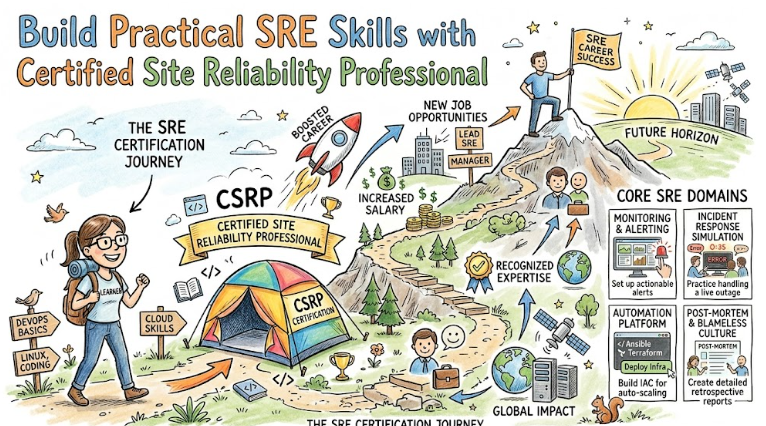
Introduction
The Certified Site Reliability Professional is a comprehensive validation for engineers who aim to master the art of balancing system stability with feature velocity. This guide is designed for professionals navigating the complex landscapes of DevOps, cloud-native architectures, and platform engineering. As organizations move away from traditional “ops” silos, the demand for verified SRE skills has surged globally.
Whether you are an individual contributor or a technical leader, this guide provides a roadmap to understanding how this certification fits into your career trajectory. Hosted on sreschool, this program bridges the gap between academic theory and the high-pressure reality of managing production environments. By following this path, professionals can make informed decisions about their learning journey and ensure they remain competitive in an evolving market.
What is the Certified Site Reliability Professional?
The Certified Site Reliability Professional represents a standard of excellence for engineers tasked with keeping large-scale systems operational and efficient. It is not merely a test of tool knowledge but a verification of a practitioner’s ability to apply SRE principles like error budgets, toil reduction, and automated incident response. It exists to provide a structured framework for learning how to manage complex, distributed systems in a way that aligns with business objectives.
This program emphasizes real-world, production-focused learning over abstract theory, ensuring that candidates understand how to handle actual system failures and performance bottlenecks. It aligns with modern engineering workflows by integrating deeply with CI/CD pipelines, container orchestration, and cloud-native infrastructure practices. For enterprises, it serves as a benchmark for hiring and developing talent that can handle the rigors of modern site reliability.
Who Should Pursue Certified Site Reliability Professional?
This certification is highly beneficial for software engineers who want to specialize in system internals and reliability, as well as dedicated SREs looking to formalize their experience. Cloud architects, platform engineers, and systems administrators find immense value in the structured approach to observability and automation provided by the curriculum. Even security and data professionals can benefit, as the principles of reliability are increasingly central to DevSecOps and DataOps.
Beginners in the field can use this certification to build a strong foundation, while experienced engineers can use it to validate their expertise in advanced topics like capacity planning and chaos engineering. Managers and technical leaders should pursue it to better understand the metrics and culture required to build reliable products. Its relevance is global, with a particularly high demand in India’s growing tech hubs where large-scale digital transformation is a priority.
Why Certified Site Reliability Professional is Valuable and Beyond
The demand for reliability engineering is driven by the increasing complexity of microservices and the high cost of system downtime. Enterprise adoption of SRE practices continues to grow as companies realize that manual operations cannot scale with modern software delivery speeds. This certification ensures that professionals possess the longevity needed to survive tool cycles by focusing on core principles that remain relevant regardless of the underlying technology.
Investing in this certification offers a significant return on time by providing a clear, accelerated path to mastering high-level operational skills. It moves an engineer’s profile from a “support” mindset to a “development” mindset, which is critical for career advancement and salary growth. As automated systems become more prevalent, the ability to architect for reliability becomes a premium skill set that distinguishes elite engineers from the rest of the market.
Certified Site Reliability Professional Certification Overview
The program is delivered via the official platform and hosted on sreschool, providing a centralized ecosystem for learning and assessment. The certification is structured into multiple tiers that cater to different stages of professional growth, from initial entry to expert leadership. Its ownership and structure are designed to reflect current industry standards, ensuring the curriculum is updated to reflect the latest shifts in cloud engineering and automation.
The assessment approach is practical, often involving hands-on scenarios that mimic real-world production issues. Unlike traditional multiple-choice exams, this certification focuses on the candidate’s ability to diagnose problems and implement sustainable solutions. The structure allows for a modular learning experience, where professionals can build their expertise incrementally while gaining recognized credentials at every stage of the process.
Certified Site Reliability Professional Certification Tracks & Levels
The certification is divided into Foundation, Professional, and Advanced levels to support a logical career progression. The Foundation level introduces core concepts such as Service Level Objectives (SLOs) and basic automation, making it ideal for those transitioning into the field. The Professional level dives deeper into incident management, observability, and infrastructure as code, targeting active practitioners.
Advanced levels and specialization tracks allow engineers to focus on specific domains such as SRE for FinOps or AIOps. These tracks ensure that the learning path is not a one-size-fits-all model but can be tailored to the specific needs of an organization or a personal career goal. By moving through these levels, an engineer demonstrates a maturing capability to handle increasingly complex and critical system responsibilities.
Complete Certified Site Reliability Professional Certification Table
| Track | Level | Who it’s for | Prerequisites | Skills Covered | Recommended Order |
| Core SRE | Foundation | New SREs, Developers | Basic Linux & Cloud | SLOs, SLIs, Toil, SRE Culture | First |
| Core SRE | Professional | SREs, DevOps Engineers | Foundation Level | Incident Response, Monitoring | Second |
| Core SRE | Advanced | Lead Engineers, Architects | Professional Level | Chaos Engineering, Architecture | Third |
| Specialized | Platform | Platform Engineers | Foundation Level | Kubernetes, Internal Platforms | Optional |
| Specialized | Operations | Systems Admins | Basic Scripting | Automation, On-call management | Optional |
Detailed Guide for Each Certified Site Reliability Professional Certification
Certified Site Reliability Professional – Foundation
What it is
This certification validates a foundational understanding of SRE principles and terminology. It ensures that the candidate understands the difference between traditional operations and site reliability engineering.
Who should take it
It is designed for junior engineers, developers, or managers who are new to the SRE framework. It is the ideal starting point for anyone looking to enter the reliability domain.
Skills you’ll gain
- Understanding of SLIs, SLOs, and SLAs.
- Knowledge of the SRE mindset and culture.
- Basic understanding of error budgets and toil.
- Introduction to monitoring and alerting basics.
Real-world projects you should be able to do
- Define meaningful SLOs for a simple web application.
- Identify and categorize toil in a standard operational workflow.
- Create a basic monitoring dashboard using standard tools.
Preparation plan
- 7 Days: Review the official syllabus and complete all introductory reading materials.
- 30 Days: Participate in online study groups and practice defining metrics for sample apps.
- 60 Days: Not required for this level, as 30 days is usually sufficient for foundation concepts.
Common mistakes
- Focusing too much on specific tools rather than the underlying principles.
- Confusing SLAs (business) with SLOs (technical).
Best next certification after this
- Same-track option: Certified Site Reliability Professional – Professional
- Cross-track option: DevOps Foundation
- Leadership option: SRE Lead Essentials
Certified Site Reliability Professional – Professional
What it is
This level validates the ability to implement and manage SRE practices in a production environment. It focuses on the practical application of automation and incident management.
Who should take it
This is for mid-level engineers who have been working in DevOps or SRE roles for at least one to two years. It requires a practical understanding of cloud environments.
Skills you’ll gain
- Advanced incident command and post-mortem analysis.
- Implementation of Infrastructure as Code (IaC) for reliability.
- Setting up comprehensive observability stacks.
- Capacity planning and scaling strategies.
Real-world projects you should be able to do
- Conduct a full blameless post-mortem for a simulated outage.
- Automate a manual deployment process to reduce toil by 50%.
- Build a distributed tracing system for a microservices architecture.
Preparation plan
- 7 Days: Intensive review of incident management protocols and case studies.
- 30 Days: Hands-on labs focusing on Prometheus, Grafana, and Terraform.
- 60 Days: Execute a complete project involving the migration of a legacy app to an SRE-managed state.
Common mistakes
- Neglecting the human element of incident management and communication.
- Over-engineering monitoring solutions that lead to alert fatigue.
Best next certification after this
- Same-track option: Certified Site Reliability Professional – Advanced
- Cross-track option: Certified DevSecOps Professional
- Leadership option: Engineering Manager Certification
Certified Site Reliability Professional – Advanced
What it is
The advanced certification is for experts who design the systems and organizational structures that ensure high availability. It focuses on strategic reliability and architecture.
Who should take it
Senior SREs, Principal Engineers, and Architects who are responsible for the reliability of large-scale, complex distributed systems.
Skills you’ll gain
- Designing for high availability across multiple regions.
- Advanced Chaos Engineering principles and practice.
- SRE team building and organizational change management.
- Performance tuning at the kernel and network levels.
Real-world projects you should be able to do
- Design and execute a multi-region failover exercise.
- Implement a chaos engineering experiment in a production-like environment.
- Develop an organizational roadmap for scaling SRE across multiple business units.
Preparation plan
- 14 Days: Deep dive into distributed systems papers and advanced architectural patterns.
- 30 Days: Advanced hands-on exercises in chaos engineering and performance profiling.
- 60 Days: Research and document a complex system failure and propose a structural fix.
Common mistakes
- Focusing only on the technical side while ignoring the organizational culture required for SRE.
- Underestimating the complexity of stateful systems in failover scenarios.
Best next certification after this
- Same-track option: Specialist Tracks (AIOps or FinOps)
- Cross-track option: Cloud Solutions Architect Expert
- Leadership option: CTO Program / VP of Engineering Track
Choose Your Learning Path
DevOps Path
The DevOps path focuses on the integration of development and operations through automation. This path is ideal for those who want to master the full software delivery lifecycle. It emphasizes CI/CD pipelines, automated testing, and collaborative culture. Professionals here will learn how to use the Certified Site Reliability Professional framework to ensure that “speed” does not come at the cost of “stability.” It is a balanced approach for generalists who handle diverse tasks.
DevSecOps Path
In this path, security is treated as a fundamental component of reliability. It integrates security checks directly into the SRE workflow, ensuring that systems are not only available but also secure. Candidates focus on automated security scanning, compliance as code, and secure secret management. This path is essential for engineers working in regulated industries like finance or healthcare. It teaches how to manage security incidents with the same rigor as operational outages.
SRE Path
This is the “pure” path for those dedicated to the discipline of site reliability engineering. It prioritizes deep system internals, advanced observability, and complex incident response. The focus is on reducing toil and using software engineering to solve operational problems. Engineers on this path are the guardians of the error budget and the architects of system resilience. It is best suited for those who enjoy debugging complex distributed systems and building robust platforms.
AIOps Path
AIOps focuses on using machine learning and artificial intelligence to enhance operational efficiency. This path explores how to use predictive analytics to anticipate system failures before they occur. It involves managing massive amounts of telemetry data and automating noise reduction in alerting systems. Professionals learn to build intelligent systems that can self-heal or provide advanced diagnostic suggestions. This is the future of managing hyper-scale environments where human intervention is too slow.
MLOps Path
The MLOps path is specialized for those managing the reliability of machine learning models in production. It applies SRE principles to the ML lifecycle, including data pipelines, model training, and inference serving. Engineers learn how to monitor for model drift and ensure that ML infrastructure is as reliable as traditional software services. This path bridges the gap between data science and production engineering. It is critical for organizations that rely on AI-driven products for their core business.
DataOps Path
DataOps focuses on the reliability and velocity of data pipelines. This path ensures that data is high-quality, available, and processed efficiently across the enterprise. It applies SRE concepts like SLOs to data delivery, ensuring that downstream analytics and AI models have the information they need. Professionals focus on data orchestration, automated testing for data, and infrastructure for big data systems. It is the perfect path for data engineers who want to bring operational excellence to their data platforms.
FinOps Path
The FinOps path combines cloud financial management with site reliability engineering. It focuses on the “cost” dimension of reliability, ensuring that systems are not just stable but also economically efficient. Engineers learn how to optimize cloud spend, track unit economics, and integrate cost metrics into their observability dashboards. This path is vital for organizations looking to scale their cloud presence without ballooning their budgets. It bridges the gap between engineering, finance, and business leadership.
Role → Recommended Certified Site Reliability Professional Certifications
| Role | Recommended Certifications |
| DevOps Engineer | Foundation, Professional, Platform Track |
| SRE | Foundation, Professional, Advanced |
| Platform Engineer | Foundation, Professional, Platform Track |
| Cloud Engineer | Foundation, Professional, Operations Track |
| Security Engineer | Foundation, DevSecOps Specialist |
| Data Engineer | Foundation, DataOps Specialist |
| FinOps Practitioner | Foundation, FinOps Specialist |
| Engineering Manager | Foundation, Leadership Essentials |
Next Certifications to Take After Certified Site Reliability Professional
Same Track Progression
Once you have completed the core levels, deep specialization is the next logical step. You might focus on becoming a subject matter expert in Chaos Engineering or advanced Observability. This involves moving beyond standard practices into experimental and cutting-edge reliability techniques. Mastery in this track leads to Principal SRE or Reliability Architect roles, where you influence the entire company’s technical direction.
Cross-Track Expansion
Broadening your skills into adjacent domains like DevSecOps or FinOps provides a more holistic view of the engineering landscape. For example, an SRE who understands cloud economics (FinOps) or security automation (DevSecOps) is significantly more valuable to an organization. This expansion allows you to act as a bridge between different engineering teams and lead cross-functional initiatives. It ensures you remain versatile and adaptable to various industry needs.
Leadership & Management Track
For those looking to move away from individual contribution, the transition to leadership requires a different focus. You will need certifications that emphasize team building, strategic planning, and business alignment. Understanding SRE at a high level allows a manager to set realistic goals and protect their team from burnout. This track prepares you for roles like Engineering Manager, Director of SRE, or even CTO, where reliability is a key business metric.
Training & Certification Support Providers for Certified Site Reliability Professional
DevOpsSchool
DevOpsSchool is a prominent provider that offers extensive training programs focused on the entire DevOps ecosystem. They provide hands-on labs and real-world projects that are essential for mastering the practical aspects of site reliability. Their curriculum is designed by industry experts to ensure that students are prepared for both the certification exams and the challenges of a production environment. With a strong focus on community and mentorship, they help professionals build a network that supports their long-term career growth.
Cotocus
Cotocus specializes in high-end technical training for cloud-native technologies and SRE practices. They are known for their deep-dive workshops that cover complex topics like Kubernetes orchestration and advanced observability. Their training methodology emphasizes “learning by doing,” which aligns perfectly with the requirements of the Certified Site Reliability Professional program. Professionals who choose this provider often find themselves better equipped to handle the rigors of modern, high-traffic system environments.
Scmgalaxy
Scmgalaxy provides a wealth of resources for software configuration management and site reliability. They offer a blend of free tutorials and structured certification training, making them a go-to source for many engineers in India and beyond. Their training programs are updated frequently to reflect the latest changes in the tech stack, ensuring that candidates are always learning the most relevant skills. They focus heavily on the automation aspect of SRE, helping engineers eliminate toil effectively.
BestDevOps
BestDevOps focuses on providing curated learning paths for engineers looking to excel in the DevOps and SRE domains. They offer personalized coaching and a curriculum that is tailored to the needs of the modern enterprise. Their training modules are concise and practical, making them ideal for working professionals who need to balance their learning with a busy schedule. By focusing on the core principles of reliability, they ensure that their students build a solid foundation for their future careers.
devsecopsschool
devsecopsschool is the leader in integrating security into the development and operations lifecycle. They provide specialized training that is essential for SREs who want to master the security dimension of system reliability. Their courses cover everything from automated security testing to compliance as code, providing a comprehensive view of DevSecOps. For professionals pursuing the Certified Site Reliability Professional, this provider offers the specialized knowledge needed to build secure and resilient systems.
sreschool
sreschool is the primary platform for the Certified Site Reliability Professional program, offering the most direct and comprehensive path to certification. They provide a structured environment that includes all the necessary study materials, labs, and assessment tools. Their focus is exclusively on site reliability engineering, ensuring that the content is deep and highly specialized. By learning directly from the source, candidates can be confident that they are meeting the exact standards required for the certification.
aiopsschool
aiopsschool focuses on the intersection of artificial intelligence and IT operations. They provide the training necessary to master the AIOps track, teaching engineers how to use machine learning for proactive system management. Their curriculum covers data science basics, anomaly detection, and automated incident resolution. As systems become more complex, the skills taught here are becoming increasingly vital for any advanced site reliability professional.
dataopsschool
dataopsschool provides the specialized training needed to apply SRE principles to data engineering and management. They focus on the reliability of data pipelines and the infrastructure that supports big data analytics. Their courses are designed for data professionals who want to improve the stability and velocity of their data delivery systems. This provider is essential for anyone looking to specialize in the DataOps track of the certification.
finopsschool
finopsschool addresses the growing need for financial accountability in cloud engineering. They offer training that helps SREs understand and optimize the cost of their infrastructure. By teaching the principles of FinOps, they enable engineers to make data-driven decisions that balance performance with expenditure. This provider is the key resource for professionals looking to master the economic side of site reliability engineering.
Frequently Asked Questions (General)
- How difficult is it to get certified?
The difficulty depends on your experience level. The Foundation level is accessible for beginners, but the Professional and Advanced levels require significant hands-on experience and a deep understanding of system internals.
- How long does the certification take to complete?
On average, a professional can complete the Foundation level in a month. The Professional and Advanced levels may take three to six months each, depending on the amount of practical project work involved.
- What are the prerequisites for the program?
Foundation has no strict prerequisites, but a basic understanding of Linux and cloud concepts is recommended. Higher levels require completion of the previous level or equivalent industry experience.
- Is there a high ROI for this certification?
Yes, the ROI is significant as SRE is one of the highest-paying roles in the tech industry. The certification validates elite skills that are in high demand across global markets.
- Should I take the levels in a specific order?
It is highly recommended to follow the sequence from Foundation to Advanced. This ensures you build a solid theoretical base before moving into complex implementation and architecture.
- Does the certification focus on specific tools like Kubernetes?
While tools are used in labs, the certification focuses on principles. You will use Kubernetes or Terraform, but the goal is to understand the “why” behind the automation and orchestration.
- Is this certification recognized globally?
Yes, the principles of SRE are universal, and the certification is recognized by enterprises worldwide as a benchmark for reliability engineering excellence.
- Can I skip the Foundation level if I have experience?
While possible in some cases, it is advised to take the Foundation exam to ensure your terminology and conceptual framework align with the certification standards.
- What kind of jobs can I get after this?
You will be qualified for roles such as SRE, DevOps Engineer, Platform Engineer, Cloud Architect, and Reliability Lead, among others.
- How often do I need to recertify?
The certification typically requires renewal every two to three years to ensure your skills remain current with the fast-moving technology landscape.
- Are there hands-on labs involved in the assessment?
Yes, the Professional and Advanced levels involve significant practical components where you must solve real-world scenarios in a lab environment.
- Is there support for India-based candidates?
Yes, the program has a strong presence in India with local training providers and community support groups tailored to the Indian tech market.
FAQs on Certified Site Reliability Professional
- What makes this certification different from standard DevOps programs?
This program focuses specifically on reliability and system internals rather than just delivery pipelines. It treats operations as a software problem.
- Does it cover AIOps and MLOps specifically?
Yes, there are specialized tracks within the program that allow you to apply SRE principles to AI and ML infrastructure.
- How does it help in incident management?
It teaches a structured approach to incident response, including incident command, blameless post-mortems, and building automated self-healing systems.
- Is coding a requirement for this certification?
Yes, a basic to intermediate level of coding (Python, Go, or Bash) is required as SRE is fundamentally an engineering discipline.
- Can managers benefit from this technical certification?
Absolutely. It provides managers with the metrics (SLIs/SLOs) needed to manage engineering teams and balance feature work with technical debt.
- How does the assessment handle real-world production scenarios?
The assessment uses sandboxed environments where you must diagnose and fix system failures, ensuring your skills are practical and not just theoretical.
- Is there a focus on multi-cloud reliability?
Yes, the curriculum covers architectural patterns that ensure reliability across different cloud providers and hybrid environments.
- How does it address the concept of Toil?
The certification provides specific frameworks for identifying, measuring, and eliminating toil through strategic automation and process improvement.
Final Thoughts: Is Certified Site Reliability Professional Worth It?
From a mentor’s perspective, the Certified Site Reliability Professional is a high-value investment for any engineer who wants to move beyond the “scripting” phase of their career. The industry is moving toward a future where “uptime” is a software engineering challenge, not just a hardware one. This certification provides the mental models and technical skills required to navigate that shift successfully.
It is not a magic pill for a career jump, but it is a rigorous validation of your ability to handle the most critical part of any business: its production systems. If you are willing to put in the work to master the labs and understand the deep principles of reliability, the career rewards—in terms of both salary and professional satisfaction—are substantial. Focus on the learning process, and the certification will serve as a powerful testament to your expertise.

